Support

Ho Chi Minh Mausoleum

About

The Ho Chi Minh Mausoleum is a monumental structure in the center of Hanoi, located on the historic Ba Dinh Square. It was here that the country's independence was proclaimed in 1945. This memorial serves as the final resting place of the first president and national hero, Ho Chi Minh, and stands as one of the most significant symbols of the Vietnamese people's gratitude and respect for their leader. For many locals, this site holds sacred importance, while for travelers, it is an opportunity to connect with key events in the country's history.

The building is designed in a strict and minimalist style, combining elements of classicism and socialist realism. Its monumental forms and symmetry emphasize the solemnity of the site. Materials from all corners of the country were used in its construction, symbolizing national unity. The majestic appearance of the structure leaves a powerful impression on visitors.
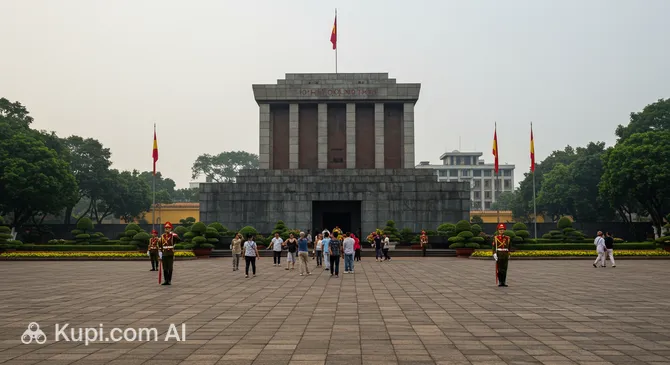
Ho Chi Minh Mausoleum. Illustration.
Source: Kupi.com AI

Traveler photos:

A picturesque garden surrounds the mausoleum and is an integral part of the memorial complex. It features around 250 species of plants representing the flora of all regions of Vietnam. This green oasis creates a peaceful atmosphere and complements the austere architecture of the main building, making a visit to Ba Dinh Square even more memorable.

Contacts

The Ho Chi Minh Mausoleum does not have an official public phone number or website for direct booking, as it is a state memorial complex with free admission. To find the latest information on opening hours, visitor rules, and potential temporary closures (such as the annual maintenance that usually takes place in autumn), it is recommended to contact tourist information centers in Hanoi or check the city's official tourism portals. The complex is located in the very heart of the capital on Ba Dinh Square and can be reached by public transport or taxi.

How to contactContact
Address1 Hùng Vương, Điện Biên, Ba Đình, Hà Nội, Vietnam
Websitewww.bqllang.gov.vn

What to Do

Visiting the Ho Chi Minh Mausoleum is an experience that requires respect and adherence to strict rules. The primary goal for most visitors is the central hall, where Ho Chi Minh’s body rests in a glass sarcophagus. The atmosphere inside is markedly solemn and contemplative, with dim lighting enhancing the significance of the moment. It is important to remember that photography is forbidden inside the mausoleum, as are loud conversations or any signs of disrespect. Honor guards ensure order is maintained to preserve the solemnity of the site.

However, the Mausoleum is only one part of a large memorial complex. Nearby is the Ho Chi Minh Museum, which features exhibits detailing the life and work of the Vietnamese leader. This is an excellent place to gain a deeper understanding of his role in the nation's history. Also a must-see is the unique One Pillar Pagoda—an ancient Buddhist temple which, according to legend, was built on a single stone pillar in the middle of a lotus pond. It is one of the most iconic structures in Hanoi.

After visiting the indoor sites, guests can enjoy a walk through the well-kept gardens surrounding the mausoleum. Here, you can rest in the shade of the trees and see unique flora gathered from all over Vietnam. This walk serves as a pleasant and peaceful conclusion to your visit to one of the country's most important memorial complexes.

Getting There

The Ho Chi Minh Mausoleum is situated in the heart of Hanoi on the famous Ba Dinh Square, making it easily accessible for travelers. You can reach this iconic landmark in several ways: by public transport, taxi, or even on foot if you are staying in the central part of the city. Its convenient location makes it easy to include the mausoleum in any sightseeing itinerary through the capital of Vietnam.

One of the most budget-friendly ways to get there is by using city buses. Several routes, including Nos. 09, 22, 33, 45, and 50, stop near Ba Dinh Square. For those who prefer comfort, taxis or popular Asian ride-hailing services are always available and will get you to the memorial from the Old Quarter in about 15–20 minutes. You can also rent a motorbike, with parking available on nearby streets.

If you are staying in the center, a walk to the mausoleum is a wonderful opportunity to get to know Hanoi better. The walking routes are convenient and well-planned. International tourists are recommended to arrive at the complex in advance, especially in the morning, to avoid long queues. Entrance is through the main checkpoint on Ba Dinh Square, where signs in Vietnamese and English help visitors find their way.

Nearest city: Hanoi

History & Facts

The history of the Ho Chi Minh Mausoleum began following the passing of Vietnam's first president on September 2, 1969. Although Ho Chi Minh requested in his will to be cremated, the government decided to preserve his body for future generations, following the tradition of preserving the body of Lenin in Moscow. Construction began on September 2, 1973, and was completed by August 28, 1975. Prior to this, the embalmed body was kept in a secret location to ensure its safety.

The architectural project was developed with the participation of Soviet architect Harold Isakovich and Vietnamese architect Bui Quang Huy. While inspired by Lenin's Mausoleum, the Vietnamese version took on its own unique features. One of the main characteristics is the sloping roof, which resembles the roofs of traditional communal houses (dinh) and symbolizes the lotus flower—a significant image in the country's culture representing nobility and purity.

Symbolism permeates every detail of the memorial. The site for its construction was chosen for a reason—it was on Ba Dinh Square that Ho Chi Minh read the Declaration of Independence on September 2, 1945. To emphasize national unity, materials brought from various parts of the country were used for construction. Granite, precious wood, and other elements donated by residents of different provinces turned the mausoleum into a monument built by the whole nation as a tribute to their leader.

Time Needed

To fully experience the Ho Chi Minh Mausoleum and its surrounding memorial complex, it is recommended to set aside 1 to 2 hours. This time is usually sufficient to go through all stages of the visit without rushing: waiting in line, seeing the central hall, and then walking through the adjacent grounds with its gardens and other historical sites. Planning your visit will help you get a complete impression of this landmark.

It is worth noting that the time spent inside the tomb itself, where Ho Chi Minh's body rests, lasts only a few minutes due to the strict protocol and continuous flow of visitors. The bulk of your time will be spent waiting in line, which can be quite long, especially in the morning, as well as going through mandatory security checks. After visiting the mausoleum, you will have time to explore other parts of the complex, such as the Ho Chi Minh Museum, the Stilt House, and the One Pillar Pagoda, which make up the total recommended duration of the visit.

Working Hours

When planning a visit to the Ho Chi Minh Mausoleum, it is crucial to take its specific operating schedule into account. Visitor access is strictly limited to morning hours. Typically, the mausoleum is open from Tuesday to Thursday, as well as on Saturdays and Sundays. Mondays and Fridays are usually closed for maintenance. Visiting hours may vary slightly depending on the season: in the summer (approximately April to October), it is usually from 7:30 AM to 10:30 AM, and in the winter (November to March), from 8:00 AM to 11:00 AM. Most importantly, remember that the mausoleum closes annually for a long period (about two months, usually in autumn) for scheduled maintenance. Therefore, be sure to check the latest information on Hanoi's tourist portals before your trip.

Entry to the mausoleum is free, and no advance booking or ticket purchase is required. However, due to the immense significance of this site to the Vietnamese people and high interest from tourists, long queues almost always form at the entrance. To avoid a long wait, it is strongly recommended to arrive early, ideally before the official opening. This will not only save you time but also make your visit more peaceful and comfortable.

7:00 – 17:00

Nearby

A visit to the Ho Chi Minh Mausoleum is just the starting point for exploring the rich history and culture of Hanoi. The complex is located in the historic city center, and its surroundings are packed with iconic sites within walking distance. A stroll through this area will allow you to dive deeper into the atmosphere of Vietnam's capital and gain a comprehensive understanding of its heritage.

Exploring nearby attractions will enrich your journey and help you better understand how history, religion, and modern city life are closely intertwined. Just a few minutes' walk away, you will find ancient temples, grand citadels, and unique museums. Below is a list of interesting places located near the mausoleum that are worth including in your itinerary.

NameDistance
Imperial Citadel of Thang Long0.6 km
Vietnam National Fine Arts Museum0.7 km
Temple of Literature1 km
AIRA Night Club1 km
Hanoi Train Street1.2 km
Acoustic Hotel & Spa Bar1.4 km
A Plus Hanoi1.5 km

Have you reached the end of the page?

So the route has been studied inside and out