Support

Temple of Literature

About

The Temple of Literature, also known as Van Mieu, is one of the most iconic historical landmarks not only in Hanoi but in all of Vietnam. This amazing complex, founded in 1070, is more than just a temple—it is the country's first university, dedicated to Confucius and his teachings. Visiting this site is an opportunity to touch centuries of history and culture, experiencing an atmosphere of ancient wisdom and tranquility.
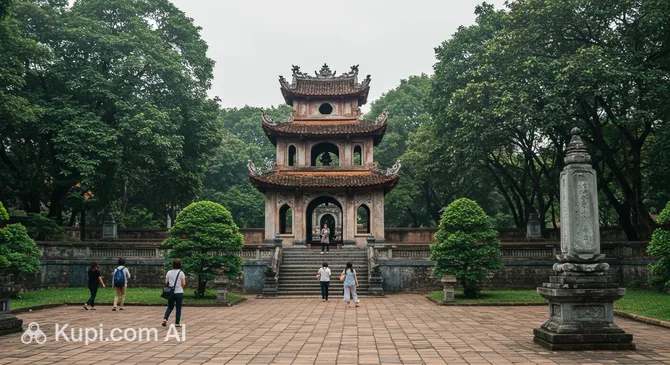
Temple of Literature. Illustration.
Source: Kupi.com AI

Traveler photos:

Initially, the Temple of Literature was founded under Emperor Ly Thanh Tong as a place to honor the great philosopher. It soon transformed into a prestigious educational institution where, for many centuries, future officials, scholars, and mandarins were trained, forming the intellectual elite of Vietnamese society. A walk through its grounds allows you to imagine how scholarly life once flourished here.

The architectural ensemble of the temple is a striking example of traditional Vietnamese architecture. It consists of five successive courtyards, each with its own symbolic meaning and unique design. Guests are greeted by elegant gates, pavilions with curved roofs, manicured gardens, and quiet ponds, creating a harmonious and peaceful space in the heart of the bustling capital.

Contacts

The Temple of Literature is primarily a large historical and architectural complex, so no prior booking or phone call is required to visit. It is located in the central part of Hanoi, in the Dong Da district, at 58 Quoc Tu Giam Street. Thanks to its convenient location, the attraction is easy to reach by taxi or public transport, such as bus No. 38 or No. 40.

How to contactContact
Address58 P. Quốc Tử Giám, Văn Miếu, Đống Đa, Hà Nội, Vietnam
Phone number+84 24 3845 2917
Websitevanmieu.gov.vn

What to Do

A visit to the Temple of Literature is an immersion into an atmosphere of tranquility and contemplation. Guests can stroll leisurely through the well-kept gardens and courtyards, admiring the traditional architecture, decorative gates, and picturesque lotus ponds. It is a wonderful opportunity to take a break from the city bustle and capture beautiful photos in one of the most photogenic spots in Hanoi.

Special attention is drawn to the stone stelae on the backs of turtles, located in the third courtyard. These stelae are inscribed with the names of graduates who successfully passed the royal examinations from the 15th to the 18th century. A total of 82 out of 117 stelae have been preserved, and each is a valuable historical artifact. There is a belief that touching the head of a stone turtle brings good luck in exams, so you can always find students here coming for a blessing.

The Temple of Literature remains an important cultural center today. It frequently hosts exhibitions, graduation ceremonies, and other formal events. Visitors can not only learn about the history of education in Vietnam but also witness modern traditions that continue to live within these ancient walls. It is a place where the past and present are harmoniously intertwined, creating a unique experience for every guest.

Getting There

The Temple of Literature is located in the very heart of Hanoi, making it an easily accessible attraction for travelers. It is situated in the central part of the city, slightly south of the Imperial Citadel of Thang Long. The main entrance to the complex is on Quoc Tu Giam Street, which serves as a convenient landmark for all visitors.

There are several ways to reach the temple. The simplest and most comfortable option is to use a taxi or motorbike taxi (xe om), which will easily take you to the main entrance. Additionally, city buses run to the complex, offering a budget-friendly alternative. There are public transport stops near the temple, as well as parking for those traveling by rented motorbike.

For those staying in the city center, walking or cycling is an excellent choice. Distances in central Hanoi are relatively short, and the route to the Temple of Literature allows you to get better acquainted with the city, see other interesting spots, and feel its authentic atmosphere. Such a leisurely stroll will be a pleasant addition to visiting the attraction itself.

Nearest city: Hanoi

History & Facts

The history of the Temple of Literature began in 1070 when it was erected as a place of worship for the great Chinese philosopher Confucius. However, by 1076, its role expanded significantly: Vietnam's first national university, Quoc Tu Giam, was opened on the grounds. Initially, only members of the imperial family and children of high-ranking officials could study here, but over time, the university became accessible to all talented young men in the country, preparing the future intellectual elite.

Over the centuries, the complex suffered repeatedly from the passage of time, but it was always restored with great reverence for its history. Significant restoration work was carried out in 1920, 1956, and 2000, using traditional materials to preserve the authentic appearance of this iconic site. A major turning point in the temple's history was 1802, when the capital was moved to Hue and the imperial university followed. Despite this, the Temple of Literature in Hanoi did not lose its significance, remaining a vital cultural and spiritual center.

One of the most remarkable facts highlighting the uniqueness of this site is its international recognition. In 2010, the collection of 82 stone stelae, inscribed with the names of scholars who passed the royal examinations between 1442 and 1779, was included in UNESCO’s "Memory of the World" Register. These stelae, mounted on the backs of stone turtles symbolizing wisdom and longevity, serve as an eternal reminder of Vietnam's rich academic history.

Time Needed

To fully enjoy your visit to the Temple of Literature and explore it without rushing, it is recommended to set aside approximately 1.5–2 hours. This will be plenty of time to leisurely stroll through all five courtyards of the complex, get acquainted with the main exhibits, and feel the peaceful atmosphere of this iconic landmark in Hanoi.

The planned time will allow you to carefully examine the architectural details of the pavilions, study the famous stone stelae on the backs of turtles, and visit the small exhibitions located inside. If you plan not only to take beautiful photos but also to delve deeper into the history of Vietnam's first university by reading the information boards, two hours will be quite enough for a thoughtful and educational visit.

Working Hours

The Temple of Literature is open for visits year-round, making it a convenient attraction to include in any Hanoi itinerary. The complex is open to guests daily, but opening hours depend on the season: in the summer (approximately from April to October) it is open from 7:30 to 17:30, and in the winter (from November to March) from 8:00 to 17:00. Please note that during national holidays or special events, the schedule may change slightly, so it is recommended to check the latest information before your visit.

For individual visits to the Temple of Literature, advance ticket booking is usually not required—they can be purchased directly at the ticket office at the entrance. This allows tourists to plan their day flexibly. However, if you are traveling in a large group or planning a visit during major festivals, it is worth checking the official website or local tourist centers for any special visiting conditions in advance.

8:00 – 17:00

Nearby

A visit to the Temple of Literature is just the starting point for exploring the rich cultural heritage of Hanoi. The district where this historical complex is located is literally saturated with other iconic landmarks. A walk through the surrounding area will allow you to dive deeper into the history and modern life of the capital of Vietnam, creating a more complete and vivid impression of the city.

Just a few minutes' walk or a short ride from the temple, you will find museums, ancient pagodas, and other important monuments. Exploring these attractions will enrich your trip, showing different facets of Hanoi—from ancient art to key moments in recent history. Below is a list of interesting places located nearby.

NameDistance
Vietnam National Fine Arts Museum0.3 km
AIRA Night Club0.7 km
Imperial Citadel of Thang Long0.9 km
Acoustic Hotel & Spa Bar0.9 km
Hanoi Train Street0.9 km
Ho Chi Minh Mausoleum1 km
Hoa Lo Prison1.2 km

Have you reached the end of the page?

So the route has been studied inside and out