Support

Imperial Citadel of Thang Long

About

The Imperial Citadel of Thang Long is an outstanding historical and architectural complex located in the heart of Hanoi, the capital of Vietnam. This UNESCO World Heritage site is more than just ruins; it is a living chronicle of the country's centuries-old history. A visit to the citadel allows you to immerse yourself in the past and see how Vietnamese culture has evolved over a millennium.
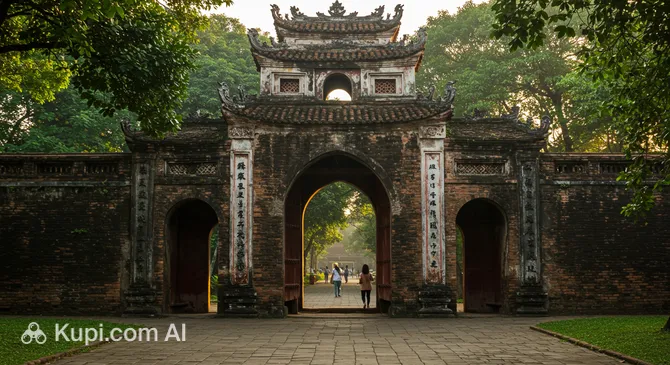
Imperial Citadel of Thang Long. Illustration.
Source: Kupi.com AI

Traveler photos:

The history of this site began in the 11th century during the Ly dynasty and continued through the reigns of the Tran, Le, and Nguyen dynasties, each contributing to the expansion and reconstruction of the complex. The citadel served as the country's political center for nearly 13 centuries. It is a unique example of cultural fusion, showing influences from China to the north and the ancient kingdom of Champa to the south, reflecting the unique Southeast Asian culture characteristic of the Red River Valley.

Today, the central part of the Thang Long-Hanoi Imperial Citadel is recognized as a Special National Monument of Vietnam. The vast territory of the complex preserves the foundations of ancient palaces, historical structures, gates, and other artifacts discovered during archaeological excavations. Walking through the citadel is an opportunity to touch the stones that witnessed key events in the history of the Vietnamese people and to imagine the former grandeur of the imperial court.

Contacts

To plan your visit to the Imperial Citadel of Thang Long, you can use the contact information below. It is always recommended to check the complex's official website for the most up-to-date information regarding opening hours, ticket prices, and available tours.

How to contactContact
Address19c Hoàng Diệu, Điện Biên, Ba Đình, Hà Nội 100000, Vietnam
Phone number+84 24 3734 5427
Websitehoangthanhthanglong.vn

What to Do

Visiting the Imperial Citadel of Thang Long is a unique opportunity to connect with the rich cultural and historical heritage of Vietnam. The main activity here is a leisurely exploration of the vast complex, where you can see preserved architectural elements from different eras and numerous archaeological finds. Tourists can stroll through the sites where royal palaces once stood, examine ancient gates, historical structures, and the foundations of buildings that reflect a blend of various cultural influences over nearly 13 centuries.

Of particular interest is the 18 Hoang Dieu Archaeological Site, where thousands of artifacts ranging from ceramics to historical items have been found, telling the story of the citadel's life through different periods. For those seeking a unique experience, the Heritage Conservation Center organizes special night tours titled "Decoding the Imperial Citadel of Thang Long." These tours take place on Friday and Saturday evenings and allow you to see the complex under magical lighting, enjoy performances with royal dances, and even participate in a traditional incense offering ceremony at the Kinh Thien Palace.

In addition to self-guided walks and tours, the citadel regularly hosts cultural events, temporary exhibitions, and educational programs. This allows visitors to delve deeper into the history and understand the significance of this site not only for Hanoi but for all of Southeast Asia. As part of some tours, guests are offered lotus tea under an ancient Bodhi tree, adding a special atmosphere of peace and authenticity to the visit.

Getting There

Getting to the Imperial Citadel of Thang Long is quite simple, as it is conveniently located in the central part of Hanoi. This makes it easily accessible for tourists from any point in the capital of Vietnam. Thanks to its location, you have several convenient options for planning your route to this iconic landmark.

One of the most popular ways is to use public transport. Hanoi has a well-developed bus network, and many routes pass near the citadel, stopping within walking distance of the entrance. Another convenient option is to take a taxi or use popular ride-hailing apps in the region, such as Grab. This allows you to reach your destination quickly and comfortably from almost any area of the city.

If you are staying in central Hanoi, for example, in the Old Quarter or near Hoan Kiem Lake (Lake of the Restored Sword), you can reach the citadel on foot. Such a walk is not only pleasant but also allows you to better experience the city's atmosphere, its lively streets, and see other interesting sights along the way.

Nearest city: Hanoi

History & Facts

The Imperial Citadel of Thang Long holds many fascinating historical facts. Its history began in the 11th century when, in 1010, the ruler of the Ly dynasty moved the capital to Dai La and renamed it Thang Long. It is important to note that the citadel was not built on an empty site but on the ruins of an older 7th-century fortress, symbolizing the independence gained by the kingdom of Dai Viet. Construction took place on reclaimed land from the Red River Delta, which was a massive engineering achievement for its time.

For almost thirteen centuries, the citadel served as the continuous center of political power in the region. Each subsequent dynasty—the Tran, Le, and Nguyen—made its own contribution, expanding and modifying the complex. Over time, the grand complex saw periods of both prosperity and decline, with many royal palaces and structures being damaged or lost during various historical periods.

The recent history of the citadel is one of revival and recognition. Systematic and large-scale archaeological excavations only began here at the start of the 21st century. These studies led to the discovery of thousands of priceless artifacts and the remains of ancient structures, allowing researchers and the world to realize the site's true significance. This painstaking work resulted in the central part of the citadel being included in the UNESCO World Heritage List in 2010, forever securing its status as one of humanity's most important cultural treasures.

Time Needed

To fully explore the Imperial Citadel of Thang Long, it is recommended to set aside 2 to 3 hours. This will be enough time to explore the main sites of the vast complex without rushing, including the preserved architectural monuments and the 18 Hoang Dieu archaeological site. A standard visit will allow you to soak in the historical atmosphere and get a general idea of its scale and significance.

If you plan a deeper dive into history or want to take part in special programs, you should budget extra time. For example, for those seeking a unique experience, a night tour called "Decoding the Imperial Citadel of Thang Long" is organized, offering a completely different perspective on the complex and lasting about 90 minutes. History and archaeology enthusiasts might need half a day to carefully study all the exhibits and ruins. At the same time, if you have limited time, you can plan a shorter 1-2 hour route, focusing only on the key structures.

Working Hours

The Imperial Citadel of Thang Long is open to visitors year-round. Standard opening hours are daily from 8:00 AM to 5:00 PM. This allows tourists to plan their visit at a convenient time during the day. It is worth noting that some sources mention Monday as a possible closing day, so it is always helpful to check current information before your visit. The complex operates without seasonal breaks, making it accessible for visits at any time of the year.

For a standard daytime visit, advance booking is usually not required; tickets can be purchased at the ticket office by the main entrance. However, to avoid queues, especially during peak tourist seasons, visitors have the option to buy tickets online on the official website. Additionally, for those seeking a more in-depth experience, special tours like the popular night tour "Decoding the Imperial Citadel of Thang Long" are organized, which may require prior registration.

8:00 – 17:00

Nearby

A visit to the Imperial Citadel of Thang Long is just the beginning of a fascinating journey through the historical heart of Hanoi. Thanks to its central location, the complex is an ideal starting point for exploring other iconic sites in the capital of Vietnam. Many of these attractions are within walking distance, allowing you to create a full day's itinerary and dive deeper into the city's unique atmosphere.

Walking around the citadel will enrich your experience, allowing you to see the contrast between ancient history and modern life in Hanoi. In the immediate vicinity of this UNESCO World Heritage site, you will find mausoleums, ancient temples, colorful streets, and famous museums. Below is a list of interesting places located very close by.

NameDistance
AIRA Night Club0.5 km
Ho Chi Minh Mausoleum0.6 km
Vietnam National Fine Arts Museum0.6 km
Hanoi Train Street0.7 km
Temple of Literature0.9 km
Acoustic Hotel & Spa Bar0.9 km
Hanoi Old Quarter1.1 km

Have you reached the end of the page?

So the route has been studied inside and out