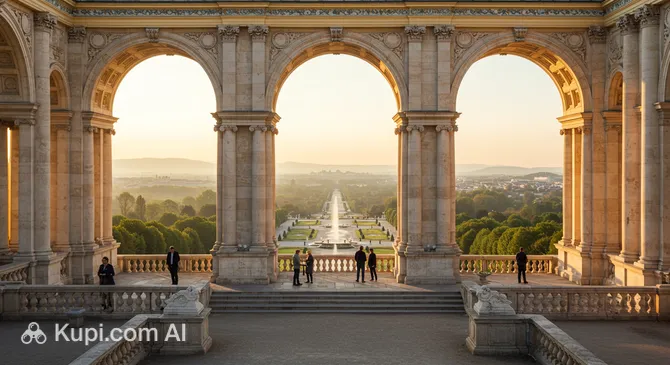
The Schönbrunn Gloriette was built in 1775 by order of Empress Maria Theresa, one of Austria's most influential rulers. The design of this elegant pavilion-colonnade was created by the talented architect Johann Ferdinand Hetzendorf von Hohenberg. Originally, the Gloriette was intended not just as a park decoration but as a symbol of Habsburg power and a monument to "just war" that led to Maria Theresa's accession to the throne. Its location at the top of the hill was no coincidence – it offered a magnificent view and served as an impressive conclusion to the main axis of the palace and park ensemble.
The structure became an important part of the Schönbrunn Palace complex, which during Maria Theresa's reign turned into the real center of political and court life of the empire. It was here that important state decisions were made, and lavish receptions and celebrations were held. The Schönbrunn Gloriette served as a place for the imperial family to have breakfast and relax, as well as an observation deck from which they could admire both the palace itself and the sprawling city of Vienna.
The history of Schönbrunn Palace itself, of which the Gloriette is an integral part, dates back to earlier times. There is a beautiful legend that Emperor Matthias, while hunting in these parts in 1612, came across "beautiful springs" – “Schöne Brunnen” in German. This discovery is believed to have given the name to the entire future palace complex. The lands themselves had been in the possession of the Habsburg dynasty since 1569, originally used as hunting grounds.
Significant damage was done to the original buildings on this site during the siege of Vienna by Turkish troops in 1683. After these events, Emperor Leopold I decided not just to restore but to build a new, more majestic castle here. In 1696, the large-scale construction of Schönbrunn Palace began, intended to be the Austrian answer to the French Versailles. Thus, on the ruins of old buildings and around the "beautiful springs," the magnificent ensemble we see today began to take shape, and the Schönbrunn Gloriette became its worthy crowning achievement.