Support

Doppelwendeltreppe

About

In the very heart of the historic center that adorns Graz, lies a true architectural phenomenon — the Double Spiral Staircase. This masterpiece of Late Gothic, located within the complex of an ancient fortress, is rightfully considered one of the rarest and most impressive structures of its kind in the world.

Also known as the Doppelwendeltreppe, it consists of two intertwining spirals that diverge and reconnect on each floor. Built at the turn of the 15th and 16th centuries, the staircase is a brilliant example of the engineering thought of that time, creating a mesmerizing optical effect of symmetry that tourists often compare to a "dance of stone."
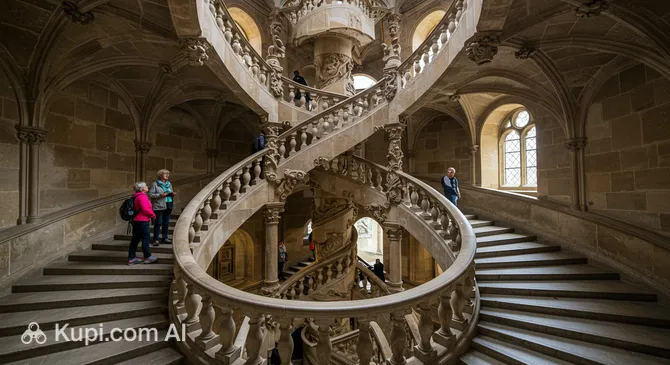
Double Spiral Staircase
Double Spiral Staircase. Иллюстрация. Источник: Kupi.com AI

For many travelers visiting the city and Austria as a whole, this place has become a symbol of harmony and unity. The staircase does not just connect different levels of the building but also serves as a living monument to the skill of medieval builders who managed to embody such a graceful and philosophical form in solid stone.

Contacts

For up-to-date information on access to the site or to arrange group tours of the castle grounds, you can use the official contact details of the tourism office.

How to contactContact
AddressHofgasse 15, 8010 Graz, Austria
Phone+43 316 80750
Websitewww.graztourismus.at

What to Do

A visit to this place is primarily a tactile and visual encounter with history. Be sure to climb the steps of one of the flights: you can observe how the second staircase either approaches or moves away from you, creating the illusion of a complex labyrinth. For couples in love, there is a tradition: part ways on the first level and meet on the top one, symbolizing the strength of the relationship and the inevitability of kindred souls meeting.

Don't forget to look through your camera lens while standing at the very base: the view from the bottom up at the intertwining spirals allows for some of the most unusual photographs in the city. After exploring the staircase, take a stroll through the Graz Castle (Grazer Burg) complex itself. Here you can see the old Karlstrakt, elegant galleries, and unique sgraffiti decor adorning the walls of the inner courtyards.

In the open areas in front of the buildings, you can see busts of prominent local figures, installed here in the middle of the last century. Since entry to the staircase is free, it is an excellent place for quiet contemplation of Gothic aesthetics without unnecessary bustle, and high visitor ratings only confirm that this engineering "attraction" leaves no one indifferent.

Getting There

Located at Hofgasse 15, this attraction is situated in the pedestrian zone of the Old Town, which is a UNESCO World Heritage site. The easiest way to get here is a pleasant 5–10 minute walk from the main square, Hauptplatz, through atmospheric medieval streets.

If you are using public transport, tram lines No. 1, 3, 4, 6, or 7 are suitable, as well as numerous buses heading to the "Hauptplatz" or "Jakominplatz" stops. From any of these points, the walk will take no more than five minutes. For those who prefer mobility, the city has a well-developed network of Nextbike bicycle rentals and electric scooters.

For tourists arriving from Graz Airport (GRZ), it is most convenient to take a train or bus to the main station (Hauptbahnhof), which takes about 20 minutes, and then transfer to a tram. If you are traveling by car, remember that parking in the center is very limited, so it is better to leave your vehicle in the Merchantegasse or Kaiser-Josef-Platz parking garages.

Ближайший город: Graz

History & Facts

This architectural masterpiece was created thanks to the ambitions of Emperor Maximilian I, who actively expanded the Graz Castle complex between 1494 and 1500. The staircase itself was built around 1499–1500 by an unknown master of a medieval builders' guild, whose technical perfection still inspires admiration among engineers today.

The design of the staircase reflects the complex transition period from Late Gothic to the early Renaissance. While most similar structures featured only a single spiral flight, a unique geometric challenge was solved here. Researchers note that this form served not only for convenient movement between the castle wings but also emphasized the high status of the imperial residence.

Despite many parts of Graz Castle being rebuilt or demolished over time, the Double Spiral Staircase has been preserved almost in its original state. Today, it is considered one of the most beautiful and rare Gothic structures in Europe, and locals often call it the "Staircase of Reconciliation", seeing the merging of the two streams of steps as a symbol of unity and eternity.

Time Needed

When planning your itinerary, you should set aside 30 to 45 minutes to see the staircase itself and the adjacent castle grounds. This is quite enough time to leisurely climb the steps, examine the details of the stonework, and take several striking shots from different angles.

If you decide to continue your walk through the inner courtyards and explore other parts of the complex, your visit may last up to an hour. Thanks to its central location, this site fits perfectly into a general introductory walk through the old town.

Working Hours

The site is open for free public access daily, allowing city guests to choose the most convenient time for their visit. The operating schedule is the same for both weekdays and weekends:

  • Monday — Sunday: from 7:30 AM to 8:00 PM

7:30 – 20:00

Nearby

Exploring the central quarters surrounding the castle will allow you to deeper experience the atmosphere of one of Austria's most beautiful cities. Just a few minutes' walk from the staircase, you will find both historical symbols and modern leisure spots.

NameDistance
Graz Castle0 km
Mausoleum of Emperor Ferdinand II0.1 km
University of Graz (Old Campus)0.1 km
Graz Cathedral0.1 km
Graz Glockenspiel0.2 km
Main Square of Graz0.4 km
Clock Tower0.4 km

Reached the end of the page?

That means the route is fully explored