Support

Grazer Landhaus

About

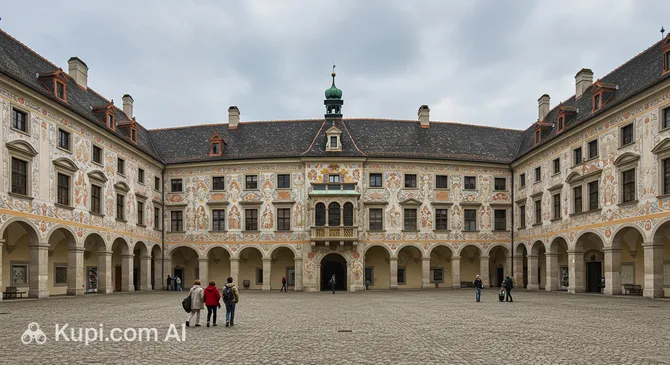
In the heart of the historical center of Graz lies a true Renaissance masterpiece — the Graz Landhaus. This majestic building serves as the seat of the Styrian provincial parliament and is considered one of the most significant architectural monuments that Austria is proud of. Its appearance, created by the Italian master Domenico dell'Allio in the 16th century, transports visitors from the Alpine foothills straight into the atmosphere of a Venetian palazzo.
\n\n
Graz Landhaus
Graz Landhaus. Иллюстрация. Источник: Kupi.com AI
\n\n

The main treasure of the complex is its three-story arched gallery and spacious inner courtyard, where the severity of lines and the lightness of Renaissance forms are harmoniously combined. The facade is decorated with elegant copper gargoyles and large semi-circular windows, while the interiors impress with Baroque luxury: stucco ceilings and halls decorated with coats of arms and the symbol of Styria — the mighty panther.

\n\n

The Landhaus is not just an administrative building, but a living witness to history. An ancient set of rules, the "Rumortafeln", which prohibits noise and strife, is still in effect here, and in winter, the courtyard turns into a magical space where masters carve the famous Christmas nativity scene from solid blocks of ice.

Contacts

To clarify information about visiting the interior halls or upcoming events, you can use the official contact details of the institution.

\n\n
How to contactContact
AddressHerrengasse 16, 8010 Graz, Austria
Phone+43 316 8776309
Websitenodu.me

What to Do

A visit to the Landhaus should begin with a leisurely stroll through its magnificent inner courtyard. Here you can endlessly admire the details: copper gargoyles on the arcades, a Mannerist-style bronze fountain, and an ornate staircase by Bartolomeo di Bosio. It is the perfect place to feel the spirit of the Italian Renaissance and take atmospheric photos against the backdrop of endless arched galleries.

\n\n

Be sure to look inside, if opening hours permit, to see the Knight's Hall (Rittersaal) with its unique paintings depicting the signs of the zodiac, and the ancient chapel. Of particular interest is the "Rumortafeln" — the text of a 1588 law that still graces the walls today, calling on visitors to maintain order and peace. In summer, the courtyard is blooming with flowers, and in winter it becomes a center of attraction thanks to the Ice Crib (Eiskrippe) — a unique nativity scene carved from transparent ice for Christmas.

\n\n

In addition, the Landhaus often serves as a venue for classical music concerts and open-air theatrical performances. Even a simple walk through its arches, connecting Herrengasse with other streets of the old city, will give you a sense of contact with great history.

Getting There

Finding the Graz Landhaus is easy, as it is located in the heart of the historical center at Herrengasse 16, just a few steps from the main pedestrian zone. If you are already walking through the old town, a walk from the central square, Hauptplatz, will take no more than 5 minutes.

\n\n

For those who prefer public transport, trams No. 1, 3, 4, 6, 7, or 13 are ideal. You should get off at the "Hauptplatz" stop or the "Landhaus" stop itself, after which you only need to walk for a couple of minutes. If you are arriving by taxi from other parts of the city, the Styrian Parliament building serves as a landmark.

\n\n

Travelers arriving from Graz Airport (GRZ) will find it most convenient to take a train or bus to the main station (Hauptbahnhof), which takes about 20 minutes. From the station to the historical center, trams run regularly and will get you to your destination in another 10 minutes. Please note that parking in the center is very limited, so public transport or walking routes are the best choice.

Ближайший город: Graz

History & Facts

The history of this magnificent building began in 1557 under the direction of the talented Italian architect Domenico dell'Allio. It was he who brought the trends of the Northern Italian Renaissance to Graz, transforming the old administrative building into a large-scale complex reminiscent of Venetian palazzos. This project was a true architectural breakthrough for the region at that time.

\n\n

Particular attention should be paid to the unique law of the "Rumortafeln", adopted in 1588. Special plaques in the courtyard strictly forbade any quarrels, shouting, or manifestations of violence on the territory of the Landhaus. Surprisingly, this rule is formally observed to this day, maintaining an atmosphere of calm and dignity within the walls of the government residence.

\n\n

The interior decoration was formed over centuries, supplemented by Baroque elements. At the beginning of the 17th century, an elegant chapel with a black-and-gold altar of the Assumption of the Virgin Mary appeared here, becoming a symbol of the Catholic faith. Today, the building continues to fulfill its historical function: the parliament of the federal state of Styria meets here, making it not just a monument, but a living center of political life.

Time Needed

To simply enjoy the beauty of the Venetian facade and look into the famous inner courtyard with its elegant arcades, 30–60 minutes is enough for most tourists. This time is sufficient to take beautiful photos and feel the "Italian" breath of Austrian architecture.

\n\n

If you plan to examine the Knight's Hall and the chapel in detail and linger by the fountain, it is worth allocating 1 to 1.5 hours. During the winter period, the visiting time may increase due to the festive installations, which you will want to stay by longer. Combined with a walk along the adjacent Herrengasse street, a visit can take up to 2 hours of your time.

Working Hours

The Graz Landhaus is surprisingly welcoming to tourists: access to the inner courtyard is open 24/7 (24 hours) seven days a week. This allows you to admire the architectural lighting in the evening or enjoy the morning silence among the ancient arches.

\n\n

However, it should be noted that access to the interior halls and administrative premises may be limited during official sessions of the Styrian parliament or during private events. If you want to take a tour inside the building, it is recommended to check the schedule in advance.

Круглосуточно

Nearby

The central location of the Landhaus makes it an ideal starting point for further exploration of the city. Literally around every corner, a new architectural masterpiece or a cozy place to relax is hidden, allowing you to feel the atmosphere of Austrian Styria more deeply.

\n\n

A walk through the surroundings will allow you to see the main symbols of the city — from the famous clock tower to modern interactive platforms for the whole family. Below is a list of interesting sites located within walking distance or a short ride away.

\n\n
NameDistance
Styrian Armoury0 km
El Gaucho at Landhaus0 km
Main Square of Graz0.1 km
Old Town of Graz0.2 km
Graz Glockenspiel0.2 km
Neue Galerie Graz0.2 km
Mausoleum of Emperor Ferdinand II0.3 km

Reached the end of the page?

That means the route is fully explored