Support

Grazer Burg

About

In the eastern part of the Old Town, where ancient stones preserve the memory of emperors, stands Grazer Burg (Graz Castle). This unique architectural ensemble, founded in the 15th century, served as the residence of Austrian rulers for centuries. Today, the castle in the city of Graz is a harmonious blend of Gothic and Renaissance styles, serving not only as the administrative heart of Styria but also as a significant historical monument within Austria.
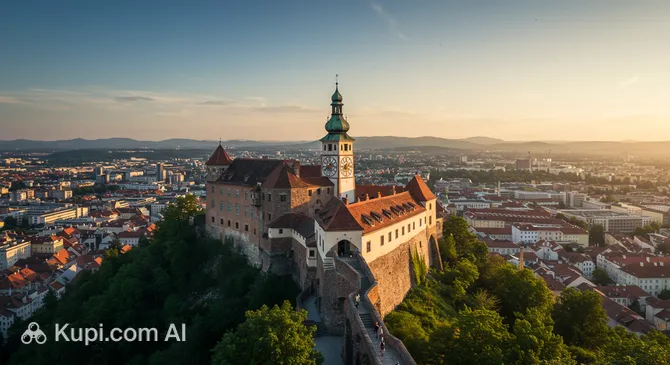
Graz Castle
Graz Castle. Иллюстрация. Источник: Kupi.com AI

The true "jewel" of the complex is the Double Spiral Staircase—a late Gothic masterpiece created in 1499. Two opposing staircases meet on each floor, forming a whimsical shape often called the "staircase of reconciliation." Beyond the architectural wonders, you can find the mysterious abbreviation A.E.I.O.U. on the building facades, the motto of Emperor Frederick III, whose meaning historians still debate today.

The modern appearance of the castle encompasses three inner courtyards and several wings, including the Friedrichsbau and Karlsbau. It is a living space where history meets modernity: while administrative work hums in the offices, tourists are free to explore the courtyards, admire the ancient sgraffito, and enjoy the tranquility of the adjacent Burggarten garden.

Contacts

To clarify visiting details or book tours, you can use the official contact information for the tourism office and the site administration.

Please note that it is best to check the website for current information regarding possible temporary restrictions due to restoration before your visit.

How to contactContact
AddressHofgasse 15, 8010 Graz, Austria
Phone+43 316 8075084
Websitewww.graztourismus.at

What to Do

Your main adventure at the castle begins with a visit to the Double Spiral Staircase in the Maximilianbau wing. Try climbing it with a companion, heading in opposite directions to meet on the next landing—this is a favorite activity for all guests, symbolizing eternity and the union of paths. This spot is considered one of the most photogenic in the city, so be sure to have your camera ready.

Be sure to wander through the spacious inner courtyards and pay attention to the building facades. Searching for the encoded A.E.I.O.U. motto and studying the ancient inscriptions turns a simple walk into a real quest. Architecture enthusiasts should take a close look at the grand staircase by Domenico dell'Allio and the elegant Renaissance arcades of the Registraturtrakt wing, adorned with delicate decoration.

You can conclude your tour on the green lawn in front of the entrance, where busts of prominent Styrian figures are installed, or in the shady Burggarten. If you're lucky, you might see archaeological finds discovered during recent restorations, which pull back the curtain on the thousand-year history of this hill.

Getting There

Finding Grazer Burg is easy, as it is located at Hofgasse 15, in the eastern part of the Old Town, just steps away from the cathedral and the Stadtpark city park. If you are already walking in the center, the walk from the main square (Hauptplatz) will take no more than 5–10 minutes at a leisurely pace.

For those who prefer public transport, trams No. 1, 3, 4, 6, or 7 are ideal, as well as bus routes going to the Burggasse or Dom im Berg stops. From the Graz Hauptbahnhof railway station, the most convenient way is to take tram No. 1, which takes about 10 minutes.

If you are arriving from Graz Airport (GRZ), you can take a taxi (about 15 minutes) or hop on tram No. 7. For drivers, paid parking is available near Stadtpark or Burggarten, but keep in mind that the historic center is a UNESCO-protected pedestrian zone, so walking is the most pleasant option.

Ближайший город: Graz

History & Facts

The history of this site dates back to ancient times: archaeologists have discovered traces of settlements here dating back to the 4th millennium BC. However, the construction of the fortress itself, known as the Grazer Burg, began in 1438 under Duke Frederick V, who later became the Holy Roman Emperor Frederick III. It was during his reign that the main Gothic structures and secret passages were built.

In the 16th century, when Graz became the capital of Inner Austria, the castle was transformed into a grand archducal residence. During this period, its architectural appearance was enhanced with Renaissance elements, such as elegant arcades and sgraffito, created by the leading masters of the time, including Pietro Ferrabosco and Domenico dell'Allio.

Interestingly, after 1619, when the imperial court moved to Vienna, the castle lost its status as the primary residence but retained its importance as the administrative center of Styria. The building was heavily damaged during World War II, particularly the historical Friedrichsbau wing, but extensive restoration work in the 1950s restored its grandeur. Today, the castle is undergoing a revitalization process to become an even more open and informative space for tourists by 2028.

Time Needed

To leisurely explore all the courtyards, climb the famous staircase, and take beautiful photos, most travelers need between 1.5 and 2.5 hours. This is plenty of time to study the architectural details and stroll through the adjacent garden.

If you decide to use a guide or plan to combine your visit with a tour of the neighboring cathedral, you should allow about 3 hours. The castle is an ideal spot for a short but rewarding walk while exploring the city center.

Working Hours

The attraction is open to visitors daily, making it very convenient to include in any travel itinerary. You can explore the castle courtyards and the famous staircase during the following hours:

Monday – Sunday: 07:30 to 20:00.

Important: Due to extensive restoration work, access to some parts of the complex may be temporarily restricted, but the main tourist sites usually remain open during the specified hours.

7:30 – 20:00

Nearby

The castle's location in the very heart of the historic center makes it easy to combine your visit with other iconic landmarks. A stroll through the surrounding area will help you fully experience the atmosphere of old Europe and see the symbols of the city.

NameDistance
Double Spiral Staircase0 km
Mausoleum of Emperor Ferdinand II0.1 km
Graz Cathedral0.1 km
Graz Glockenspiel0.2 km
University of Graz (Old Campus)0.2 km
Main Square of Graz0.4 km
Clock Tower0.4 km

Reached the end of the page?

That means the route is fully explored