Support

Ferhadija Mosque

About

Among the cozy streets that grace the city of Banja Luka stands the magnificent Ferhadija Mosque—a recognized masterpiece of 16th-century Ottoman Islamic architecture. This majestic complex, officially known as the Ferhat Pasha Mosque, is considered one of the most significant spiritual and historical monuments preserved by Bosnia and Herzegovina.
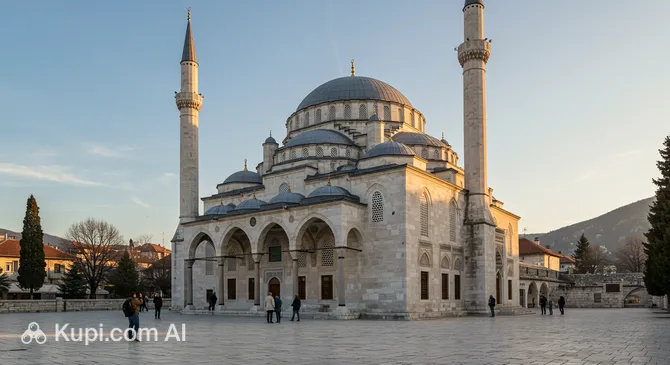
Ferhadija Mosque
Ferhadija Mosque. Иллюстрация. Источник: Kupi.com AI

Built in 1579, the mosque impresses with the harmony of its proportions and the elegance of its lines. Its 43-meter minaret with a spiral staircase, decorated with geometric ornaments, is the architectural dominant of the area. The complex also includes three family mausoleums (turbes) and a charming courtyard with a shadrvan fountain designed in the Turkish Baroque style.

The interior decoration of the mosque is of particular value: the asymmetrical women's balcony (mahfil), intricate wall paintings, and stained-glass windows create an atmosphere of peace and loftiness. Thanks to a meticulous reconstruction completed in 2016, visitors can see the building almost in its original form, feeling the craftsmanship of the builders of the empire's "golden age."

Contacts

For more information or to organize group tours, you can use the official contact details of the religious complex.

How to contactContact
AddressQ58P+XVQ, Kralja Petra I Karađorđevića, Banja Luka 78000, Bosnia and Herzegovina
Phone+387 51 211-840
Websitewww.medzlis-bl.ba

What to Do

The primary reason travelers visit is to connect with living history through its architectural details. Be sure to notice the carved wooden doors and exquisite stained-glass windows that fill the space with soft light. If you have the chance, climb the minaret: after ascending the 128 steps of the spiral staircase, you will find yourself on the muazzin's balcony (sherefe), which offers an inspiring view of the central part of the city.

In the courtyard, it is pleasant to spend time by the shadrvan—a traditional ablution fountain whose canopy is decorated in the Baroque style. This is an ideal place to relax to the sound of trickling water and take atmospheric photographs. Also, within the complex, it is worth exploring the turbes (mausoleums) and the ancient cemetery where prominent citizens of the past are buried, immersing yourself in an atmosphere of peace and antiquity.

In addition to the visual tour, it is worth chatting with local guides who are eager to share legends about the builders of the mosque and their legendary escape on wings. When planning your visit, remember the rules of conduct for an active religious site: it is recommended to choose modest clothing that covers shoulders and knees, and to maintain silence inside so as not to disturb the worshippers.

Getting There

Located in the heart of the historical center, the mosque is situated at Kralja Petra I Karađorđevića, just a few steps away from the famous Kastel Fortress. Thanks to its central location, reaching it on foot from any point in the city's business or tourist district is quite easy.

If you plan to use public transport, look for central bus routes—stops are located in the immediate vicinity of the complex. For those arriving from the airport, which is 15 kilometers from the city, the most convenient option is a taxi (the trip takes about 20–30 minutes) or a regular bus to the bus station.

Travelers with cars should keep in mind that paid parking zones are organized in the city center; however, due to the abundance of pedestrian paths and the proximity of other iconic sites, walking remains the most pleasant way to reach your destination and enjoy the atmosphere of the old quarters.

Ближайший город: Banja Luka

History & Facts

The construction of this architectural masterpiece began in 1579 at the initiative of Gazi Ferhad Pasha Sokolović. It is believed that the building's design was created by the pupils of the legendary Mimar Sinan, the chief architect of the Ottoman Empire. Funds for the construction of the complex were sourced from the revenues of more than 30 villages, allowing for the creation of not just a mosque, but an entire cultural center with markets and hammams.

Over the centuries, the building has faced significant trials: it survived a devastating earthquake in 1969 and major bombings in 1944. However, the most important milestone in its modern history was the complete restoration, which was finished in 2016. Restorers performed a monumental task, using archival documents and traditional construction methods to recreate its 16th-century appearance as accurately as possible.

Remarkably, about 65% of the original stone fragments were successfully preserved and integrated during the reconstruction. Craftsmen used a special mortar mixed with water from a local well, following ancient recipes. Today, the mosque holds the status of a national monument and serves as a living reminder of the region's rich historical path.

Local folklore preserves a beautiful legend about the builders: it is said that Ferhad Pasha locked the craftsmen in the minaret so they could not replicate such beauty elsewhere. But the skilled artisans were not discouraged; they built wooden wings and flew to freedom. This legend is so popular that it inspired a modern opera and gave names to several city districts.

Time Needed

To leisurely explore the interior of the mosque, study the details of the exterior facade, and walk through the courtyard, 1–2 hours is usually sufficient. This time is enough to enjoy the silence by the shadrvan fountain and take a close look at the exquisite carvings on the doors and minaret.

If you plan to combine your visit with an exploration of the nearby Kastel Fortress or want to listen to local guides' stories about the city's history, you should allow about 3 hours in your schedule. In any case, this place encourages thoughtful contemplation rather than haste.

Working Hours

You can visit the mosque and explore its architectural ensemble daily during the morning hours. The complex is open to tourists according to the following schedule:

Monday – Sunday: 08:30 – 11:30.

Please note that access to the main hall may be restricted during prayer times, so it is best to plan your visit specifically during the indicated interval.

8:30 – 11:30

Nearby

A visit to the Ferhadija Mosque is an excellent reason to explore the central part of the city, where interesting sites are hidden around every corner. A walk through the neighborhood will allow you to better experience the multi-layered history and culture of this place.

Within walking distance, you will find both ancient fortifications and modern monuments that create the unique character of the area.

NameDistance
Kastel Fortress0.3 km
Pod Lipom0.3 km
Museum of Republika Srpska0.4 km
Hotel Moskva0.5 km
Mac Tire Pub0.6 km
Museum of Contemporary Art of the Republic of Srpska0.6 km
Cathedral of Christ the Saviour0.6 km

Reached the end of the page?

That means the route is fully explored