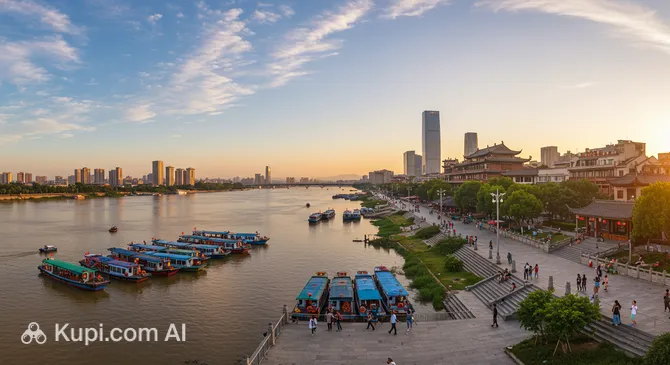
Binzhou is a dynamically developing prefecture-level city located in the northern part of Shandong Province, on the picturesque northern bank of the legendary Yellow River (Huang He). This region in China harmoniously combines industrial power with the tranquility of natural landscapes. Binzhou spans an area of over 9,000 square kilometers and has a population of approximately 3.9 million people, making it an important administrative and cultural center in the region.
Binzhou. Illustration.
Source: Kupi.com AI
The city attracts visitors with its unique atmosphere, where modern industrial architecture stands alongside traditional manors and green recreational areas. The city's rich historical heritage dates back to the deep past when these lands were part of ancient Chinese states. Today, Binzhou is known not only as the "oil and textile capital" of northern Shandong but also as a place that carefully preserves the traditions of northern China.
For travelers, the city is interesting for its spacious parks along its waterways and the authentic atmosphere of provincial China, which has not yet been fully reached by mass international tourism. Here, you can feel the true rhythm of life in modern Chinese society, stroll along the embankments of the Yellow River, and explore the achievements of local science at the Binzhou University campuses.
A visit to Binzhou is an excellent choice for those who want to see China beyond the standard tourist routes, appreciate the hospitality of Shandong, and witness the large-scale transformations taking place in this industrial heart of the province.
Weather Overview
The climate in Binzhou is characterized as humid subtropical with a pronounced monsoon influence. Travelers should expect hot and rainy summers, as well as cold and dry winters. The warmest month is July, when the average daytime temperature stays around +32°C, and humidity reaches its peak.
In the winter period, especially in January, the weather in Binzhou becomes frosty: the average temperature drops to -0.5°C, and night frosts down to -6°C are common. There is very little precipitation in winter, which makes the air dry. The most favorable times to visit the city are considered spring (April–May) and autumn (September–October), when comfortable temperatures of about +15...+22°C are established and rainfall is moderate.
Average monthly temperature
Average monthly precipitation
Interesting Facts
Scale and Status: Binzhou is not just a city but an entire prefecture-level city, comparable in area to some small European countries, with a population exceeding 3.9 million people.
Etymology: The name "Binzhou" translates to "Bin Prefecture." It originated from a historical administrative unit that existed in these parts as far back as the Middle Ages.
Industrial Giant: The city is a crucial hub for northern Shandong, specializing in petrochemistry and the textile industry. A significant portion of China's exported textiles is produced here.
University Scope: The local state university (Binzhou University) boasts a colossal campus area of about 160 hectares, highlighting the city's status as an educational center.
Geographical Borders: Binzhou holds a strategic position, bordering four major Shandong prefectures simultaneously and having access to the Bohai Gulf of the Yellow Sea.
How to Get There
The transport accessibility of Binzhou is due to its location in the developed industrial region of Shandong. Although the city does not have a major international airport, all ways to get to Binzhou usually involve transfers in neighboring metropolises. The main flow of travelers arrives via the province's major transport hubs using a modern network of railways and highways.
The closest and most convenient air hub is Jinan Yaoqiang International Airport (TNA), located in the provincial capital. From there, Binzhou can be reached by express bus or taxi in approximately 1.5–2 hours. Travelers also frequently use Qingdao Airport to enter the region.
Railway services connect the district with key cities in China. Major stations serve both regular and high-speed trains, providing comfortable access from Beijing or Shanghai via transfer stations in Jinan or Dezhou. Within the district itself, intercity bus services are actively used, linking the areas of Bincheng, Boxing, and Zouping.
Despite its predominantly industrial character, Binzhou offers several interesting locations for exploring the culture and nature of the region. One of the central recreational spots for residents is Puhu Park. This is a vast green area with lakes and walking trails, where you can observe the daily life of locals and enjoy silence away from the city highways.
History enthusiasts should head to the Weiji Landlord Manor. This unique architectural complex is a beautifully preserved example of a traditional Chinese estate. Here, you can study the features of northern Chinese architecture and courtyard layouts, and learn about the lifestyle of wealthy families from past centuries.
For those who prefer natural beauty, a visit to the Baoji Sanhe Lake recreational area is a great option. This lake and its surrounding areas are important natural sites in the district, offering opportunities for ecotourism and observing local flora and fauna. The calm waters of the lake and the fresh air make this a popular spot for weekend trips.
Local Cuisine
The gastronomic scene in Binzhou is inextricably linked to the traditions of Lu cuisine (Shandong cuisine), which is considered one of the eight great culinary schools of China. Shandong cuisine is famous for its mastery in preparing seafood, the use of grains, and rich sauces. In local restaurants, you must try dishes made from fresh fish delivered from the nearby Bohai Gulf.
A typical lunch in Binzhou often includes hearty soups and wok-fried dishes with garlic and shallots. Special attention should be paid to local flour-based products—various steamed buns (mantou) and flatbreads, which are more popular in Shandong than rice. Popular drinks include various types of Chinese tea and local beer, which is traditionally of high quality in Shandong Province.
The dining culture here is democratic: most residents prefer to eat in family restaurants or food courts in large shopping centers. In the evening, street food stalls appear, serving "chuan" skewers and fried noodles. Despite the lack of many specialized tourist establishments, the catering in Binzhou delights with its authenticity and generous portions characteristic of northern China.
Travel Tips
Planning a trip to Binzhou requires attention to detail, as the city is primarily oriented toward the domestic market. These tips will help you feel confident in the industrial heart of Shandong Province.
Clothing and Essentials: The region's climate features harsh winters and hot summers. In winter (December–February), bring warm clothes that protect against the wind; in summer, wear light cotton clothing and use sunscreen. Comfortable shoes are a must for walks in parks and manors.
Transport: The best way to get around is by taxi via the Didi app. For buses, install payment apps in advance. Renting a car is difficult for foreigners without a Chinese driver's license.
Finances: The main currency is the Yuan (CNY). Cash is rarely accepted, and international Visa/Mastercard cards only work in large hotels. Be sure to set up Alipay or WeChat Pay before your trip.
Health and Safety: The city is safe, but due to its industrial status, you should monitor the air quality. Pharmacies are common, but there is little English-speaking staff—use a translator.
Communication: English is not widely spoken in Binzhou. Download an offline translator and carry a hotel card with the address in Chinese. It is better to buy a SIM card at the arrival airport (Jinan or Beijing).
Local Etiquette: Residents of Shandong are straightforward and hospitable. A greeting is a slight nod. In restaurants, it is customary to order several dishes for the whole group to share ("family style").
What to Avoid: Do not discuss political topics and avoid criticizing local customs. Do not drink tap water—use only bottled water.
Regional Specifics: Since Binzhou is a major center for petrochemistry, when choosing a hotel, aim for residential areas in central Bincheng, away from the industrial zones on the outskirts.
Binzhou will reveal to you the real, "non-tourist" China, full of industrial power and sincere hospitality. Have a great trip!
Entertainment & Nightlife
Nightlife in Binzhou is primarily local in character and concentrated around major shopping districts and university zones. While you won't find an abundance of giant nightclubs like in Beijing, the city offers many cozy bars and traditional Chinese KTV (karaoke clubs), which are the center of evening leisure. The most vibrant venues can be found in the Bincheng district, where local youth and university students gather.
The city's evening atmosphere is perfect for leisurely walks along illuminated embankments and visiting night food markets, where life teems until late. This is a great opportunity to try local snacks and experience the flavor of Shandong evenings. For those who prefer a quieter pastime, modern cinemas are available in major shopping centers like Bohai International Plaza.
Daytime entertainment includes visiting city parks such as Puhu Park, which often hosts local festivals and exhibitions. Safety in the city is high, making even late-night walks through the central districts quite comfortable. For moving around the city at night, it is best to use official taxi apps, which operate around the clock.
Parks & Museums
The park culture of Binzhou is centered around the district's water resources. The main place for walking is Puhu Park, a classic urban park with well-maintained alleys, bridges, and relaxation zones. It is an ideal spot to see elderly people practicing Tai Chi and families spending time by the water. Another significant natural site is the Baoji Sanhe Lake recreational area, where natural landscapes offer a break from the city's industrial rhythm.
The city's museum scene is primarily represented by historical and architectural monuments. The Weiji Landlord Manor is essentially an open-air museum, where the history of the region and the social structure of old China are told through its architecture and interiors. It is one of the most important cultural heritage sites in northern Shandong.
While Binzhou does not have massive world-class art galleries, the city has local cultural centers and exhibition halls, often associated with Binzhou University. These venues regularly host exhibitions dedicated to local industrial development, the ecology of the Yellow River, and traditional Shandong province crafts.
Getting Around
The public transport system in Binzhou is represented by an extensive network of bus routes connecting the central Bincheng district with the outskirts and neighboring counties. Buses are the most budget-friendly way to get around, with fares usually ranging from 1 to 2 yuan. Route maps are often provided only in Chinese, so tourists are recommended to use navigation apps on their smartphones.
For more comfortable trips around the city, taxis are ideal. Cars can be hailed on the street or called via the Didi Chuxing app (similar to Uber). This is very convenient, as the app allows you to enter the address in English and automatically deducts payment. Electric bike rental services are also popular in Binzhou and can be found at special parking spots throughout the city.
Payment for transport is mostly done via mobile apps (Alipay/WeChat), which is the standard for modern China. If you plan to use buses frequently, it makes sense to purchase a local transport card, which can be topped up at kiosks or through terminals. There is currently no metro in the city, but the road network in Binzhou is modern and spacious, minimizing traffic issues compared to larger metropolises.
Accommodation
Accommodation in Binzhou features a wide range of hotels primarily aimed at business travelers and domestic tourists. There are more than 400 lodging facilities in the city, dominated by Chinese hotel chains and mid-range hotels. The main concentration of quality accommodation is in the Bincheng district, which is the administrative center of the prefecture.
For those seeking comfort at a reasonable price, 3- and 4-star hotels like Hanting Hotel or local business hotels are available. The average cost of staying here is significantly lower than in China's coastal tourist metropolises: a room in a good 3-star hotel will cost about 1,500 rubles, while for 2,500–3,000 rubles, you can find a higher-class option.
When planning your trip, it is recommended to book accommodation in advance, especially if your visit coincides with major industrial exhibitions or national holidays. The main tools for booking are major international and local aggregators. If you plan to visit businesses or the university, choose hotels in the central blocks of the Bincheng district for better access to transport and restaurants.
Nearby Cities
Thanks to its location in northern Shandong Province, Binzhou serves as a convenient starting point for exploring neighboring cities, each with its own unique character. A developed network of expressways and railways allows for easy planning of day trips to nearby industrial and cultural centers.
One of the nearest interesting destinations is Dongying, located just 62 kilometers to the east. This city grew around the Yellow River delta and rich oil fields; here, you can visit unique nature reserves. Also worth noting is Zibo, known for its ancient history and traditions of ceramic production. For a shorter trip, the city of Zouping, which is part of the Binzhou prefecture, offers the peaceful atmosphere of a provincial town.
Exploring the surroundings of Binzhou will allow you to see the diversity of northern China's landscapes—from endless plains to the coastline of the Bohai Gulf. Each of these destinations complements the overall picture of life in one of the country's most economically active regions.
Shopping & Souvenirs
Shopping in Binzhou primarily involves visiting modern shopping centers and bustling city markets aimed at the daily needs of residents. The main shopping area is considered the central part of the Bincheng district, where major commercial spaces are located. The large Bohai International Plaza complex offers a familiar shopping format with clothing, cosmetics, and electronics stores.
The city is famous for its textile industry, so you can find high-quality products made of cotton and synthetic fabrics produced locally at very attractive prices. If you are looking for something more authentic, it is worth checking out the local food markets, which sell Shandong delicacies, fresh fruits, and spices. This is the best way to purchase products that you won't find in regular supermarkets.
Shops usually operate from 9:00 or 10:00 AM until 9:00–10:00 PM every day. In Binzhou, as in all of China, payments via Alipay and WeChat Pay apps are accepted everywhere, and larger retail outlets accept UnionPay cards. Traditional regional souvenirs include ceramics and Shandong embroidery, which make excellent reminders of your trip.