Support

Notre-Dame Cathedral

About

Notre-Dame Cathedral, also known as Notre-Dame de Paris, is not just a Catholic church, but the true heart of Paris and one of the greatest symbols of France. Located on the Île de la Cité, this masterpiece of Gothic architecture has attracted travelers, historians, and art lovers for centuries. Its history dates back to antiquity: the cathedral was built on the site where the city's first Christian church once stood, and before that, a Gallo-Roman temple of Jupiter.

The construction of this grand structure began in 1163 and lasted nearly two centuries. The result was a unique architectural ensemble combining the power of the Romanesque style with the elegance of Gothic. Majestic towers, famous rose windows, delicate flying buttresses, and the gallery of chimeras create a unique appearance that has inspired many creators, including Victor Hugo, author of the immortal novel "The Hunchback of Notre-Dame".
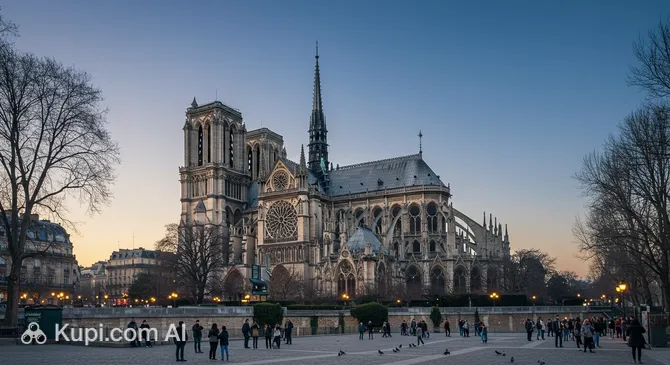
Notre-Dame Cathedral. Illustration.
Source: Kupi.com AI

Traveler photos:

In April 2019, the cathedral was seriously damaged by a devastating fire that destroyed the spire and roof. This event shocked the world, but thanks to the unprecedented efforts of restorers and donations from hundreds of thousands of people from different countries, Notre-Dame has been restored. In December 2024, after five years of painstaking work, the cathedral reopened its doors to visitors, becoming a symbol not only of historical heritage but also of incredible resilience and rebirth.

Contacts

To get the most up-to-date information on opening hours, visiting conditions, and special events, it is recommended to consult official sources. All necessary visitor information is regularly updated on the cathedral's website, which serves as the primary communication channel.

Below are the key contact details for planning your visit:

How to contactContact
Address6 Parvis Notre-Dame - Pl. Jean-Paul II, 75004 Paris, France
Phone number+33 1 42 34 56 10
Websitewww.notredamedeparis.fr

What to Do

A visit to Notre-Dame Cathedral is an opportunity to touch centuries of history and see unique examples of Gothic architecture. Inside the cathedral, visitors can admire restored stained-glass windows, including the famous 13th-century roses, which fill the space with colored light. The interior, devoid of wall paintings, emphasizes the austerity and grandeur of the Gothic style, while the stone choir screen is decorated with relief sculptures featuring scenes from the Gospel. The great organs, among the most famous in the world, also deserve special attention as they once again sound during masses and concerts.

Once inside, travelers can explore the rich sculptural decor, restored in the 19th century under the direction of architect Viollet-le-Duc after damage during the French Revolution. While walking through the nave, it is worth noticing the chapels located between the buttresses. The treasury is also open to visitors, housing priceless Christian relics and liturgical items. While entry to the main space of the cathedral is free, a separate ticket may be required for access to the treasury.

In addition to viewing architectural and artistic treasures, visitors can experience the spiritual atmosphere of the place. Notre-Dame de Paris is an active church, whose main altar was consecrated as far back as 1182. Tourists have the opportunity not only to view it as a historical monument but also to attend services, allowing for a deeper sense of its significance. And from autumn 2025, the towers are planned to reopen for climbing, offering one of the best panoramas of Paris.

Getting There

Notre-Dame Cathedral is located in the heart of Paris on the Île de la Cité, making it easily accessible from anywhere in the city. Thanks to its central location, this famous symbol of France can be reached via many convenient ways, whether by public transport, taxi, or a pleasant stroll.

The quickest and most convenient way to reach the cathedral is by using the Paris Metro. The closest station, Cité, is on Line 4 and is just a few minutes' walk away. You can also travel to the Saint-Michel (Line 4), Hôtel de Ville (Lines 1 and 11), or Châtelet (Lines 1, 7, 11, 14) stations. The RER express train is another excellent option: lines B and C stop at the Saint-Michel — Notre-Dame station, which is in the immediate vicinity of the cathedral.

If you prefer surface transport to enjoy the city views along the way, numerous bus routes are at your service. Buses No. 21, 38, 47, 85, 96, and others stop near the Île de la Cité. Furthermore, since the cathedral is in the historic center, it is very pleasant to reach it on foot, for example, from the Latin Quarter or the Louvre. For the most romantic travelers, there is the option to arrive by water — the Batobus river shuttle makes a "Notre-Dame" stop on the banks of the Seine.

Nearest city: Paris

History & Facts

The history of Notre-Dame Cathedral is a chronicle of nearly two centuries of continuous construction and creative exploration. The grand project was initiated by the Bishop of Paris, Maurice de Sully, and the first stone of the future masterpiece was laid in 1163 in the presence of Pope Alexander III. Notably, stones remaining from earlier structures that stood on this site, sacred to Parisians, were used for the foundation. The entire construction process took nearly 182 years and was only completed in 1345.

The construction of the cathedral took place in several key stages, each adding unique new features to the building. By 1182, the altar area was consecrated, and by 1196, the longitudinal nave was nearly finished. The western facade with its famous towers took its final form in the second quarter of the 13th century. Later, starting from 1235, significant changes were made to the structure: architects Jean de Chelles and Pierre de Montreuil increased the size of the transept, and in the early 14th century, elegant chapels and large flying buttresses were added, which still inspire awe today with their boldness.

One of the most important periods in the cathedral's life came in the 19th century, when it was in a state of disrepair following the French Revolution. Thanks to Victor Hugo's novel, which drew attention to the monument's fate, a large-scale restoration began under the leadership of architect Eugène Viollet-le-Duc. It was he who not only restored the damaged sculptures and the famous rose windows but also erected a new 96-meter spire to replace the one lost previously. This spire, which became one of the most recognizable elements of Notre-Dame's silhouette, was tragically lost during the 2019 fire, but its recreation has become a symbol of the cathedral's rebirth.

Time Needed

When planning a visit to Notre-Dame Cathedral, one of the main symbols of France, you should expect a basic tour to take about 1–2 hours. This is generally enough time to walk leisurely through the central nave, admire the grandeur of the Gothic architecture, examine the famous rose windows, and feel the special atmosphere of this historic site in Paris. In this timeframe, you can form a general impression of the cathedral's interior, its scale, and the key elements restored after the renovation.

However, if you want to dive deeper into the history and treasures of Notre-Dame, it is worth setting aside more time. For instance, visiting the treasury, which houses precious relics and liturgical items, can take an additional 30–45 minutes. If you plan to attend a service or an organ music concert, this will also require extra time. Additionally, from autumn 2025, the towers are planned to reopen for climbing. You should budget at least another hour or an hour and a half for this, considering the climb up 422 steps and time to enjoy the panoramic views. Thus, for a full and comprehensive experience of the cathedral, it is best to plan for about half a day.

Working Hours

Following a massive restoration, the long-awaited reopening of Notre-Dame Cathedral to visitors is scheduled for December 2024. This event marks an important stage in the cathedral's history, as it once again becomes accessible to believers and tourists from all over the world. Formal opening celebrations will take place on December 7 and 8, 2024.

Since the exact opening hours and visiting rules will be published closer to the opening date, it is strongly recommended to check the most current information on the cathedral's official website. All details will be posted there, including the schedule of services, entry conditions (such as the need for pre-booking free time slots), and any possible restrictions. When planning your visit, be sure to consult the official source to ensure your visit goes smoothly.

DayOpening hours
Monday7:50 – 19:00
Tuesday7:50 – 19:00
Wednesday7:50 – 19:00
Thursday7:50 – 22:00
Friday7:50 – 19:00
Saturday8:15 – 19:30
Sunday8:15 – 19:30

Nearby

Visiting Notre-Dame Cathedral is just the beginning of your acquaintance with the historic heart of Paris. The Île de la Cité and its surroundings are packed with cultural treasures and iconic landmarks located within walking distance. A walk through this area will allow you to dive deeper into the city's atmosphere, see other architectural masterpieces, and simply enjoy the picturesque views of the Seine.

Exploring nearby attractions will significantly enrich your experience. You will be able to form a more complete picture of the history of France, as many of these sites are inextricably linked to one another by centuries of events. Below is a list of interesting places located in the immediate vicinity of the cathedral.

NameDistance
Le Caveau de la Huchette0.3 km
Louvre Museum1.2 km
Supersonic1.5 km
Galerie Vivienne1.7 km
Musée d'Orsay1.9 km
Hôtel de Crillon2.6 km
Les Invalides2.7 km

Have you reached the end of the page?

So the route has been studied inside and out