Support

Bois de Boulogne

About

The Bois de Boulogne is a massive urban park stretching across the western edge of Paris, in close proximity to the city of Versailles. This picturesque corner of nature, part of France, is traditionally considered one of the "green lungs" of the capital region. It serves as a favorite leisure spot for both locals and tourists looking for a break from the city bustle.

The scale of the park is impressive: it covers an area of about 846 hectares, which is nearly two and a half times the size of Central Park in New York. Once used as royal hunting grounds, the forest was transformed in the 19th century by order of Napoleon III into a park inspired by London's squares. Today, it is a true oasis with centuries of history.
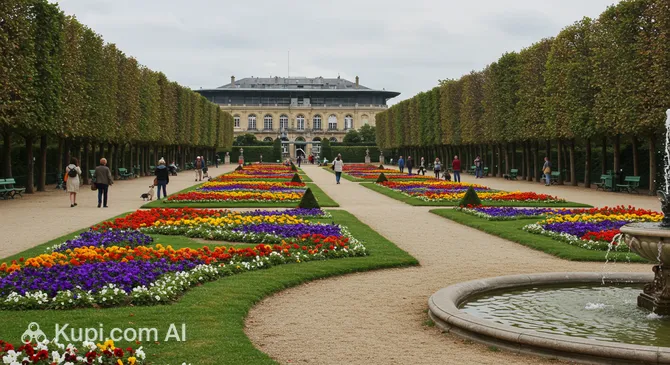
Bois de Boulogne. Illustration.
Source: Kupi.com AI

Traveler photos:

Inside the Bois de Boulogne, visitors will find picturesque alleys, several lakes with waterfalls, botanical gardens, and even a rose garden. The park's infrastructure offers many opportunities for leisure: you can have a picnic, take a boat out on the lake, go for a bike ride on specially designated paths, or simply enjoy the peace and beauty of nature.

Contacts

Since the Bois de Boulogne is a vast public park, it does not have a single contact center or phone number. The most convenient way to reach it is by public transport: you can take the RER C suburban train to Avenue Foch station or the metro to Porte Dauphine station. For specific information regarding the opening hours and services of particular establishments within the park, such as restaurants or amusement parks, it is recommended to visit their official websites.

How to contactContact
Address75016 Paris, France
Phone number+33 1 53 92 82 82
Websitewww.paris.fr

What to Do

The Bois de Boulogne offers visitors plenty of opportunities for active and cultural recreation. For sports enthusiasts, there are numerous jogging and cycling paths, as well as horseback riding trails. You can have a picnic on one of the green lawns or rent a boat for a romantic trip on one of the artificial lakes. It is an ideal place for those who want to go cycling or rollerblading while enjoying the fresh air and picturesque landscapes.

Besides active recreation, the park is rich in cultural and family entertainment. The magnificent Bagatelle Botanical Garden, famous for its rose garden, deserves special attention. For families with children, there are playgrounds and even a mini-zoo within the park, which will make the walk exciting for the little ones. Sports fans can visit the legendary Longchamp Racecourse, tennis courts, or golf courses. Furthermore, the Bois de Boulogne regularly hosts various exhibitions, concerts, and cultural events, making it a hub for residents and visitors at any time of year.

Getting There

Getting to the Bois de Boulogne from Paris is most convenient by public transport. Depending on which part of this massive park you are heading to, you can choose from several stations. The closest metro stations to the forest are Porte Maillot (Line 1) and Porte Dauphine (Line 2). Another popular option is the RER C suburban train, which stops at Avenue Foch station, located near one of the park entrances.

If you are planning a trip from Versailles, the most convenient route is to take the same RER C train to Avenue Foch, from where you can reach the park on foot. Besides the metro and RER, many city buses serve the Bois de Boulogne. For those who prefer traveling by car, dedicated parking lots are located near the main entrances. Active travelers can also comfortably reach the park by bike via the numerous cycling paths leading to it from various parts of the city.

Nearest city: Versailles

History & Facts

The history of the Bois de Boulogne dates back centuries, when the area, then known as the Rouvray Forest, was a royal hunting ground. For a long time, the thickets served as a place for hunting and secluded walks for the French nobility. Everything changed in the mid-19th century when, by order of Emperor Napoleon III, work began to transform the forest into a modern urban park open to the public. This ambitious project was inspired by the famous London parks the Emperor had seen during his exile.

During a massive reconstruction that took place from 1852 to 1858, the landscape was completely transformed. Artificial lakes and cascades were created, and shaded alleys and kilometers of walking paths were laid out, making it an ideal place for relaxation. These works, which included the planting of about 400,000 trees, turned the former hunting grounds into the masterpiece of landscape art we see today.

Since its opening, the Bois de Boulogne has played an important role in the cultural and social life of not only Paris but its surrounding areas. At different historical periods, it has hosted exhibitions, festive celebrations, and iconic sporting events such as the Roland-Garros tennis tournament. This place attracted artists, writers, and aristocrats, becoming an integral part of Parisian life. Today, the Bois de Boulogne is not only a monument of landscape architecture but also an essential part of France's rich cultural heritage.

Time Needed

When planning a visit to the Bois de Boulogne, it is important to calculate your time correctly, as it is one of the largest urban parks in the world. For a superficial acquaintance and a short walk along the nearest alleys, a couple of hours might be enough. However, to truly feel the scale and beauty of this place, it is worth setting aside significantly more time.

For a full walk along the main routes, with stops at picturesque lakes and gardens, it is recommended to allow 3 to 5 hours. This will be enough time to leisurely walk through the most beautiful spots, enjoy the views, and perhaps visit one of the local attractions, such as the famous rose garden in Bagatelle Park.

If you are looking for a deeper immersion, want to visit several sites, or engage in active recreation, you should dedicate an entire day to the Bois de Boulogne. In this time, you can manage not only to walk through a significant part of the park but also to go boating, visit the Fondation Louis Vuitton, spend time with your family at the Jardin d'Acclimatation amusement park, or have a long picnic on one of the lawns.

Working Hours

The Bois de Boulogne, as a vast public park, is open to visitors 24/7 all year round, and entrance to the main area is free. You can come here for a walk at any time convenient for you, whether it's early morning for a jog or in the evening to enjoy the sunset. The main alleys and paths are accessible without any restrictions, making the park an ideal place for spontaneous relaxation.

However, it is worth noting that many individual sites are located within the Bois de Boulogne: botanical gardens, amusement parks, museums, restaurants, and sports facilities. Each of these places has its own operating schedule, visiting rules, and admission fees, which it is recommended to check in advance. For example, to visit the Fondation Louis Vuitton or Bagatelle Park, it is best to check the latest information and possibly book tickets on their official websites.

Open 24 hours

Nearby

Visiting an iconic place like the Bois de Boulogne is a memorable experience in itself. However, to make your trip even more fulfilling and complete, it is worth paying attention to the attractions located nearby. Exploring the surroundings will allow you to dive deeper into the region's atmosphere and discover new interesting spots.

Although the Bois de Boulogne is a vast park area adjacent to Versailles, the city itself and its immediate surroundings are also rich in points of interest. By expanding your itinerary, you can complement your impressions of walking through the park with visits to other notable sites located very close by. Below is a list of some of them, including their distance from the Bois de Boulogne.

NameDistance
Noah's World - Centre Dauphine2.1 km
Maritime Museum2.6 km
Musée de l'Homme2.6 km
Aquarium Club2.8 km
Parc André Citroën2.8 km
Francette2.9 km
Quinzerie - Neighborhood Hotel and Bar2.9 km

Have you reached the end of the page?

So the route has been studied inside and out