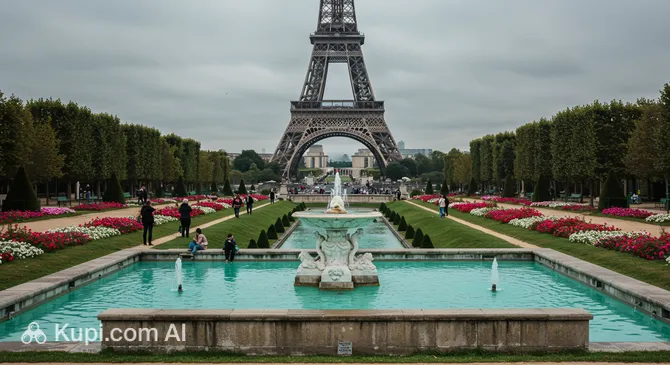
The Garden at the Eiffel Tower is a charming green space located in the heart of France at the foot of its most famous architectural masterpiece. As part of the historical ensemble of the Champ de Mars, these gardens offer tourists a chance to enjoy peace and nature while being at the epicenter of tourist life.
Eiffel Tower Garden. Illustration.
Source: Kupi.com AI
Traveler photos:
Although the site is administratively mentioned in the context of trips to the city of Versailles and its surroundings, it is a significant landscape attraction in its own right. After a major renovation, the area around the tower's pillars was transformed into modern gardens with cozy paths, decorative ponds, and carefully selected plants that create a living frame for the steel structures.
The main feature of this place lies in its atmosphere: it is a quiet "green pocket" where you can admire the details of Gustave Eiffel's engineering genius from the bottom up, through the tree canopies. The gardens adjoin the tower's parvis and serve as an ideal place to relax before ascending to the observation decks or after a long walk along the banks of the Seine.
Contacts
When planning a walk through the area occupied by The Garden at the Eiffel Tower, it is worth noting that it is part of the general complex of the main attraction in this region. We recommend checking for up-to-date access information on official resources in advance to ensure your visit to France is as comfortable as possible.
Since the garden is an open public space, it does not have a separate information service; however, all questions regarding security and entry procedures can be clarified through the information centers located near the tower's pillars.
The main pleasure of visiting The Garden at the Eiffel Tower is the opportunity to see the legendary monument from an unusual angle. Winding pedestrian paths offer stunning photo opportunities: the tower's delicate iron latticework harmoniously coexists with lush greenery and is reflected in the mirror-like surfaces of small artificial ponds.
In the garden, you can take a short break on the well-kept lawns, admiring the skill of landscape designers and the variety of flora. This place is excellent for family walks in the city of Versailles and its surroundings—there are areas convenient for visitors with children. You can often find street musicians here, whose performances create the unique romantic backdrop characteristic of all of France.
Getting There
The Garden at the Eiffel Tower is located at Tour Eiffel – Parc du Champ-de-Mars, making it an easily recognizable landmark for any tourist. The easiest way to get here is to use the well-developed public transport network. The nearest metro and RER commuter train stations are within a few minutes' walk, allowing you to quickly reach the site from most districts.
If your route starts in the center of the city of Versailles, a train ride followed by a transfer to the metro will take approximately 40–50 minutes. This is a convenient and popular route for those who want to combine a tour of the royal residence with a walk at the foot of the country's main symbol.
For those who prefer comfort, taxi services or ride-hailing apps are always available. However, keep in mind that traffic is often heavy in this popular area of France, so taking the metro is often the faster option.
Nearest city: Versailles
History & Facts
The history of this picturesque spot began long before the famous iron tower rose into the sky. In the 18th and 19th centuries, the territory where The Garden at the Eiffel Tower now stretches served as a parade ground for military processions and ceremonial reviews on the Champ de Mars. Later, these lands became the central venue for World Expos, showcasing the progress and achievements of France to the world.
After the tower was built in 1889, the surrounding green areas were carefully preserved and eventually transformed into a modern garden and park complex. At the beginning of the 21st century, the gardens underwent a major renovation: landscape designers reimagined the space, making it more eco-friendly and pedestrian-friendly, creating new routes and updating the system of decorative ponds.
It is noteworthy that despite its status as a site of global importance and increased security measures, access to the gardens and the parvis remains free for everyone. This emphasizes the park's status as an open cultural space accessible to every guest of the city of Versailles and the entire capital region.
Time Needed
For a leisurely exploration of The Garden at the Eiffel Tower, including a walk along the main alleys and several photo sessions from unique angles, 30–60 minutes is usually sufficient. This is enough time to enjoy the landscape design and rest for a bit in the shade of the trees.
However, if you plan to combine a tour of the gardens with a visit to the tower's observation decks or nearby museums, you should allocate at least 2–3 hours for this location. Take into account the time needed for security checks and possible queues, especially during the peak tourist season.
Working Hours
According to publicly available data, The Garden at the Eiffel Tower is accessible 24/7, allowing guests to admire the night illumination and walk under the stars at any time. This makes it one of the most open and welcoming recreation areas in France.
Nevertheless, actual access to certain sections near the pillars may depend on the tower's operating schedule and special events. Before visiting this area of the city of Versailles, it is recommended to check the information on the official Eiffel Tower website to account for possible temporary restrictions in security zones.
Open 24 hours
Nearby
A walk through The Garden at the Eiffel Tower is just the beginning of an exciting journey. Right nearby is the majestic Eiffel Tower itself, where an ascent offers unforgettable views of the surroundings. Also within walking distance is the legendary Champ de Mars, perfect for long promenades and contemplating architectural ensembles.
If you wish to continue your cultural exploration, it's worth visiting the Musée du quai Branly – Jacques Chirac or crossing to the other bank via the historic Pont d'Iéna. Exploring these locations will allow you to feel the atmosphere of France more deeply and make your visit to the Versailles region truly fulfilling.