Support

Palais Garnier

About

Palais Garnier (Palais Garnier), also known as the Opéra Garnier, is one of the most recognizable architectural masterpieces in Paris and an important cultural center in France. Located in the city's 9th arrondissement, this opera house is not just a venue for outstanding productions, but a true treasure trove of art and history, attracting travelers from all over the world. Designed by architect Charles Garnier and opened in 1875, the building is considered a pinnacle of the eclectic Napoleon III style, also known as "Beaux-Arts."
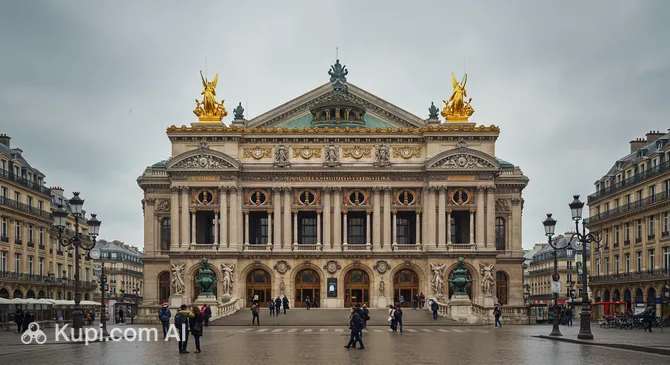
Palais Garnier. Illustration.
Source: Kupi.com AI

Traveller photos:

The exterior of Palais Garnier is striking in its magnificence and rich decoration. The façade is adorned with numerous sculptures, columns, and friezes representing allegories of Music, Poetry, Drama, and Dance. Various types of marble, bronze, and gold leaf were used for its finishing, giving the building a monumental yet graceful appearance. This luxurious style, combining elements of Baroque, Classicism, and Renaissance, was intended to reflect the brilliance and grandeur of the Second Empire.

The theater's interior is just as impressive as its façade. Visitors are greeted by the famous grand staircase made of white Carrara marble with a balustrade of red and green marble, leading to the opulent foyers. However, the crown jewel of the auditorium is the massive crystal chandelier weighing about 7 tons and the magnificent ceiling painted in 1964 by artist Marc Chagall. This vibrant and dynamic work of art, depicting scenes from 14 famous operas and ballets, has become as much a symbol of the Opera as its century-old architecture.

Contacts

For the most up-to-date information on performance schedules, ticket purchases, and visiting hours for Palais Garnier, we recommend contacting the theater directly. The latest details can always be found on the official website or by calling for further clarification.

How to contactContact
AddressPl. de l'Opéra, 75009 Paris, France
Phone+33 1 40 07 00 43
Websitewww.operadeparis.fr

What to Do

A visit to Palais Garnier offers several ways to spend your time. First and foremost, it is, of course, the opportunity to see world-class opera and ballet performances or attend one of the many concerts regularly held on this legendary stage. Art lovers can plan their visit to catch a performance by the famous Paris Opera Ballet, one of the oldest and most prestigious in the world.

Even if you don't plan to attend a performance, the theater is open to visitors during the day. You can take a self-guided or organized tour to explore its luxurious interiors. The route usually includes viewing the famous grand marble staircase, the richly decorated foyers, and, of course, the auditorium itself with its massive crystal chandelier and the ceiling painted by Marc Chagall. This is a wonderful opportunity to enjoy the building's architectural splendor at your own pace and take unforgettable photos.

Additionally, temporary exhibitions dedicated to the theater's history, outstanding performers, costumes, and stage sets are often held at Palais Garnier. The building also houses a museum-library containing unique artifacts related to the Opera's past. After sightseeing, you can stop by the souvenir boutique or relax in the local cafe, enjoying the atmosphere of one of Paris's most beautiful buildings.

Getting There

Getting to Palais Garnier is quite simple, as the opera house is located in the very heart of Paris, on the famous Place de l’Opéra in the 9th arrondissement. Thanks to this prime location, it serves as a major transport hub and a starting point for many tourist routes.

The most convenient and fastest way to reach the theater is by using the Paris Metro. The nearest station is aptly named Opéra, where lines 3, 7, and 8 intersect, making it accessible from almost any part of the city. Additionally, many city bus routes pass right by the building, adding even more flexibility to your journey.

For those who prefer comfort, taxi stands are always available near the building. However, many tourists include a visit to the Opera in their walking tours of the city. It is particularly pleasant to walk toward the theater along the Avenue de l’Opéra, which leads directly to its majestic façade, offering a classic Parisian view.

Nearest city: Paris

History & Facts

The history of Palais Garnier is inextricably linked to the massive reconstruction of Paris initiated by Emperor Napoleon III. Following an assassination attempt on his life at the old opera house in 1858, it was decided to build a new, safer, and more grand building. As part of the city's renovation under Baron Haussmann, an architectural competition was announced, which was unexpectedly won by a young and then little-known architect, Charles Garnier. Construction, which began in 1861, faced difficulties: groundwater was discovered at the foundation site, necessitating the construction of a massive concrete reservoir to drain it. This process took nearly a year, but it was because of this that the famous underground lake was created beneath the building.

Construction stretched over 15 years due to several historical events, including the Franco-Prussian War and the fall of the imperial regime. The theater’s grand opening took place on January 5, 1875, and it immediately became one of Europe’s premier opera and ballet stages. The building's architecture, designed in an eclectic style that Garnier himself jokingly called the "Napoleon III style," stunned contemporaries with its luxury. It harmoniously combined elements from different eras, using the most expensive materials for decoration. Interestingly, it was this building and its mysterious underground lake that inspired writer Gaston Leroux to create the famous novel "The Phantom of the Opera."

One of the most discussed interior details was the auditorium ceiling. Originally painted by artist Jules-Eugène Lenepveu, the ceiling was updated in 1964 at the initiative of Minister of Culture André Malraux. The new painting was created by the artist Marc Chagall. His vibrant avant-garde work, depicting scenes from 14 famous operas and ballets, provoked a strong public reaction but eventually became as much a symbol of the theater as its historical architecture. Notably, Chagall's work was installed on special panels over the original 19th-century painting, preserving it for future generations.

Time Needed

For a self-guided tour of Palais Garnier, which allows you to enjoy the architectural splendor, visit exhibitions, and take photos without rushing, you should set aside one and a half to two and a half hours. Guided tours generally fit into this timeframe as well, offering routes that last about 90 minutes.

During this time, you can admire the legendary grand staircase, stroll through the luxurious Grand Foyer, peek into the auditorium if it is open to visitors, and view temporary exhibitions. However, if your plans include not just a tour but attending an opera or ballet performance, your total time at the theater will increase significantly depending on the duration of the show. In this case, you should add time before the start and for the intermission to the show's duration to fully experience the unique atmosphere of one of the world's most beautiful theaters.

Working Hours

For self-guided tours, Palais Garnier in Paris is generally open to the public year-round. Typically, the theater can be visited daily from 10:00 AM to 5:00 PM, with entry closing 45 minutes before the final closing time. However, it is important to remember that this is an active venue, and the schedule may change due to rehearsals, technical work, or afternoon performances. It is highly recommended to check the current opening hours on the official website before your visit to avoid unforeseen closures of specific halls or the entire building.

To guarantee entry and save time, especially during peak tourist season, it is recommended to book your tickets for a visit in advance online. This is particularly relevant for attending performances—opera and ballet shows at Palais Garnier are extremely popular, and tickets often sell out long before the performance date.

Nearby

A visit to Palais Garnier is just the starting point for exploring one of the most vibrant and elegant districts of Paris. Its central location provides access to many other iconic landmarks just a few minutes' walk away. Strolling through the surrounding area allows you to dive deeper into the city's atmosphere, see the contrast between monumental architecture and cozy streets, and complement your cultural impressions of the opera with gastronomic or shopping discoveries.

The area around the Opéra Garnier is rich in attractions for every taste. From here, you can easily reach famous department stores, historical squares, and world-renowned museums. To help you plan your route, we have compiled a list of interesting places located very close by.

NameDistance
Galerie Vivienne0.8 km
Hôtel de Crillon0.9 km
Louvre Museum1.3 km
Musée d'Orsay1.4 km
Petit Palais1.4 km
Dior Gallery1.9 km
Les Invalides2.2 km

Reached the bottom of the page?

Looks like you know this route inside out