Support

Pitti Palace

About

The Pitti Palace is the largest and most impressive palace complex in Florence, serving as a remarkable architectural monument of the Quattrocento era. Located on the left bank of the Arno River, it towers over the square of the same name and serves as the architectural landmark of the Oltrarno district. This palace is not just a historic building but a true symbol of the cultural and artistic wealth that Italy holds.

The monumental facade of the building, stretching 205 meters in length, impresses with its power and harmony. The austere and majestic appearance of the palace, built from large stone blocks, reflects the spirit of the Renaissance and the ambitions of its first owners. The Pitti Palace is a place where history comes alive, allowing visitors to touch the past of the great Florentine dynasties.
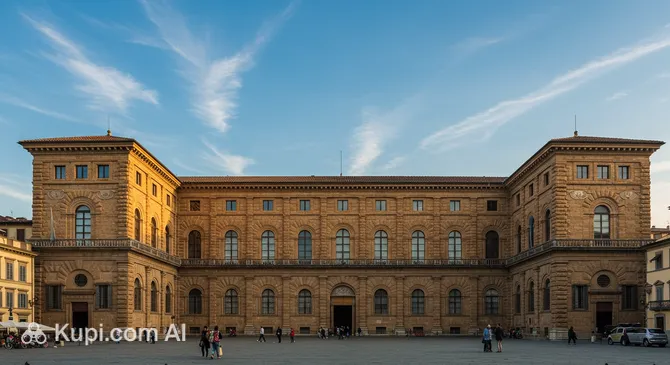
Pitti Palace. Illustration.
Source: Kupi.com AI

Traveler photos:

Today, the Pitti Palace is one of Florence's most important museum centers. Within its walls are several galleries and museums, including the Palatine Gallery with masterpieces by Raphael and Titian, the Gallery of Modern Art, the Silver Museum, and the Costume Museum. A visit to the palace is unthinkable without a walk through the famous Boboli Gardens—a magnificent example of Italian Renaissance landscape art that served as a model for many royal parks in Europe.

Contacts

To plan your visit, check current opening hours, or get more information, you can use the official contact details for the Pitti Palace. All necessary information is available on the website and by phone.

How to contactContact
AddressPiazza de' Pitti, 1, 50125 Firenze FI, Italy
Phone number+39 055 294883
Websitewww.uffizi.it

What to Do

A visit to the Pitti Palace is a true immersion into the world of high art and luxury. The palace's main treasure is the Palatine Gallery, where masterpieces by great masters are displayed in opulent Baroque interiors. Here, you can get a close look at paintings by Raphael, Titian, Caravaggio, Rubens, and other artists whose works form the golden fund of European painting. The paintings are arranged as they would have been in private aristocratic collections, creating the special atmosphere of a lived-in palace rather than a formal museum.

In addition to the Palatine Gallery, the palace complex offers visitors several other unique museums. In the Royal Apartments, you can see richly furnished rooms where representatives of the Medici, Lorraine, and Savoy dynasties lived. Also located within the Pitti Palace are the Gallery of Modern Art, featuring Italian artists of the 19th and 20th centuries, the Silver Museum with the treasures of the Medici family, the Costume and Fashion Museum, and the Porcelain Museum. This variety of collections allows every visitor to find something of interest, from painting to decorative and applied arts.

An integral part of a visit to the Pitti Palace is a stroll through the famous Boboli Gardens. This magnificent example of Renaissance landscape art became a prototype for many royal parks in Europe, including Versailles. Here, you can spend hours walking among fountains, sculptures, grottoes, and terraces, enjoying the peace and beautiful views of Florence. The Boboli Gardens are the perfect place to take a break from the city bustle and conclude your day dedicated to art and history.

Getting There

Getting to the Pitti Palace is quite easy, as it is located in the heart of Florence, in the picturesque Oltrarno district on the left bank of the Arno River. If you are already exploring the historic center, the best way to reach it is a pleasant walk. From the famous Ponte Vecchio or Piazza della Signoria, the walk will take you only 10–15 minutes. It is a great opportunity to enjoy the atmosphere of Florentine streets on your way to one of the city's main attractions.

For those who prefer public transport or are coming from more distant parts of the city, city buses are an excellent choice. Many routes pass through the center, and you should look for those that go to the Pitti stop or those nearest to it. This is a quick and convenient way to reach the palace while avoiding long walks. Additionally, you can always use a taxi, which will take you right to the entrance of the complex.

Travelers coming by car should be particularly careful. The historic center of Florence is a Limited Traffic Zone (ZTL), and entry for non-residents is strictly regulated and can lead to heavy fines. Therefore, it is highly recommended to leave your car in one of the parking lots outside the central part of the city and continue on foot or by public transport. This approach will not only save you stress and money but also allow you to fully enjoy the beauty of the city without any rush.

Nearest city: Florence

History & Facts

The history of the Pitti Palace begins in 1458, when the ambitious Florentine banker Luca Pitti commissioned its construction. According to one version, he wished to surpass the luxury of the residences of his rivals, the powerful Medici family. For a long time, it was believed that the great Filippo Brunelleschi designed the project, but modern historians lean towards the version that the author was his pupil, Luca Fancelli. The palace was initially characterized by its monumentality and austere, fortress-like appearance, thanks to its massive rusticated masonry and arched windows, which clearly demonstrated the power and influence of its owner.

Ironically, Luca Pitti's descendants were unable to complete the grandiose project due to financial difficulties, and in 1549, the palace was purchased by Eleanor of Toledo, the wife of Cosimo I de' Medici. Thus, the Pitti Palace became the main residence of the ruling Medici dynasty, marking the start of a new chapter in its history. As early as 1558, under the direction of architect Bartolomeo Ammannati, a large-scale reconstruction and expansion of the building began: the famous inner courtyard was created and side wings were added, turning it into an even more majestic complex.

For centuries, the palace served as a home not only for the Medici dukes but also for their successors from the House of Habsburg-Lorraine. In the 19th century, during the brief period when Florence was the capital of a united Italy, it even became the residence of the Italian kings. It wasn't until 1919 that King Victor Emmanuel III transferred the Pitti Palace, along with its rich collections, to state ownership. From that moment, the palace doors opened to the general public, turning the former royal residence into one of the largest and most important museum complexes in the world.

Time Needed

When planning a visit to the Pitti Palace, it is worth allocating enough time to enjoy its treasures without rushing. For a full discovery of the complex's main museums and gardens, it is recommended to set aside at least 3–4 hours. This time is enough to see the main masterpieces of the Palatine Gallery and take a leisurely stroll through the picturesque Boboli Gardens, getting a comprehensive sense of the scale and beauty of this unique place in Florence.

However, if you are a true art or history lover, be prepared to dedicate much more time to this place. Considering that several major museums are located within the palace—from the Gallery of Modern Art to the Costume and Fashion Museum—thoughtfully exploring them could take a whole day. To avoid rushing and to fully immerse yourself in the Renaissance atmosphere, it is better to plan your route through the complex in advance or, if time permits, even split the visit over several days.

Working Hours

The Pitti Palace is open to visitors year-round, making it accessible for a visit in any season. Standard opening hours are Tuesday to Sunday, from 8:15 AM to 6:30 PM. Monday is the official closing day. It is important to remember that on public holidays or during special events, the schedule may change, so it is highly recommended to check current information on the official palace website before your visit.

To avoid long lines, especially during the height of the tourist season, it is wise to purchase tickets in advance online. This will not only save you time but also guarantee entry on your chosen day. Advance booking is particularly relevant if you plan to visit the palace on weekends or on free admission days, when the number of visitors increases significantly.

DayOpening hours
MondayClosed
Tuesday8:15 – 18:30
Wednesday8:15 – 18:30
Thursday8:15 – 18:30
Friday8:15 – 18:30
Saturday8:15 – 18:30
Sunday8:15 – 18:30

Nearby

A visit to the Pitti Palace is just the starting point for exploring the Oltrarno district and all of Florence. Exploring its surroundings allows for a deeper immersion into the city's atmosphere, as many iconic sites are within walking distance. Such walks enrich the experience, turning a visit to a single museum into an exciting journey through streets where history was made.

Thanks to the compactness of Florence's historic center, it is easy to reach other architectural and artistic masterpieces from the Pitti Palace. Just a few minutes of leisurely walking will bring you to the famous bridge, the halls of a world-renowned gallery, or a lively square. Below is a list of interesting places located very close by.

NameDistance
Ponte Vecchio0.4 km
Uffizi Gallery0.5 km
Loggia dei Lanzi0.6 km
Rooster Cafe Firenze0.6 km
The Old Stove Irish Pub0.6 km
Palazzo Vecchio0.7 km
Piazza della Signoria0.7 km

Have you reached the end of the page?

So the route has been studied inside and out