Support

Uffizi Gallery

About

The Uffizi Gallery is one of the world's most famous and significant art museums, located in the heart of Florence, the cultural capital of Italy. It is a true treasure house, home to the greatest collection of Italian paintings, attracting millions of art lovers from around the globe every year. The Uffizi is considered the most visited museum in the country, and for good reason.

The core of the exhibition consists of masterpieces by Italian masters from the 13th to 18th centuries, making the gallery the premier place to experience Renaissance art. Here you can see firsthand the works of geniuses like Sandro Botticelli, Leonardo da Vinci, Michelangelo, Raphael, and Caravaggio. Many rooms are dedicated to the work of individual artists, allowing for a deep dive into their worlds.
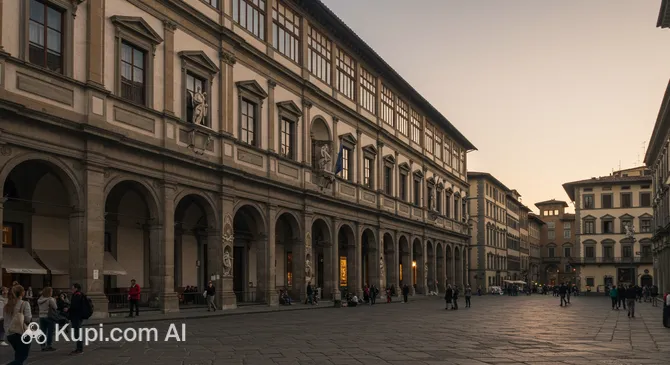
Uffizi Gallery. Illustration.
Source: Kupi.com AI

Traveler photos:

The history of the building itself is also fascinating. The name "Uffizi" translates from Italian as "offices," as it was originally built in the 16th century by order of Cosimo I de' Medici to house the city's administrative and judicial offices. The architectural complex, designed by Giorgio Vasari, consists of two long wings connected by an elegant arch, forming a narrow and picturesque street that opens onto the Arno River. As early as 1581, part of the building was converted into an exhibition space for the Medici family collection, marking the beginning of one of the oldest museums in the world.

Contacts

To plan your visit, check current opening hours, or book tickets, it is best to use the official contact details for the Uffizi Gallery. All the essential visitor information is gathered below.

How to contactContact
AddressPiazzale degli Uffizi, 6, 50122 Firenze FI, Italy
Phone number+39 055 294883
Websitewww.uffizi.it

What to Do

A visit to the Uffizi Gallery is, above all, an immersion into the world of fine art. The main activity for visitors is exploring the priceless collection of Renaissance masterpieces. In the museum's halls, you can see legendary paintings such as Sandro Botticelli's "The Birth of Venus" and "Primavera", which have become symbols of the Italian Renaissance. Additionally, works by Leonardo da Vinci are on display, including his early masterpieces "The Annunciation" and "The Adoration of the Magi," along with works by Michelangelo, Raphael, Titian, and Caravaggio. Each room represents a distinct chapter in art history, allowing you to enjoy the creations of the great masters who shaped the history of Western European art.

Walking through the gallery allows you not just to see individual paintings, but to trace the entire evolution of Italian painting over several centuries. The exhibition is arranged chronologically, starting with 13th-century masters like Giotto and Cimabue and ending with High Renaissance and Baroque artists. Visitors can clearly see how artistic styles, techniques, and subjects changed from room to room. This is a unique opportunity to immerse yourself in the era's cultural context and understand how art developed during one of history's most significant periods.

Special attention should be paid to the rooms dedicated to the Florentine school of painting. This is where the spirit of the Renaissance is most fully revealed. The collection, originally formed by the powerful Medici dynasty, reflects their passion for art and the humanist values of the era. Besides painting, the gallery also features ancient sculptures that inspired Renaissance artists. Walking through the long corridors designed by Vasari, with views of the Arno River and the Ponte Vecchio, is an unforgettable experience in itself, capturing the atmosphere of historical Florence.

Getting There

Getting to the Uffizi Gallery is quite simple, as it is located in the heart of Florence's historic center on Piazzale degli Uffizi, just a few steps from the famous Piazza della Signoria and the Ponte Vecchio. Given this central location, the most pleasant and convenient way to visit the gallery is on foot. If you arrive at the city's main railway station, Santa Maria Novella (SMN), the walk to the museum will take about 15–20 minutes. The route winds through picturesque streets past major landmarks such as the Duomo, turning the walk into an engaging mini-tour.

For those who prefer public transport or are staying further from the center, there are convenient bus routes. Small city buses, including lines C1, C2, C3, and C4, run through the center and stop near the gallery. One of the closest stops is Diaz, located just a couple of minutes' walk from the museum entrance. This is a great option to save your energy for the long walk through the Uffizi's halls. You can also arrive by tram: line T2 connects Florence Airport to Santa Maria Novella station, from which it's an easy walk to the gallery.

If you plan to take a taxi, the ride from Santa Maria Novella station will take about 10 minutes. However, keep in mind that Florence's historic center is a restricted traffic zone known as Zona a Traffico Limitato (ZTL). Entry for private cars is mostly prohibited, so driving your own or a rental car is not recommended. It's better to leave your vehicle in one of the parking lots outside the ZTL, such as near the station or at Porta al Prato, and continue on foot or by public transport.

Nearest city: Florence

History & Facts

The history of the Uffizi Gallery begins in 1560, when the Grand Duke of Tuscany, Cosimo I de' Medici, commissioned his court architect Giorgio Vasari to design and build a grand building. Interestingly, the original purpose was purely practical: it was intended to house the main administrative and judicial offices of Florence, which is why the complex was named "Uffizi," translated from Italian as "offices" (uffizi). Construction spanned two decades and was completed only in 1581, after the deaths of both the patron, Cosimo I, and the architect, Giorgio Vasari.

Though the building was intended for city services like the magistrate and archives, its fate changed thanks to the Medici family's passion for art. Cosimo's son, Francesco I de' Medici, decided to use the top floor of the east wing to house the family's priceless art collection. By 1581, immediately after construction ended, these halls were transformed into an exhibition space accessible to select guests, marking the beginning of one of the oldest museums in the modern sense. Thus, an administrative building began its transformation into a treasury of world art.

The gallery's creation coincided with the High Renaissance—a period when Italy and Florence in particular were the centers of European cultural life. It was in Florence that the ancient term "museum" (house of the muses) was revived to describe Lorenzo the Magnificent's sculpture collection. But perhaps the most important fact in the Uffizi's history involves the last member of the dynasty. In 1743, Anna Maria Luisa de' Medici signed the "Family Pact," bequeathing all the family's artistic treasures to the city of Florence on one condition: they must never leave its borders. Thanks to this wise decision, these priceless masterpieces have forever remained the property of the city and the world.

Time Needed

When planning a visit to the Uffizi Gallery, it is important to allocate your time correctly to fully enjoy its treasures. A quick tour of the main masterpieces, such as the works of Botticelli, Leonardo da Vinci, and Michelangelo, will take at least 2–3 hours. This is enough time to walk through the most famous halls on the second floor and get a general sense of the collection's grandeur. This express format is suitable for those short on time who don't want to miss the essentials.

However, to truly immerse yourself in the Renaissance atmosphere and study not only the main highlights but also the lesser-known yet equally valuable works, we recommend setting aside about 4 hours or even half a day. Such a leisurely pace allows you to examine the details of the paintings more closely, trace the evolution of Italian art from room to room, and perhaps take a break at the terrace cafe with a view of the city. Remember that the Uffizi is a massive museum, and trying to see everything in a short time can be quite exhausting.

Working Hours

The Uffizi Gallery is open to visitors year-round but follows a specific schedule. Standard opening hours are Tuesday to Sunday from 8:15 AM to 6:30 PM. It is important to remember that Monday is a closing day. The ticket offices close earlier, and the last entry to the museum is at 5:30 PM, so it's best not to delay your visit until the very end of the day. While the schedule is stable, it's always recommended to check current information on the gallery's official website before visiting, especially during public holidays when changes may occur.

Given the museum's immense popularity, it is highly recommended to book your tickets online in advance. This will help you avoid the multi-hour queues that are common at the entrance, particularly during peak tourist season. Buying a timed ticket guarantees entry without unnecessary waiting or stress, allowing you to spend all the saved time enjoying the artistic masterpieces. For those wishing to avoid crowds inside, the best time to visit is early morning right after opening or later in the afternoon, after 4:00 PM.

DayOpening hours
MondayClosed
Tuesday8:15 – 18:30
Wednesday8:15 – 18:30
Thursday8:15 – 18:30
Friday8:15 – 18:30
Saturday8:15 – 18:30
Sunday8:15 – 18:30

Nearby

Visiting the Uffizi Gallery is an immersion into the heart of Renaissance art, but you shouldn't stop at its halls. Florence is an open-air museum, and the gallery's surroundings are just as filled with history and beauty as its famous paintings. A stroll through the adjacent streets and squares allows you to fully experience the atmosphere of the city that gave the world its greatest geniuses.

Just steps from the Uffizi are other iconic sites that form a single architectural and cultural ensemble. Exploring these landmarks will enrich your journey, adding new strokes to the portrait of Italy's magnificent capital. Below is a list of interesting sites located in the immediate vicinity of the gallery.

NameDistance
Palazzo Vecchio0.2 km
Loggia dei Lanzi0.2 km
Ponte Vecchio0.2 km
Piazza della Signoria0.2 km
Rooster Cafe Firenze0.3 km
The Old Stove Irish Pub0.3 km
I' Girone De' Ghiotti0.3 km

Have you reached the end of the page?

So the route has been studied inside and out