Support

Porta Romana

About

Porta Romana, or the Roman Gate, is an impressive monument of medieval architecture located in the southern part of Florence, one of Italy's most enchanting cities. This monumental city gate once served as an essential part of the ancient defensive walls that protected the city and is now a significant historical site.
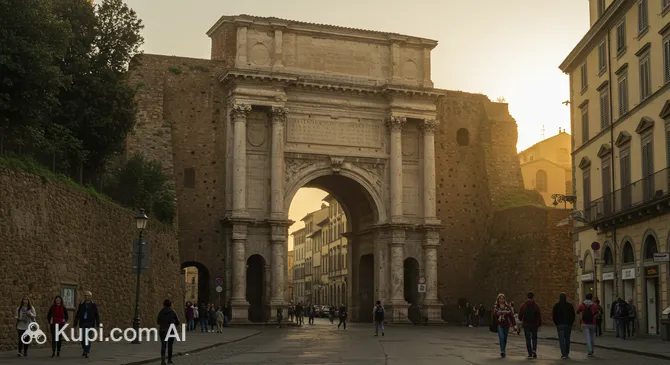
Porta Romana. Illustration.
Source: Kupi.com AI

Traveler photos:

Built in the 14th century, Porta Romana is more than just a passage in a wall; it is a true testament to the rich history of Florence. It stands as a prime example of defensive architecture from that era and still impresses with its power and preservation. A walk to this gate is an opportunity to touch the past and imagine how life bustled at the city's southern borders centuries ago.

A special feature of Porta Romana is that it is considered the southernmost of all the gates of medieval Florence. Its name is no coincidence: it was from here that the road leading south to Siena and on to Rome began. What is particularly remarkable is that the gate still retains its original massive oak doors, making it an even more valuable historical artifact and a must-visit for anyone interested in the heritage of this great city.

Contacts

Porta Romana is a public historical site that does not require specific contact information for visiting. The gate is located in the southern part of Florence; for information on routes or tours, please refer to the city's tourism portals or local visitor centers.

How to contactContact
AddressPiazzale di Porta Romana, 50125 Firenze FI, Italy
Websitewww.feelflorence.it

What to Do

Visiting Porta Romana is, first and foremost, an opportunity to immerse yourself in the atmosphere of medieval Florence. Explore the ancient fortifications, which have been well-preserved to this day, and imagine how life hummed around these gates centuries ago. Pay special attention to the inner side of the gate (to the left when coming from the city): there you will find a unique marble plaque with an inscription in Vulgar Latin dated 1327. This is a rare chance to touch authentic details of the past and feel the breath of history.

Passing through Porta Romana, you will find yourself in close proximity to the famous Boboli Gardens—the perfect place for a leisurely walk among greenery, fountains, and sculptures. Additionally, the area around the gate offers pleasant gastronomic experiences: here you can relax in a cozy cafe, enjoy local Tuscan cuisine in traditional restaurants, or try some real artisanal gelato, which is so popular in Italy.

Porta Romana is not only a historical monument but also an important transport hub, making it a convenient starting point for further exploration of Florence. Scenic routes leading to other iconic city landmarks begin here. For instance, you can take a walk to the famous Piazzale Michelangelo, which offers breathtaking panoramic views of all of Florence, especially beautiful at sunset.

Getting There

Porta Romana is located in the southern part of the historic center of Florence, making it easily accessible for travelers. If you are already exploring the central areas of the city, the most pleasant way to reach the gate is on foot. The route to Porta Romana can be a fascinating journey in itself through narrow Florentine streets, allowing you to enjoy the city's architecture and atmosphere.

Thanks to its strategic location at the junction of Via Romana and Via dei Serragli, on Piazza della Calza, Porta Romana is an important transport hub. This means the gate is easy to reach by public transport. Numerous city buses stop nearby, so you can easily find a suitable route from anywhere in Florence. Check the latest bus line numbers at a local tourist information center or using online maps.

If you prefer comfort, you can also reach Porta Romana by taxi. A trip from central Florence, such as from Santa Maria Novella station or the Duomo, won't take much time, though keep in mind there may be traffic restrictions in the historic center (ZTL zone). Regardless, due to its significance, the gate is well-known to all taxi drivers.

Additionally, Porta Romana serves as a convenient starting point for further exploration of Florence's sights. After passing through the gate, you will find yourself in close proximity to the famous Boboli Gardens. Scenic routes to other iconic spots, such as Piazzale Michelangelo with its magnificent views of the city, also begin here.

Nearest city: Florence

History & Facts

The construction of Porta Romana began in the 14th century, specifically between 1328 and 1331, although some historical sources point to 1326 as the start date. This majestic gate became an integral part of the sixth ring of defensive walls that encircled Florence for protection between 1285 and 1388. Over the following centuries, these defensive structures were repeatedly reconstructed and updated, adapting to changing times and military technologies.

Throughout its long history, Porta Romana has undergone several significant changes. The most serious transformations occurred during the famous Siege of Florence. To make the gate less vulnerable to the new type of weaponry using gunpowder, it was reinforced and lowered. Despite these necessary modifications, Porta Romana has remarkably preserved its historical value and authenticity. This is clearly evidenced by the original massive oak doors, which have survived through the centuries to the present day as a true relic.

One of the unique details adding to the gate's historical significance is a marble plaque. It is located on the inner side, to the left of the passage, and features an inscription in Vulgar Latin dated 1327. This artifact is a rare witness to the language and script of that era. Today, Porta Romana stands proudly as a monumental reminder of Florence's medieval past, of a time when the city was a mighty fortress, securely protected from external threats by its walls.

Time Needed

Viewing Porta Romana itself usually doesn't take much time. To carefully examine the architecture, take photos, and perhaps find the marble plaque mentioned in historical accounts, 30-60 minutes will likely be enough. This is sufficient time to appreciate the scale of the structure and its historical significance as part of Florence's ancient city fortifications.

However, if you plan a deeper immersion into the atmosphere of this area, your visit may be significantly longer. Porta Romana often serves as a starting point for exploring nearby attractions. For example, if you decide to visit the famous Boboli Gardens located right next door, this will take at least another 2-3 hours or even half a day. You can also spend pleasant time strolling through the neighborhood, popping into local shops, or relaxing at one of the cafes on Piazza della Calza.

Thus, just getting to know Porta Romana as an individual architectural site is a relatively short stop. But if you view the gate as part of a more extensive route through the southern part of Florence, including gardens, viewpoints, or just a leisurely walk, feel free to set aside from a few hours to half a day to fully enjoy the atmosphere of this historic corner of Italy.

Working Hours

Porta Romana in Florence, being a monumental city gate, is a public historical monument. This means you can approach and view it from the outside at any time convenient for you, as it is part of the city landscape. Access to the gate for external viewing is open year-round, and there are no strict "opening hours" like there are for museums or indoor attractions.

Since it is an open architectural site, no advance ticket booking or registration is required for a simple viewing of Porta Romana. However, if you are interested in information about possible guided tours that include this gate, or any special events taking place nearby, it is recommended to check for details on the official tourism websites of Florence or at local information centers. They will be able to provide the most up-to-date information.

Open 24 hours

Nearby

Visiting Porta Romana is just the beginning of a fascinating journey through Florence. Exploring the surroundings of this ancient gate will allow you to dive deeper into the city's rich history and culture, discovering new interesting spots and hidden gems. By extending your route, you can get a more complete picture of the many facets of this wonderful corner of Italy.

Near Porta Romana, there are many other attractions that deserve your attention. From world-famous museums and galleries to charming squares and historic buildings, everyone will find something to their taste. Below is a list of some interesting sites located within walking distance.

NameDistance
Pitti Palace0.8 km
Ponte Vecchio1.2 km
Rooster Cafe Firenze1.3 km
Uffizi Gallery1.3 km
Loggia dei Lanzi1.4 km
The Old Stove Irish Pub1.4 km
Palazzo Vecchio1.5 km

Have you reached the end of the page?

So the route has been studied inside and out