Support

Basilica of Sant'Ambrogio

About

The Basilica of Sant'Ambrogio, or Saint Ambrose, is one of the oldest and most significant churches in Milan, considered second in importance only to the famous Duomo. Founded in the 4th century by Saint Ambrose, the city's patron saint, it is not only a pilgrimage site but also an outstanding monument of history and architecture. The basilica acquired its current appearance in the 11th-12th centuries and today stands as a magnificent example of Lombard Romanesque architecture.

The architectural style of the basilica is unique and recognizable. Its austere brick facade is preceded by a spacious atrium—an inner courtyard with arcades that served as a shelter for pilgrims in the Middle Ages. One of the most striking features is the two bell towers of different heights: the shorter "Bell Tower of the Monks" from the 9th century on the right, and the tall, elegant "Bell Tower of the Canons" on the left, built in the 12th century. This asymmetrical silhouette gives the church a special charm.
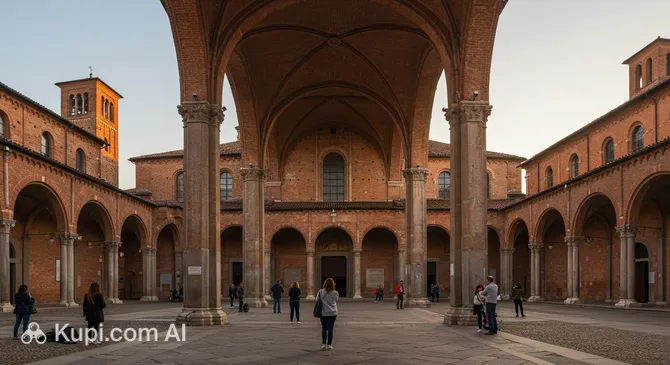
Basilica of Sant'Ambrogio. Illustration.
Source: Kupi.com AI

Traveler photos:

The interior of the basilica is no less impressive. It was one of the first churches in Italy to use massive cross vaults to cover the central nave instead of traditional wooden beams—a major innovation for its time. The relics of Saint Ambrose himself, along with the early Christian martyrs Gervasius and Protasius, rest in the church's crypt. Other treasures include a unique 9th-century golden altar and the San Vittore chapel with its stunning 5th-century mosaics.

A visit to the Basilica of Sant'Ambrogio is a chance to touch the centuries-old history and spiritual life of Milan. It is a place where the austerity of the Romanesque style blends with the grace of early Christian art, creating a unique atmosphere of peace and grandeur.

Contacts

To plan your visit, check service schedules, or get more information about events held at the basilica, it is recommended to use the official contact details. The most up-to-date information is always available on the basilica's website or by phone.

How to contactContact
AddressPiazza Sant'Ambrogio, 15, 20123 Milano MI, Italy
Phone number+39 02 8645 0895
Websitewww.basilicasantambrogio.it

What to Do

A visit to the Basilica of Sant'Ambrogio is a true immersion into art and history. Inside the church, your attention will surely be drawn to the unique column capitals created by Lombard masters in the 11th-12th centuries. Each is decorated with intricate carvings depicting fantastic creatures, animals, and biblical scenes, providing a vivid glimpse into the Romanesque style of medieval architecture. The famous Sarcophagus of Stilicho is also located here—an outstanding example of 4th-century Late Roman art, adorned with skillful carving. Studying these details allows for a deeper understanding of the tastes and traditions of that era.

The San Vittore Chapel, known as "San Vittore in Ciel d’Oro" (Saint Victor in the Golden Sky), deserves special attention. It is a 5th-century architectural monument whose dome is decorated with magnificent gold mosaics. The glow of the mosaic combined with the ancient walls creates an unforgettable impression and transports visitors back to the era of early Christianity. This is one of the most precious and well-preserved parts of the basilica.

The exterior area of the basilica is equally interesting. In front of the church entrance lies a spacious 11th-century atrium—a rectangular courtyard surrounded by a covered gallery. From here, you get the best view of the basilica's asymmetrical facade and its two famous bell towers of different heights. A walk through the atrium allows you to appreciate the monumentality of the architectural design. Additionally, an elegant inner courtyard (cloister), created during the Renaissance according to a design by the great architect Bramante, adjoins the basilica.

Getting There

The Basilica of Sant'Ambrogio is conveniently located in the historic center of Milan, making it easily accessible for tourists. The simplest and fastest way to get here is by metro. You'll need the Sant'Ambrogio station, located on the green line (M2). From the metro exit, it’s just a few minutes' leisurely walk to the basilica's entrance.

Besides the metro, you can reach the basilica via several city bus or tram routes that pass through the city center. Specifically, buses No. 50, 58, and 94 stop nearby. Since Sant'Ambrogio is close to other key attractions like the Milan Cathedral or Sforza Castle, a walk to the basilica can be a pleasant part of your tour, allowing you to enjoy the city's architecture and atmosphere along the way.

Nearest city: Milan

History & Facts

The history of the Basilica of Sant'Ambrogio dates back to the 4th century, when it was founded by Saint Ambrose himself, the bishop and patron saint of Milan. Originally consecrated as the "Basilica of the Martyrs," its structure still reflects the layout of an early Christian church. One of its unique features is the large atrium (inner courtyard), which at the time served as a gathering place for catechumens—people preparing for baptism.

At the end of the 11th century, the basilica was radically rebuilt and acquired its modern Lombard-Romanesque appearance, which has reached us almost unchanged. However, the church's history wasn't without its challenges: after the devastating Verona earthquake of 1117, the vaults of the main nave had to be restored. It was then that rib vaults were used here—one of the earliest examples of this innovative architectural element in Europe, which foreshadowed the Gothic style.

The basilica's historical and architectural richness is highlighted by two different bell towers. The more austere and shorter one, known as the "Bell Tower of the Monks," was built in the 9th century by Benedictine monks. The second, taller and more elegant "Bell Tower of the Canons," appeared in the 12th century and was built by canon priests. These two towers from different eras and styles visually symbolize the long and multi-layered history of this sacred place in Italy.

Time Needed

To fully experience the Basilica of Sant'Ambrogio, it is recommended to set aside approximately 1 to 2 hours. This time is usually enough to leisurely explore the key architectural elements and interior treasures of the church, as well as to soak in its unique historical atmosphere.

The planned time will allow you to take a slow walk through the spacious atrium, examine the asymmetrical facade, and see the two famous bell towers of different heights. Inside the basilica, you'll have time to study the rich decorations, paying attention to artifacts such as the San Vittore chapel with its ancient mosaics and the impressive Sarcophagus of Stilicho. For those who just want a brief overview, 45-60 minutes might suffice, but for a deeper immersion, it's better to aim for an hour and a half to two hours.

Working Hours

The Basilica of Sant'Ambrogio is generally open to visitors year-round, but it is important to distinguish between the church's general opening hours and the time specifically designated for tourist visits. From Monday to Saturday, the basilica is open to tourists from 10:00 to 12:00 and from 14:30 to 18:00. On Sundays and public holidays, the time for sightseeing is reduced and usually runs from 15:00 to 17:00. Entry to the basilica itself is free.

No special ticket booking is required for individual visits. However, as the basilica is an active church, schedules may change due to religious services and holidays. Before your visit, it is strongly recommended to check the latest information on the official website to ensure the church is open to tourists and that your visit does not coincide with a church Mass.

DayOpening hours
Monday9:30 – 12:30, 2:30 – 18:00
Tuesday9:30 – 12:30, 2:30 – 18:00
Wednesday9:30 – 12:30, 2:30 – 18:00
Thursday9:30 – 12:30, 2:30 – 18:00
Friday9:30 – 12:30, 2:30 – 18:00
Saturday9:30 – 12:30, 2:30 – 18:00
Sunday3:00 – 17:00

Nearby

Visiting the Basilica of Sant'Ambrogio is an excellent starting point for exploring the historic center of Milan. Thanks to its convenient location, many other iconic sites are within walking distance. A stroll through the surrounding area will allow you to dive deeper into the city's rich culture and history, discovering new facets of its architectural and artistic heritage.

Exploring nearby attractions will enrich your experience and help you form a more complete picture of Milan's grandeur. Just a few minutes' walk away, you'll find world-famous museums, churches, and squares, each telling its own unique story. Below is a list of interesting places located near the basilica.

NameDistance
Leonardo da Vinci Museum of Science and Technology0.4 km
The Last Supper0.6 km
Sforza Castle0.9 km
Piazza della Scala1.2 km
Royal Palace of Milan1.2 km
Gloria Osteria1.2 km
Galleria Vittorio Emanuele II1.2 km

Have you reached the end of the page?

So the route has been studied inside and out