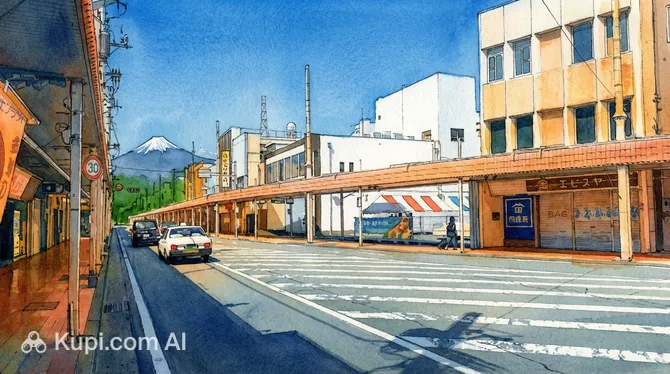
Honcho is a cozy and quiet residential area located in the Nakano ward of the Tokyo metropolis. Unlike the bustling tourist centers of Japan, a peaceful everyday atmosphere prevails here, allowing visitors to see the life of ordinary citizens from the inside. The district is a typical "commuter town" with dense housing and well-developed local infrastructure.
Honcho. Illustration.
Source: Kupi.com AI
Geographically, Honcho occupies a favorable position, providing quick access to the capital's main hubs. While official statistics sometimes combine data, the population of this specific residential sector is approximately 29,587 people. You can learn more about how this area's appearance was formed by studying the historical heritage of the district.
For tourists, Honcho is primarily attractive for its authentic tranquility and proximity to Nakano's famous shopping streets. It is an excellent place for those who want to take a break from the neon lights of the center while remaining just a 20-minute ride from Shinjuku. We invite you to stroll through its narrow streets to feel the true rhythm of Tokyo life.
Weather Overview
The climate and weather in Honcho are determined by its location in the heart of the Tokyo metropolitan region. Typical of this part of the country, the temperate monsoon character of the weather brings hot and humid summers, as well as cool but mostly dry winters. August is considered the hottest period, when temperatures can rise above +30°C, and humidity makes the air feel particularly heavy.
In winter, especially in January, average daytime figures are around +5...+10°C, while at night the thermometer can drop to 0°C. Precipitation is distributed unevenly throughout the year: the peak of rain falls in the summer months and early autumn, while winter enjoys clear skies and rare snowfalls. Expect a warm summer with occasional typhoons in September and sunny, invigorating winter days.
Average monthly temperature
Average monthly precipitation
Interesting Facts
Geographical Precision: The Honcho district in Nakano is located exactly at coordinates 35°41′46″ North latitude and 139°40′19″ East longitude.
Postal Identification: A unique postal code, 164-0012, is assigned to this territory and is used for all correspondence within the district.
Administrative Status: Despite its distinct character, Honcho is part of Nakano, which is considered one of Tokyo's most densely populated and creative wards.
Time Zone: Time in the district follows the UTC+9 standard (Japan Standard Time), and seasonal daylight saving time is not practiced here.
Demographic Profile: As of October 2020, the district's population was approximately 29,587 people, making its density typical for Tokyo's outskirts.
How to Get There
The Honcho district in Japan boasts excellent transport accessibility, which is characteristic of most Tokyo residential areas. Travelers will find it useful to learn about the ways to get there to save time when planning their route. The main connection to the city center is provided via railways and the subway.
The nearest transport hubs are Nakano and Kami-Shakujii stations on the Seibu Shinjuku Line. If you are coming from the central Shinjuku area, a trip on the JR Chuo Line train will take no more than 15–20 minutes. The journey from Narita Airport to central Tokyo Station by express train takes about an hour and a half, after which a transfer to a local line to Honcho is required.
Station
Passenger traffic
Distance
Nakano Station
16
1 km
Shin-Ōkubo Station
16
3 km
Yoyogi-Uehara Station
16
3 km
Yoyogi Station
18
3 km
Takadanobaba Station
16
3 km
For those who prefer a car, a trip from central Tokyo takes between 20 to 40 minutes; however, during peak hours (7:00 to 9:00 AM and 5:00 to 7:00 PM), heavy traffic in Nakano can significantly increase travel time. Bus services are also well-developed, but they are more dependent on traffic conditions than high-speed trains.
Main Attractions
While Honcho is considered a primarily residential area without world-famous architectural masterpieces, its charm lies in the details of everyday Japanese life. One local feature is Honcho 3-chome 1st Nakayoshi Square — a small public square where locals relax. It’s a great place to slow down for a moment and observe the leisurely pace of Tokyoites.
The famous Nakano Broadway is located in the immediate vicinity of the district. This iconic spot for fans of anime, manga, and collectible figurines attracts tourists from all over the world. You can reach it on foot or by subway from Honcho in just 10–15 minutes, making the district a convenient base for fans of Japanese pop culture.
For those who appreciate quiet walks, the narrow streets of residential blocks from 1-chome to 6-chome will be of interest. Here, you can see typical Tokyo architecture with houses pressed tightly together, tiny front gardens, and small Shinto shrines hidden between buildings. Such a walk allows you to feel the true scale and layout of the vast metropolis.
Local Cuisine
The gastronomic scene in Honcho reflects the everyday tastes of Tokyo residents. There are no pretentious Michelin-starred restaurants here, but cozy family cafes and noodle shops are found at every turn. The diet is based on classic dishes: rich ramen, thin soba noodles, and hot udon, with portions averaging 800–1,200 yen.
Local residents often grab a bite at konbini (24-hour convenience stores) like 7-Eleven or Lawson, where you can always buy fresh onigiri and ready-made bento sets. In the evening, small izakayas and teppanyaki establishments open their doors, where you can enjoy snacks and a glass of cold Asahi beer or local craft beer in a relaxed atmosphere.
While there are no drinks specific to just this district, ubiquitous vending machines offer a huge selection of hot and cold tea, as well as coffee. For those looking for more refined flavors, such as Japanese okonomiyaki or Taiwanese cuisine, it's worth taking a stroll toward central Nakano, where the choice of restaurants is significantly wider.
Travel Tips
A trip to Honcho will be a pleasant and comfortable experience for you if you take into account a few practical nuances of life in this typical Japanese neighborhood in advance.
Clothing and Essentials: Summer in Tokyo is very humid and hot, so choose clothes made of natural, breathable fabrics. In winter, a light jacket is enough. Be sure to bring comfortable shoes, as you will have to walk a lot, and an adapter for flat Type A sockets.
Transport: The most convenient way to get around is by subway and trains. Buy a Suica or Pasmo card immediately upon arrival at the airport — this will save you a lot of time.
Finance: Although cards are increasingly accepted, cash yen are still necessary in small cafes and shops. It is best to withdraw money from ATMs in 7-Eleven stores — they are open 24/7 and accept international cards.
Health and Safety: Honcho is an extremely safe area. Pharmacies can be found by signs with the character 薬 (kusuri). Emergency services work promptly, and the level of street crime is minimal.
Communication: English is not very common among the older generation of locals, so download an offline translator. A few phrases like "Arigato" (thank you) will elicit a sincere smile.
Local Etiquette: In Japan, it is not customary to tip — it may even be offensive. Also, try not to talk loudly on the phone in public transport.
What to Avoid: Strictly follow waste sorting rules if you are staying in an apartment. Mistakes in waste categories are a serious violation of local order.
Additional Tip: Try using a luggage delivery service (Takkyubin) from the airport to your hotel to avoid traveling with suitcases on crowded subways.
Following these simple rules will help you feel at home in Honcho and enjoy the true hospitality of the Land of the Rising Sun.
Entertainment & Nightlife
Nightlife in Honcho is virtually non-existent, as it is a quiet residential area where peace and quiet are valued. In the evening, the streets empty out quite early, and most local establishments close before midnight. You won't find noisy nightclubs or karaoke halls here, which makes the area ideal for those who prefer a restful sleep after a busy day.
If you're looking for vibrant entertainment, it's best to head to the neighboring Nakano district or Shinjuku Station, which is just a 20-minute ride away. A huge number of bars, izakayas, and nightclubs are concentrated there. You can get back to Honcho at night by taxi; however, keep in mind that night rates are significantly higher.
Daytime entertainment in the area is limited to visiting local parks and small game centers in the shopping quarters. For more serious cultural leisure — such as theaters or major exhibitions — residents usually travel to central Tokyo districts like Shibuya or Roppongi, which are easily accessible via the subway.
Parks & Museums
In Honcho itself, there are no large museums or galleries, as the district's territory is densely built up with residential houses. Cultural life here is concentrated in small details, and for large-scale exhibitions, residents usually head to central parts of Tokyo. Nevertheless, the peace and quiet of the local streets themselves create the atmosphere of an open-air museum showcasing modern Japanese architecture.
The district's green zones are represented by small squares such as Nakayoshi Square. These are intimate spaces with playgrounds and benches that serve as a resting place for families with children. The landscaping here is typical of Tokyo residential areas — compact but very neat and well-maintained, allowing you to feel the change of seasons even amidst dense urban development.
For a full outdoor experience, it’s worth walking about 10–15 minutes to Nakano Central Park. This is a spacious modern park with large open lawns where local festivals and picnics are often held. If you are interested in history, a trip to the Tokyo National Museum takes about half an hour by public transport.
Getting Around
The public transport system in Honcho is a model of efficiency and punctuality. The district is served by several key lines at once: Seibu Shinjuku, JR Chuo, and the Toei Oedo subway line. Stations are located so that they can be reached from any point in the district in 5–10 minutes, making travel around the metropolis as comfortable as possible.
For fare payment, it is best for tourists to get Suica or Pasmo cards. These rechargeable cards work on all types of transport, including buses and even some taxis, eliminating the need to buy paper tickets every time. Fares depend on the distance, but on average, a single trip within the central districts costs between 170 and 300 yen.
It is worth considering that during the morning and evening rush hours, trains can be very crowded, and delays due to heavy passenger traffic sometimes reach up to 10 minutes. As an alternative for short trips within the district, bike-sharing systems like Hello Cycling are popular. A bicycle is a great way to explore Honcho during the day when the streets are free from hustle and bustle.
Accommodation
Accommodation options directly in Honcho are limited, as the district is geared toward long-term housing for local residents. Large hotel chains are rare here, but there is a wide selection of apartments and "mansions" (condominiums) often rented out through online services. This is an excellent option for those planning to spend a week or more in Tokyo who want to feel like part of the local community.
For short stays, tourists often choose the neighboring Nakano neighborhoods, where modern mid-range business hotels are located. These hotels offer compact but functional rooms with all amenities, including Wi-Fi and breakfast. The average cost of renting a full apartment in this area can vary from 80,000 to 150,000 yen per month, depending on size and proximity to the subway.
We recommend booking accommodation in advance, especially during the cherry blossom season or autumn festivals, when the influx of tourists to the capital increases. If you're looking for a more traditional experience, small guesthouses can be found in the vicinity, offering more affordable prices and the chance to meet other travelers.
Nearby Cities
The Honcho area serves as an excellent starting point for exploring the surroundings and the most iconic places in Japan. Thanks to the developed railway network, you can easily reach the capital's main cultural and business centers in just a few minutes.
Just a couple of kilometers away is the bustling Nakano, famous for its shopping and anime culture. If you go a little further, you will find yourself in Shinjuku — a district of skyscrapers and endless entertainment. Also within quick reach are legendary Shibuya with its famous crossing and cozy Suginami.
Don't miss the chance to visit the center of Tokyo itself to see imperial palaces and modern museums. Each of these destinations offers a unique look at Japanese culture and architecture, making your stay in Honcho rich and diverse.
Shopping & Souvenirs
Shopping in Honcho is primarily everyday and practical. You won't find huge shopping malls with high-fashion boutiques here, but the network of supermarkets and local shops is well-developed. Residents of the district most often shop at AEON and Life chain stores, where everything you need — from fresh produce to household goods — is available.
If you're looking for unusual items or souvenirs, it's worth paying attention to Sun Mall and Nakano Broadway, located in the neighboring quarter. There, you can find unique vintage clothing, rare manga editions, and souvenirs that are hard to find in other parts of Tokyo. A walk to these shopping areas takes no more than 10 minutes.
Shops in the area usually operate from 10:00 AM to 9:00 PM, and 24-hour konbini are available at any time of day. Most large outlets accept international cards; however, cash yen are still common in small family shops. The Tax-Free system is usually only available in large department stores in neighboring Nakano.