Support

Ishikawa-mon Gate

About

Imagine a massive portal to the past that greets you at the border of austere fortress architecture and refined garden art. Ishikawa-mon Gate is one of the few surviving original structures of the famous Kanazawa Castle in the city of Kanazawa. Erected in 1788, it proudly holds the status of an Important Cultural Property of Japan.
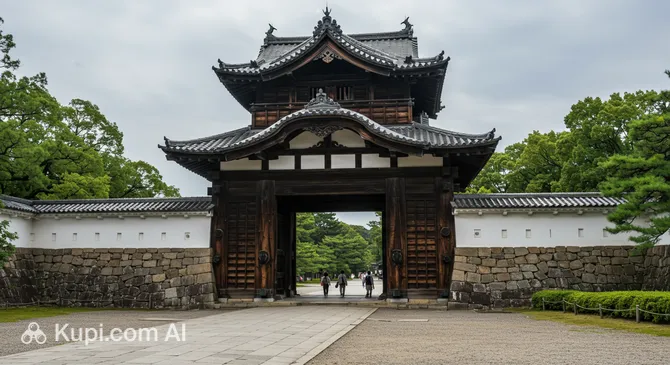
Ishikawa-mon Gate
Ishikawa-mon Gate. Иллюстрация. Источник: Kupi.com AI

This historical structure serves as the main entrance to the castle park and leads straight to Kenroku-en—a garden ranked among the three most beautiful landscape parks in the country. The architecture of the gate is a classic example of the Edo period style: powerful wooden beams, a heavy tiled roof, and ingenious defensive mechanisms designed to protect the residence of the influential Maeda clan.

One of the most amazing features of the site is the stonework surrounding it. Here you can see a unique mosaic technique of fitting stones, performed so skillfully that it is impossible to insert even a thin blade between the huge boulders. Today, the gate is perceived not just as a fortification element, but as a majestic symbol of the region's longevity and prosperity.

Contacts

To clarify current information regarding events or visiting rules, you can contact the Kanazawa Castle Park administration. Official resources will help you plan your route in advance and learn about any temporary exhibitions inside the historical buildings.

Below are the main contact details for communication and navigation:

How to contactContact
Address1-1 Marunouchi, Kanazawa, Ishikawa 920-0937, Japan
Phone+81 76-234-3800
Websitewww.pref.ishikawa.jp

What to Do

When visiting the gate, be sure to take time to study its complex construction. Pay attention to the defense mechanisms and the massive wooden gates: in the samurai era, they were an impregnable barrier. This is a great place for photography—the gates look especially impressive from an angle where the expanses of the castle park or the view of the bridge leading to the Kenroku-en Garden open up behind them.

Continue your route with a walk along the fortress walls. You will see a unique variety of stonework created by masters of different eras. It is recommended to look into the neighboring reconstructed towers—Hishi-yagura and Tsuzuki-yagura. Inside these structures, as well as in the long Gojukken-nagaya storehouse, you can see stunning examples of Japanese carpentry, where huge cedar beams are joined without a single nail.

If you happen to be here in the spring, the area around turns into a pink cloud of blooming sakura, and in the fall, the park is painted in the flaming shades of momiji maples. Don't forget to climb to the park's heights, which offer panoramic views of the city of Kanazawa and the distant mountains. To complete the experience, it's worth combining your visit with a tour of the free exhibitions in the Hashizume-mon Gate dedicated to the history of the restoration of this grand complex.

Getting There

Getting to this historical site in Kanazawa is quite simple. The site is located at 1-1 Marunouchi, Kanazawa, right in the heart of the city, in close proximity to the famous Kenroku-en Garden. If you are already walking around the center, the path from the colorful Higashi Chaya district or the Nagamachi samurai quarter will take only 10–15 minutes at a pleasant pace.

Regular buses run from the city's main station (routes to Kenroku-en or Kanazawa Castle Park), which will get you to your destination in about 15–20 minutes. Travelers arriving from Tokyo by Shinkansen high-speed train (the journey takes about 2.5 hours) can take a taxi from the station—it's the fastest way to reach the gates in just 5–7 minutes.

For those who prefer to travel by rental car, there are parking zones in the vicinity of the park. Coordinates for navigation: 36.5653558, 136.6613462. A visit to the gate fits perfectly into a circular route through the Omicho Market and Kenroku-en Garden.

Ближайший город: Kanazawa

History & Facts

The history of this majestic structure is inextricably linked with the fate of Kanazawa Castle, erected at the end of the 16th century. Originally, a fortified monastery called Oyama Gobo stood on this site, serving as a stronghold for the Ikko-ikki rebel movement until it was destroyed by the troops of the legendary Oda Nobunaga. In 1583, the castle became the main residence of the powerful Maeda clan, who ruled these lands for thirteen generations.

The Ishikawa-mon Gate as we see it today dates back to approximately 1788. Over the centuries, the castle has endured many disasters: devastating fires in 1602, 1631, 1759, and 1881 almost completely destroyed the main buildings, including the main keep. However, the Ishikawa-mon Gate, together with the Sanjukken-nagaya storehouse, miraculously survived the last major fire, becoming an invaluable witness to the Edo period.

During the construction of the gate and adjacent walls, the most sophisticated fortification techniques of the time were used. It is believed that the Christian feudal lord Ukon Takayama participated in the design of the fortifications, bringing some elements of European fortification to Japanese architecture. Today, the gate has the status of an Important Cultural Property of Japan.

The modern appearance of the castle complex is the result of a large-scale reconstruction that began in the 1990s. Craftsmen restored towers and additional gates, such as Hashizume-mon and Kahoku-mon, using exclusively traditional woodworking methods without the use of nails. Currently, it is one of the largest projects to recreate wooden castle structures in the country since the Meiji era.

Time Needed

To simply admire the architecture of the Ishikawa-mon Gate and take beautiful photos against its backdrop, you will need about 30–40 minutes. This is enough time to examine the details of the wooden structures and appreciate the massiveness of the stone masonry of the walls leading to the park.

If you are planning a full walk through the entire territory of Kanazawa Castle, including a visit to the restored Hishi-yagura towers and storehouses, you should budget at least 1.5–2 hours. This will allow you to study the exhibits and climb to the observation decks without rushing.

For those who want to combine a tour of the gate with a walk through the neighboring Kenroku-en Garden, it is better to allocate 3–4 hours or even half a day to this area of the city. This approach will allow you to fully immerse yourself in the atmosphere of "Little Kyoto," unhurriedly moving from the austere castle walls to the graceful landscapes of one of the country's best gardens.

Working Hours

Access to the gate area is in accordance with the Kanazawa Castle Park schedule. As a rule, the gates are open to the public daily: from Monday to Thursday, as well as on Saturday and Sunday, they welcome guests from 7:00 to 18:00. On Friday, the opening hours are slightly extended—you can walk here from 6:00 to 19:00.

Please note that entry to the grounds and viewing the Ishikawa-mon Gate from the outside is free. However, if you plan to visit the interior exhibits of the reconstructed towers (yagura) or storehouses, keep in mind that they may close 30–60 minutes earlier than the main park closing time. During the winter period, operating hours may be shortened due to the early sunset.

DayWorking hours
Понедельник7:00 – 18:00
Вторник7:00 – 18:00
Среда7:00 – 6:00
Четверг7:00 – 18:00
Пятница6:00 – 19:00
Суббота7:00 – 18:00
Воскресенье7:00 – 18:00

Nearby

The location in the heart of the historical part of the city makes this place an ideal starting point for further exploration of the region's culture. Just a few minutes' walk away, you will find both quiet samurai estates and lively geisha districts where time seems to have stood still for several centuries.

A walk through the neighborhood will allow you to see not only the ruins of ancient fortifications but also excellently preserved residential houses from the Edo period. Below are the most interesting sites located nearby:

NameDistance
Kanazawa Castle Park0.2 km
Kanazawa Castle0.3 km
Kenrokuen Garden0.4 km
Seisonkaku0.5 km
Ishiura Shrine0.5 km
Ishikawa Prefectural Museum of Art0.6 km
Kanazawa Shrine0.6 km

Reached the end of the page?

That means the route is fully explored