Support

Tokyo Tower

About

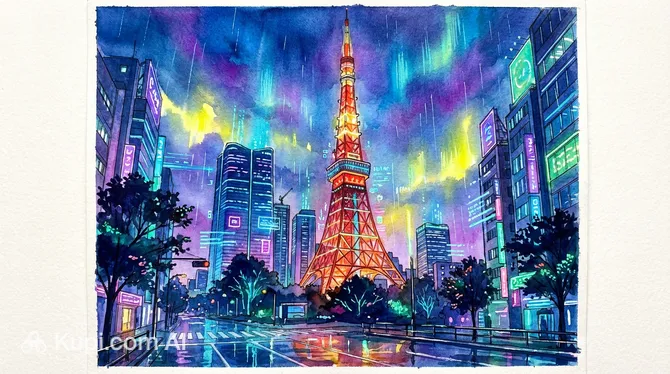
Rising proudly above the skyline of bustling Tokyo is one of Japan's most recognizable symbols—an elegant steel structure painted in vibrant orange and white. Tokyo Tower, built in 1958, stands 333 meters tall, making it slightly taller than the famous Eiffel Tower, which served as its architectural inspiration.

Tokyo Tower
Tokyo Tower. Иллюстрация. Источник: Kupi.com AI

This iconic broadcasting tower is not just an engineering feat; it is also an embodiment of the country's economic triumph in the post-war years. Thanks to its lattice design weighing 4,000 tons, it looks remarkably light and fits harmoniously into the Minato district. The tower was designed with an enormous margin of safety, allowing it to withstand major typhoons and earthquakes.

Today, Tokyo Tower remains a major tourist attraction, drawing millions of people with its observation decks and magnificent night lighting. In 2013, it was deservedly granted the status of a Tangible Cultural Property of Japan, and it continues to delight visitors with breathtaking views of Mount Fuji and modern skyscrapers.

Contacts

If you are planning a visit to Tokyo Tower, you may find the following reference information useful. For details regarding special events or ticket bookings, we recommend using the official communication channels.

How to contactContact
Address4-chōme-2-8 Shibakōen, Minato City, Tokyo 105-0011, Japan
Phone+81 3-3433-5111
Websitewww.tokyotower.co.jp

What to Do

The highlight of visiting Tokyo Tower is ascending to its observation levels. The Main Deck, located at 150 meters, offers a 360-degree panorama of the city, while the renovated Top Deck at 250 meters allows you to literally soar above the metropolis. On a clear day, you can even spot the snow-capped peak of the sacred Mount Fuji from here.

Inside the tower, visitors will find interactive exhibits detailing its construction, as well as numerous cafes and restaurants where you can dine while enjoying the view. Photography enthusiasts should wait until evening when the famous illumination is switched on—its colors change according to the season and special events, turning the tower into a glowing work of art.

After your descent, be sure to check out the base of the tower, which houses souvenir shops and entertainment zones. A walk through the surrounding Shiba Park is the perfect way to end your visit: here, you can take classic photos of the tower with the ancient Zojo-ji Temple in the foreground, which looks particularly stunning during the cherry blossom season.

Getting There

Finding Tokyo Tower is easy, as it is located in the heart of the city at 4-chōme-2-8 Shibakōen, Minato City, Tokyo. The most convenient way to get here is by subway. The closest station is Akabanebashi (Oedo Line), which is just a 3–5 minute leisurely walk from the tower. You can also use Kamiyacho Station (Hibiya Line) or Onarimon Station (Mita Line), both of which are about a 10-minute walk away.

If you are traveling from the central Tokyo Station area, take the Hibiya Line to Kamiyacho. For travelers arriving from Haneda Airport, it is convenient to take the monorail to Hamamatsucho and then either walk or take the subway for one stop. For those who prefer a taxi or a rental car, there is parking available near the tower, though it is worth keeping in mind the heavy traffic in Tokyo.

Ближайший город: Tokyo

History & Facts

Construction of Tokyo Tower began in June 1957 and became a true symbol of Japan's post-war rebirth. The project was completed in record time—just a year and a half. The official opening took place on December 23, 1958. Interestingly, about 30% of the steel used in the construction was sourced from recycled American tanks left over from the post-war era.

The architect, Tachu Naito, drew inspiration from the famous Eiffel Tower while aiming to surpass it. Ultimately, the Tokyo structure ended up 3 meters taller than its Parisian prototype (at 333 meters) but significantly lighter thanks to advanced steel engineering. All the complex mathematical calculations were performed by hand without the use of computers, highlighting the engineering mastery of the time.

For a long time, the tower served as the primary hub for television and radio broadcasting in the Kanto region. Although its main broadcasting functions were transferred to the taller Tokyo Skytree in 2012, Tokyo Tower has retained its status as a vital cultural landmark. In 2013, it was officially recognized as a Tangible Cultural Property of Japan, remaining a beloved site for both locals and millions of tourists.

Time Needed

For a standard visit to Tokyo Tower, most visitors need between 1.5 and 2.5 hours. This is usually enough time to ascend to the observation decks, take memorable photos of the metropolis, and browse the souvenir shops.

If you decide to round off your visit with lunch at one of the tower's restaurants or wish to take a leisurely stroll through the adjacent Shiba Park, you should plan for about 3–4 hours. Keep in mind that during the evening or on holidays, queues for the elevators may increase your total visit time.

Working Hours

Tokyo Tower is open to visitors every day, including weekends and public holidays. Operating hours are from 9:00 AM to 11:00 PM. This allows tourists to see the city both in daylight and in the glow of nighttime lights.

Please note that the final ascent to the observation decks takes place 30 minutes before closing. If you plan to visit the Top Deck, it is recommended to arrive early, as access may be restricted by time or the number of visitors.

9:00 – 23:00

Nearby

The area around Tokyo Tower offers many interesting spots that allow for a deeper dive into the culture and modern life of the Japanese capital. The juxtaposition of ancient temples and ultra-modern digital museums creates the unique contrast for which Tokyo is so well-loved.

A walk through the neighborhood is an excellent addition to viewing the skyline from the observation decks. You can visit quiet parks, see unique art installations, or relax in elegant bars with views of the city.

NameDistance
teamLab Borderless0.4 km
Nijubashi Bridge2.5 km
Blue Note Tokyo2.6 km
Nezu Museum2.6 km
Tokyo Imperial Palace3 km
Suga Shrine3.6 km
Shibuya Stream Bar3.8 km

Reached the end of the page?

That means the route is fully explored