Support

Tokyo National Museum

About

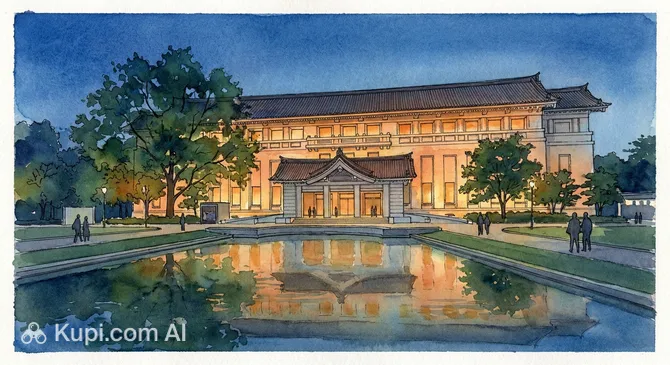
The Tokyo National Museum is not just a collection of artifacts, but a majestic treasury housing the soul of Japan. Founded in 1872, it holds the status of the oldest and largest museum in the country, offering visitors to Tokyo a unique immersion into Eastern culture.
\n
Tokyo National Museum. Illustration.
Source: Kupi.com AI

Traveler photos:

\n

Located on the picturesque grounds of Ueno Park, the museum complex comprises five main buildings. The main building, Honkan, designed in an Art Deco style with traditional Japanese features, houses priceless samurai armor, kimono, and calligraphy masterpieces. Other pavilions, such as Toyokan and Heiseikan, reveal a panorama of Asian art and ancient archaeological finds.

\n

The museum's collection is impressive in its scale, featuring over 120,000 items, including dozens of objects designated as National Treasures. It is a must-visit for anyone wishing to understand the centuries-old history of the East through exquisite ukiyo-e prints, ancient Buddhist statues, and fine ceramics.

Contacts

To ensure your visit to the Tokyo National Museum is as comfortable as possible, we recommend checking for the latest updates on its official resources. The schedule for temporary exhibitions and special events may affect the availability of certain galleries and the time required for your visit.

How to contactContact
Address13-9 Uenokōen, Taito City, Tokyo 110-8712, Japan
Phone+81 50-5541-8600
Websitewww.tnm.jp

What to Do

A stroll through the museum's galleries turns into a fascinating journey through the centuries. In the Honkan building, be sure to see the legendary katana swords and the armor of great warriors, and admire the exquisite works of Hokusai and Hiroshige in the print gallery. If you are interested in the origins of Japanese civilization, don't miss the collection of haniwa clay figures in the archaeology department.

\n

The Gallery of Horyu-ji Treasures deserves special attention, featuring hundreds of 7th-century Buddhist relics that have preserved their grandeur after fifteen hundred years. After exploring the exhibits, you can relax in the quiet Japanese gardens on the museum grounds or stop by the local cafe to try traditional dishes with a modern presentation.

\n

For a deeper immersion, we recommend using an audio guide or attending one of the workshops on ikebana or calligraphy. Remember that admission to the regular exhibitions remains free for children and teenagers under 18, making the museum an excellent destination for a family outing in Tokyo.

Getting There

The museum is located in the heart of the Taito district at 13-9 Uenokōen. The easiest way to get here is by metro or JR trains. The most convenient route is via Ueno Station (Ginza and Hibiya lines) or Ueno Park Station (JR Yamanote Line). From the Park Exit, it is a 5–10 minute leisurely walk along the park's shaded avenues to the main entrance.

\n

If you are traveling from Tokyo Central Station, the trip on the Yamanote loop line takes only about 5 minutes and costs approximately 230 yen. For those who prefer buses, Toei bus routes run regularly from Tokyo Station to Ueno Park, with a travel time of about 20–30 minutes depending on traffic.

\n

For travelers arriving from Narita Airport, the most convenient option is the Keisei Skyliner express, which reaches Keisei Ueno Station in less than an hour. A taxi ride from Haneda Airport takes about 40 minutes. Within Ueno Park itself, numerous signs in English will help you quickly find your way to the museum complex.

Nearest city: Tokyo

History & Facts

The history of the Tokyo National Museum began in the spring of 1872 with a large-scale exhibition at the Yushima Seido Temple. Originally, the exposition was created as a showcase for the country ahead of the World Expo in Vienna, presenting imperial relics, rare animals, and natural wonders to the world. This event laid the foundation for the museum industry throughout Japan.

\n

In 1882, the museum finally settled in Ueno Park. One of the first permanent buildings was designed by British architect Josiah Conder, who brought European scale to the architectural landscape of the Japanese capital. It was during this period, through the efforts of scholars Ernest Fenollosa and Okakura Kakuzo, that the canonical list of Japanese fine art masterpieces began to take shape.

\n

A severe test for the museum was the Great Kanto Earthquake of 1923, which destroyed the historical building. However, by 1938, a new Honkan rose in its place, designed by Jun Watanabe. The building became a benchmark of the Teikan (Imperial Crown) style, in which modern reinforced concrete structures blend harmoniously with traditional tiled roofs and Eastern aesthetics.

Time Needed

Given the immense scale of the Tokyo National Museum, you should allow at least 3–4 hours for a brief look at the main masterpieces in the Honkan and Toyokan buildings. This is enough time to see the key national treasures and get a general impression of the collection.

\n

For true art and history lovers, we recommend dedicating an entire day to the museum. Taking into account temporary exhibitions in the Heiseikan, strolls through the park grounds, and breaks in the cozy cafes, your visit could take 6 to 8 hours. Plan to arrive first thing in the morning to avoid queues and explore every corner of this cultural labyrinth at a relaxed pace.

Working Hours

The Tokyo National Museum is open to visitors from Tuesday to Sunday. According to the standard schedule, the museum operates from 9:30 AM to 5:00 PM; however, on Fridays and Saturdays, hours are extended until 8:00 PM, allowing you to enjoy the art in a more intimate evening atmosphere.

\n

It is important to remember that Monday is the official closing day. Additionally, ticket counters stop selling tickets 20 minutes before closing, and final admission to the galleries is no later than 30 minutes before the museum closes. It is recommended to check the official website before visiting on public holidays, as there may be seasonal changes to the schedule.

DayWorking hours
MondayClosed
Tuesday9:30 – 17:00
Wednesday9:30 – 17:00
Thursday9:30 – 17:00
Friday9:30 – 20:00
Saturday9:30 – 20:00
Sunday9:30 – 17:00

Nearby

Its location in Ueno Park makes the Tokyo National Museum an ideal starting point for a major cultural itinerary. Just a few steps away is the National Museum of Nature and Science, which is especially interesting for families with children thanks to its interactive exhibits and dinosaur skeletons.

\n

Fans of European painting and sculpture should visit the neighboring National Museum of Western Art, whose building was designed by the great Le Corbusier. Exploring the park's surroundings allows you to cover the capital's most significant cultural venues in a single day, creating a complete picture of world heritage in the heart of Japan.

NameDistance
National Museum of Nature and Science0.3 km
The National Museum of Western Art0.4 km
Kaminarimon2 km
Tokyo Imperial Palace4.3 km
Nijubashi Bridge4.8 km
Suga Shrine6.1 km
teamLab Borderless7 km

Reached the end of the page?

That means the route is fully explored