Support

Hassan Tower

About

Hassan Tower is a majestic unfinished minaret that stands as one of the primary symbols of Rabat, the capital of Morocco. This iconic historical structure, rising on the banks of the Bou Regreg river, speaks of the ambitious plans of the Almohad dynasty and attracts travelers with its monumental appearance and rich history.
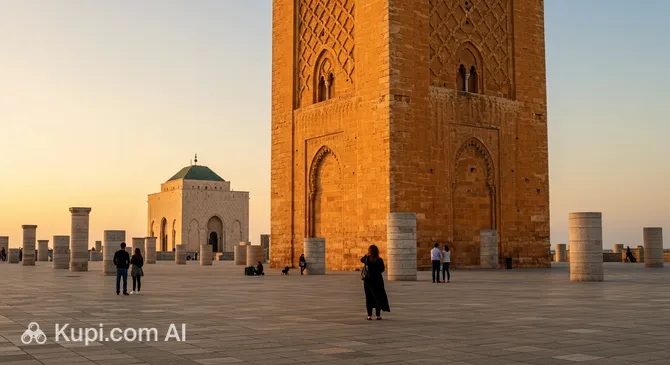
Hassan Tower. Illustration.
Source: Kupi.com AI

Traveler photos:

The tower was originally conceived as the tallest minaret in the Islamic world. It was intended to be the centerpiece of a grand mosque capable of accommodating thousands of worshippers. However, after the death of Emir Yaqub al-Mansur in 1199, construction was halted, and the tower remained at a height of about 44 meters, becoming a lasting monument to a grand yet unfinished project.

Today, Hassan Tower stands surrounded by over 200 sandstone columns—all that remains of the giant prayer hall. This "stone army" creates an impressive and almost surreal sight. Next to the tower is another important landmark—the Mausoleum of Mohammed V—making this complex not only a historical site but also an important cultural center of modern Morocco.

Visiting this site is an opportunity to touch a great history, admire unique Moorish architecture, and enjoy panoramic views of the city and the river. It is a place where the grandeur of the past meets the serenity of the present, leaving every visitor with unforgettable impressions.

Contacts

Hassan Tower is a famous historical monument in Rabat, which is part of a large open-air complex. The tower does not have a dedicated contact service, but it is open to the public. You can reach this iconic Morocco landmark by public transport or taxi, as it is located in the city center next to the Mausoleum of Mohammed V.

How to contactContact
AddressBd Mohamed Lyazidi, Rabat, Morocco

What to Do

Visiting Hassan Tower is primarily about immersing yourself in the history and atmosphere of past greatness. The main thing to do here is to take a leisurely walk through the vast grounds among the ruins and massive sandstone columns. These columns were meant to support the vaults of a giant mosque, but the project was never completed. Today, this space creates a unique sense of scale and serves as a beautiful backdrop for photos, allowing visitors to fully appreciate the ambition of the ancient architects' vision.

Architecture enthusiasts can examine the tower itself in detail, which is an outstanding example of Islamic craftsmanship. Its sophisticated patterns and monumental forms remain impressive to this day. An integral part of the visit is seeing the Mausoleum of Mohammed V located nearby. This modern building, constructed in the 1960s, is considered one of the main shrines in Morocco. It is open to visitors, providing an opportunity to see the richly decorated interior and learn about the country's modern traditions.

The platform near the tower offers picturesque panoramic views of the city of Rabat and the Bou Regreg river, making it an ideal spot for contemplative relaxation. Thus, a visit to Hassan Tower offers a comprehensive experience: from exploring ancient ruins and architectural masterpieces to discovering the modern cultural heritage of the Moroccan capital.

Getting There

Hassan Tower is conveniently located in the central part of Rabat, making it easily accessible for tourists. It is situated near the mouth of the Bou Regreg river and the famous Kasbah of the Udayas, so a visit to the tower can be easily combined with exploring other key attractions in the capital of Morocco. Thanks to its location, reaching this historical monument is straightforward from anywhere in the city.

The simplest and most popular way to reach the tower is by taxi or city public transport, with routes passing in close proximity to the site. If you are arriving in Rabat by train, the central railway station is about 2.5 kilometers away. This distance can be covered on foot in 25–30 minutes while enjoying city views, or by taking a local bus, which only takes a few minutes.

For travelers moving by private or rental car, convenient parking is available near the complex, significantly simplifying the visit. Overall, the well-developed transport infrastructure around Hassan Tower allows you to include it in your Rabat itinerary without any extra hassle, regardless of your preferred mode of transport.

Nearest city: Rabat

History & Facts

Hassan Tower is not just an ancient minaret, but a monument to grand yet unfulfilled ambitions. Its construction began in 1195 by order of Emir Yaqub al-Mansur, a ruler of the Almohad dynasty. The tower was intended to be the tallest minaret in the world, reaching 86 meters, and serve as part of a grand mosque. However, upon the Emir's death in 1199, the grand project came to a sudden halt. As a result, the tower remains frozen at a height of 44 meters, standing as a silent witness to a bygone era.

The mosque for which the tower was built was intended to be the largest in the western Muslim world. Its prayer hall was to be adorned with three courtyards and supported by more than 360 columns, creating a virtual forest of stone. Unfortunately, this architectural marvel was not destined to survive. In 1755, a powerful earthquake with its epicenter in Lisbon destroyed most of the mosque. Remarkably, the minaret itself stood firm, and today the ruins of the columns surrounding it create a particularly picturesque and slightly melancholic landscape.

Interestingly, the architectural style of Hassan Tower is not unique. It has two famous "sisters" built during the same Almohad era: the Giralda tower in Seville, Spain, and the Koutoubia minaret in Marrakech. This trio clearly demonstrates the unity and scale of the architectural traditions of this great dynasty. Today, Hassan Tower, along with the mosque ruins and the nearby Mausoleum of Mohammed V, is not only a major landmark in Rabat but also a UNESCO World Heritage site, attracting travelers from all over the world.

Time Needed

A typical visitor will need about 1–1.5 hours to explore Hassan Tower and the adjacent historical complex. This is quite enough time to leisurely enjoy all the main elements of this iconic site in Rabat. A standard visit includes viewing the minaret itself, walking across the vast square among the column ruins, and visiting the magnificent Mausoleum of Mohammed V, located opposite the tower.

If you plan more than just a quick tour and want to take beautiful photos at sunset or study the intricate mosaics and carvings inside the mausoleum in detail, it’s worth setting aside up to 2 hours. Most of the time is usually spent at the mausoleum and walking around the square. The tower itself is viewed from the outside, so it won't take long. Overall, it is a compact but very impressive attraction that is easy to fit into any itinerary through the capital of Morocco.

Working Hours

Hassan Tower and the surrounding area, including the Mausoleum of Mohammed V, are generally open to visitors daily. Access to the grounds is usually possible from early morning until sunset. This allows guests to enjoy the majesty of this historical monument both in bright daylight and in the soft rays of the evening sun, which create a unique atmosphere.

It is important to remember that exact opening hours may vary depending on the season and religious holidays. Special booking or ticket purchases for visiting the complex are usually not required. However, to avoid inconvenience, it is strongly recommended to check for up-to-date information on the official tourism websites of Rabat or at local information centers before your visit.

6:30 – 22:45

Nearby

A visit to the majestic Hassan Tower is just the starting point for discovering the rich history and culture of Rabat. The surroundings of this famous minaret are filled with other iconic sites that allow you to delve deeper into the atmosphere of the Moroccan capital. A stroll through this area will enrich your experience and reveal the city's many facets.

Just a few minutes' walk away, you can discover everything from sacred shrines and ancient gates to picturesque gardens and bustling markets. Exploring these nearby attractions will help form a complete picture of Morocco, bringing together different eras and moods in a single itinerary.

NameDistance
Mausoleum of Mohammed V0.2 km
The Marina Steakhouse0.6 km
Bab Mrissa1 km
Rabat Medina1 km
Nouzhat Hassan Garden1 km
Rabat Grand Mosque1 km
Mohammed VI Museum of Modern and Contemporary Art1.3 km

Have you reached the end of the page?

So the route has been studied inside and out