Support

Qorikancha

About

Qorikancha, which means "Golden Temple" in the Quechua language, is one of the most significant and sacred sites of the Inca Empire, located in the heart of the ancient city of Cusco in Peru. Originally named Intikancha, or the "Temple of the Sun," it was entirely dedicated to the primary deity of the Incas — the sun god, Inti. This complex was not just a major temple but the true spiritual center of the entire empire.

The complex was not a single building, but a whole system of shrines arranged around a central courtyard. Besides the main temple dedicated to Inti, there were separate structures for the worship of the Moon, the Rainbow, Thunder, and other important deities of the Incan pantheon. According to chronicles, the layout of the entire site resembled the shape of a sun, with sacred lines radiating outward like rays, emphasizing its cosmic significance.

Today, Qorikancha is a unique and fascinating combination of two great cultures. After the Spanish conquest and the devastating earthquake of 1650, the Catholic Santo Domingo Monastery was built upon the foundations of the ancient Incan temple. Four of the original temple rooms were incorporated into the structure of the monastery, allowing visitors to see the masterful and perfectly fitted Incan masonry side-by-side with colonial architecture. This is a vivid demonstration of the fusion of two different worlds in one place.
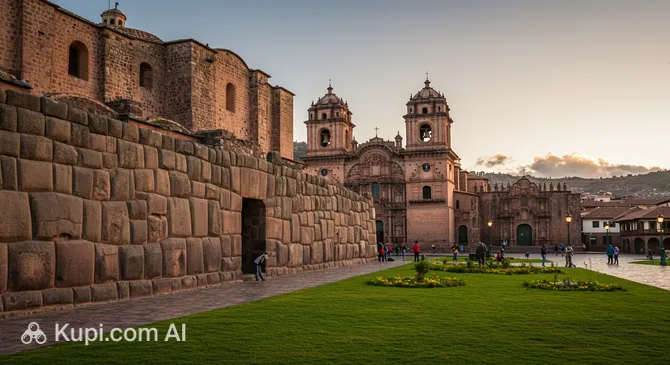
Qorikancha. Illustration.
Source: Kupi.com AI

Traveler photos:

Visiting Qorikancha is not just about viewing historical ruins; it is a true journey through time. Here, you can touch the spiritual heritage of a great civilization, appreciate the incredible skill of ancient builders, and see how different eras and worldviews have intertwined to create one of the most memorable places in Peru.

Contacts

The Qorikancha complex is located within the grounds of the Santo Domingo Monastery in the historic center of Cusco, just a few minutes' walk from the central Plaza de Armas. For the most up-to-date information regarding opening hours, ticket prices, or visiting conditions, it is recommended to contact the monastery directly via its official channels.

How to contactContact
AddressSanto Domingo s/n, Cusco 08000, Peru
Phone number+51 84 249176
Websitewww.museoqorikancha.pe

What to Do

A visit to Qorikancha is a unique opportunity to witness the fusion of two great civilizations: the Inca and the Spanish colonial. The main thing tourists notice is the striking contrast between the massive, perfectly fitted Incan masonry and the Baroque architecture of the Santo Domingo Monastery, built directly upon the ancient foundations. After a strong earthquake in 1950 damaged the Spanish building, the surviving walls of the Inca temple were exposed, allowing for a detailed study of their incredible construction today.

The famous Incan polygonal masonry deserves special attention. You can take a close look at the massive stone blocks, fitted together with such precision that it is impossible to slide even a knife blade between them. These walls have withstood numerous earthquakes, while the Spanish structures built upon them were destroyed multiple times. This leads one to ponder the mysteries of ancient construction technologies—specifically, how the Incas transported and shaped these massive boulders without the use of modern tools.

In addition to exploring the impressive ruins, you can visit a small underground archaeological museum on the complex grounds. Its collection features interesting artifacts found during excavations, such as mummies, examples of ancient textiles, and stone idols. This allows for a deeper dive into Inca history and culture, complementing the impressions left by the architectural grandeur of the temple.

Getting There

Getting to Qorikancha is quite easy, as the complex is situated in the very heart of the historic center of Cusco. It is only a few minutes' walk from the main square, Plaza de Armas, so for most tourists staying in the center, a pleasant walk is the best way to reach the temple. This allows you not only to enjoy the atmosphere of the ancient streets but also to see other interesting sites along the way.

If you are staying in a more distant district of Cusco or prefer not to walk, a taxi is the most convenient option. A ride from most parts of the city to the center is quick and inexpensive. There is also a public transport system consisting of buses and shuttles (combis), but navigating their routes can be challenging for travelers unfamiliar with the city. Therefore, for convenience and to save time, a taxi is the preferred choice.

For those arriving in Cusco by plane, Qorikancha is easily accessible by taxi from Alejandro Velasco Astete International Airport (CUZ). The trip takes approximately 20-25 minutes depending on traffic. Tourists arriving by train, for example, after visiting Machu Picchu, will also find it convenient: the stations are located relatively close to the center, and a short taxi ride will quickly bring you to this iconic landmark of Peru.

Nearest city: Cusco

History & Facts

The history of Qorikancha dates back to the distant past, around the 12th century, when the founder of the Inca dynasty, Manco Cápac, established a temple here called Intikancha — the "House of the Sun." However, it reached its true grandeur by 1438, transforming into Qorikancha, which means "Golden Temple" in the Quechua language. During the peak of the Inca Empire, it was not just the main sanctuary, but the spiritual and astronomical heart of an entire civilization, used for observing celestial bodies and performing the most important rituals.

The temple fully lived up to its name. According to the records of the conquistadors, its walls and floors were covered with hundreds of gold plates, and the inner courtyard housed the legendary golden garden. This garden featured life-sized replicas of plants and animals made of gold and silver: from llamas and lizards to fields of corn. Most of this immense wealth was melted down to pay the ransom for the last Inca ruler, Atahualpa, who was captured by the Spanish. Legend has it that the Incas managed to hide part of the treasure, giving rise to numerous stories of lost gold.

Following the Spanish conquest of Peru, the majestic temple was looted and partially destroyed. In the 17th century, the Catholic Santo Domingo Monastery was built upon its sturdy foundations. A historical irony occurred in 1950 when a powerful earthquake severely damaged the Spanish structures but revealed the perfectly preserved walls of the Inca temple. This event clearly demonstrated the superiority of Incan engineering: their seismic-resistant masonry withstood what colonial architecture could not. Today, this contrast between two worlds, visible within the walls of a single complex in Cusco, is one of its most impressive features.

Time Needed

A visit to Qorikancha typically takes between 1 and 2 hours. This is usually enough time to leisurely walk through the main complex, closely examine the famous Incan stonework, see how the Spanish Santo Domingo Monastery was built over it, and soak in the unique atmosphere of the site. During this time, you can visit the courtyard, explore the surviving temples dedicated to the Moon and the Stars, and take photos.

The duration of your visit may vary depending on your interest in the details. If you only want to get a general overview, you can manage in 45-60 minutes. However, if you are a fan of history and archaeology, it is worth setting aside more time. The complex also features a small underground museum with artifacts found during excavations, which will require an additional 30 minutes or so. Furthermore, if you choose to use the services of a guide, the tour will be more detailed and informative, taking about 1.5–2 hours.

Working Hours

Qorikancha in the city of Cusco is open to visitors year-round, although operating hours may vary slightly depending on the day of the week. Generally, the complex welcomes guests from Monday to Saturday from 08:30 to 17:30. On Sundays, the schedule is usually shortened, with doors opening in the afternoon, approximately from 14:00 to 17:00. Since hours of operation—especially on weekends and holidays—can change, it is highly recommended to check current information on the official website or at tourist centers in Cusco before your visit.

Tickets can be purchased directly at the box office at the entrance to the complex. However, to avoid long lines, especially during the peak tourist season, you might consider the option of buying tickets online in advance if available. While pre-booking is not always mandatory, it can save you time and make your visit to this iconic landmark of Peru more comfortable.

DayOpening hours
Monday8:30 – 17:30
Tuesday8:30 – 17:30
Wednesday8:30 – 17:30
Thursday8:30 – 17:30
Friday8:30 – 17:30
Saturday8:30 – 17:30
Sunday2:00 – 17:00

Nearby

After immersing yourself in the history and grandeur of Qorikancha, don't be in a hurry to leave the area. Its central location in Cusco makes it an ideal starting point for further exploration of the city's treasures. A stroll through the surrounding neighborhood will allow you to deeper experience the atmosphere of the ancient Inca capital and see how history intertwines with modern life.

In the immediate vicinity of the temple, you will find many other interesting sites — from museums and archaeological monuments to cozy restaurants and craft centers. Exploring these locations will enrich your experience and help you form a more complete picture of the cultural heritage of Peru.

NameDistance
Chull's Peruvian Cuisine & Craft Beer0 km
Qosqo Center of Native Art0.2 km
Museum of Popular Art0.4 km
El Muki0.4 km
Twelve Angled Stone0.5 km
Molly's Irish Bar and Restaurant0.5 km
Kusykay Peruvian Craft Food0.5 km

Have you reached the end of the page?

So the route has been studied inside and out