The Carmo Church (Igreja do Carmo) is one of the iconic Catholic churches gracing the historic center of Porto, Portugal. It is not just a place for prayer, but a true architectural masterpiece that attracts attention with its exquisite beauty and rich history. A visit to this church will be a vivid experience for anyone interested in religious architecture and art.
Traveler photos:
Built by the Carmelite Order between 1756 and 1768, the Carmo Church is a magnificent example of Late Baroque with Rococo elements. Its construction took place during the golden age of Portuguese architecture, reflected in its lavish decoration and attention to detail. The church was designed by architect José de Figueiredo Seixas, and its construction spanned over ten years.
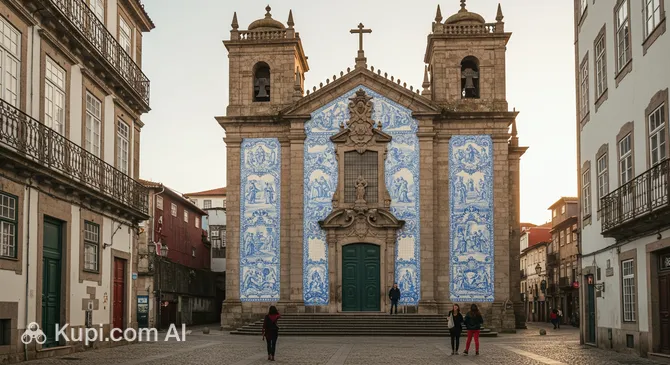
The church is particularly famous for its side facade, completely covered in the renowned blue-and-white azulejo tiles. This monumental panel, created in 1912 by Silvestre Silvestri, depicts scenes related to the founding of the Carmelite Order and Mount Carmel. The magnificent facades and the interior of the church are richly adorned with decorative elements characteristic of the Baroque and Rococo styles, making it a striking example of Portuguese religious architecture from that period.
Interestingly, the Carmo Church stands almost right next to another church—the Church of the Carmelites (Igreja dos Carmelitas)—separated only by one of the narrowest houses in the world, which is just over a meter wide. This unusual architectural ensemble is often a source of fascination and a popular photo spot. It is important not to confuse the Carmo Church in Porto with the church of the same name in Lisbon, which has its own equally interesting history.