Support

Saint Petersburg Stadium

About

St. Petersburg Stadium, better known as the Gazprom Arena, is one of the most modern and high-tech sports venues not only in St. Petersburg but in all of Russia. Located on the picturesque Krestovsky Island, it was built on the site of the historic S.M. Kirov Stadium. Opened in 2017, this grand complex has become a true magnet for fans of football, architecture, and large-scale shows. Its futuristic design, resembling a spaceship, was developed by the renowned Japanese architect Kisho Kurokawa.
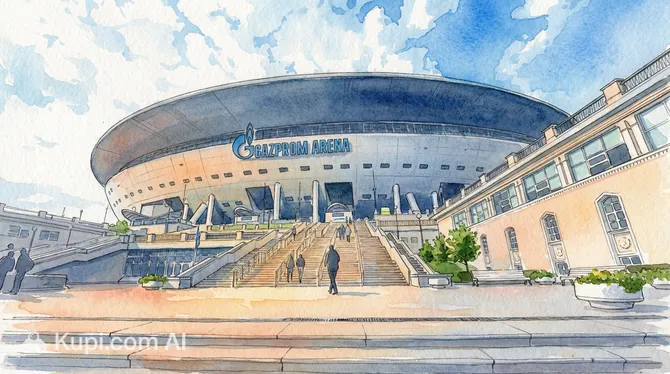
Saint Petersburg Stadium. Illustration.
Source: Kupi.com AI

Traveler photos:

The main technological features of the stadium are the retractable roof and the roll-out pitch—a combination found in only a few arenas worldwide. This unique engineering solution allows events to be held in any weather and transforms the football arena into a venue for concerts, festivals, and other cultural events. The stadium's capacity reaches about 68,000 spectators for football matches and up to 80,000 for concerts, making it one of the largest in Eastern Europe.

The Gazprom Arena has already made history as a host for iconic international competitions. The stadium was one of the key venues for the 2018 FIFA World Cup, hosting seven matches of the tournament, including the third-place play-off. Thanks to its multifunctionality, impressive architecture, and unique atmosphere, the arena is rightfully considered a new city landmark, attracting both tourists and locals alike.

Contacts

For detailed information on events, ticket purchases, or stadium tours of the Gazprom Arena, it is recommended to use the official communication channels. The most up-to-date information can be found on the stadium's official website, and for inquiries related to the football club, please contact the customer service office.

How to contactContact
AddressFutbol'naya Alleya, 1, Sankt-Peterburg, Russia, 197110
Phone number+7 812 244-33-33
Websitegazprom-arena.com

What to Do

A visit to St. Petersburg Stadium offers guests a wealth of experiences beyond simply watching an event. The main reason thousands of people come here is, of course, the football matches. Here you can see the local Zenit team in action and feel the incredible energy of the stands. Additionally, the arena regularly hosts concerts by world stars and other large-scale cultural events, making it a hub for a wide audience.

Even if no events are scheduled on the day of your visit, the stadium is open to visitors through fascinating guided tours. During the tour, you can peek into the most interesting corners of the arena usually hidden from fans: visit the Zenit FC locker room, walk through the players' tunnel to the edge of the pitch, sit on the substitutes' bench, and visit a VIP box. This is a great chance to learn more about the history and unique technologies of the stadium, including its famous retractable roof and roll-out pitch.

A stay at the Gazprom Arena isn't limited to the building itself. The stadium is located on scenic Krestovsky Island, offering beautiful panoramic views of the Gulf of Finland and the cityscape, especially from the seventh-floor promenade. Before matches begin, the "Fan Promenade" entertainment program is often organized for fans, featuring food courts, photo zones, and autograph sessions. The surrounding area with its park and numerous cafes is an ideal place for walking and relaxing in the atmosphere of one of modern St. Petersburg's most iconic landmarks.

Getting There

There are various ways to reach the St. Petersburg Stadium, but the metro is the most convenient and predictable option. Two stations are located in the immediate vicinity: Zenit (Line 3, Green), which is situated almost right at the stadium entrance, and Krestovsky Ostrov (Line 5, Purple). From Krestovsky Ostrov, it is about a 20–25 minute walk to the arena through the scenic Primorsky Victory Park. During matches and major events, surface transport routes on Krestovsky Island may change, so the metro remains the most reliable choice.

If you prefer to travel by car or taxi, it's worth planning your route in advance. There are parking areas near the arena, but access to Krestovsky Island is often restricted on event days, and the number of parking spaces can be limited. To avoid traffic jams, it is recommended to leave early. A taxi can be a good alternative as it allows you to get as close as possible to the stadium without worrying about parking. You can also use buses that stop within walking distance of the arena.

Nearest city: Saint Petersburg

History & Facts

The history of the modern St. Petersburg Stadium is inextricably linked with its legendary predecessor, the S.M. Kirov Stadium. The idea for its creation arose as early as 1932, based on a project by architects Alexander Nikolsky and Konstantin Kashin. Construction work, which began on an artificial mound in the western part of Krestovsky Island, was interrupted by the Second World War and the Siege of Leningrad. The arena was finally opened in a grand ceremony on July 30, 1950. It originally held 100,000 spectators and was one of the largest stadiums in the world at the time.

Kirov Stadium witnessed many historical events. In 1959, an all-time attendance record for Soviet football was set here, with 110,000 fans gathering for a match. The arena hosted matches of the 1980 Olympic football tournament and was the main venue for the 1994 Goodwill Games. However, over time, the grand structure no longer met modern requirements, and the decision was made to replace it with a new, more technologically advanced arena.

Construction of the new stadium, now known as the Gazprom Arena, began in 2007, and it opened in 2017. The new arena maintained its continuity: the football pitch remains on the same historical site as in the Kirov Stadium. This modern complex, designed by Japanese architect Kisho Kurokawa, quickly became not only the home of Zenit Football Club but also a new symbol of the architectural and technological achievements of St. Petersburg.

Time Needed

The amount of time you should set aside for visiting St. Petersburg Stadium depends directly on the purpose of your visit. If you simply want to see this grand structure, a guided tour is the best choice. A standard tour usually takes about 1–1.5 hours. During this time, you can see the main locations of the arena that are inaccessible to regular spectators on match days and learn about its unique technologies.

The situation is quite different if you plan to attend a football match or a concert. In this case, be prepared to spend several hours or even half a day. Spectators are allowed into the stadium two hours before the event starts, and this time can be spent on the "Fan Promenade"—an entertainment program with food courts, activities, and performances. The event itself, whether it's a football match or a show, will last another two to three hours. Don't forget to also factor in travel time to and from Krestovsky Island, especially considering possible transport restrictions during major events.

Working Hours

Working hours for St. Petersburg Stadium depend directly on the schedule of events. If you plan to visit the arena as part of a tour, they are generally available throughout the day. However, the exact schedule can change, so it is highly recommended to check information and availability in advance on the stadium's official website. During football matches, concerts, and other large-scale events, the arena is open to visitors according to the event schedule, which is also published on official resources.

To guarantee a spot on a tour, especially during the peak tourist season, it's best to book tickets in advance online. This will not only help you avoid queues but also allow you to plan your visit better. The stadium is a year-round attraction, but access to certain areas may be restricted during preparation for major events. Always check the latest information before your trip to ensure your visit to one of St. Petersburg's most high-tech sports complexes is as comfortable as possible.

Nearby

Visiting St. Petersburg Stadium is a vibrant event in itself, but exploring its surroundings can make your trip even more fulfilling. The arena is located on Krestovsky Island, which is famous for its parks and entertainment complexes, offering many options for relaxation before or after an event.

Within walking distance or a short ride from the stadium, you'll find both natural and modern attractions that will interest adults and children alike. From water parks and beaches to the city's latest architectural landmarks, there is something for everyone here. Below is a list of nearby points of interest with their distance from the arena.

NameDistance
Piterland Water Park1.1 km
Vysotny Gorod1.3 km
Plyazh Beach1.5 km
Yuntolovsky Reserve3.8 km
Relics of St. John of Kronstadt4.4 km
Harvest5.2 km
Military Historical Museum of Artillery, Engineers and Signal Corps5.5 km

Have you reached the end of the page?

So the route has been studied inside and out