Support

Winter Palace

About

The Winter Palace is a magnificent architectural monument and one of the main symbols of Saint Petersburg. Located on Palace Square, it served as Russia's primary imperial residence for 150 years. Today, its walls house the main collection of the State Hermitage Museum—one of the largest and oldest museums in the world. It is a place where the history of imperial Russia comes to life through luxurious interiors and priceless works of art.
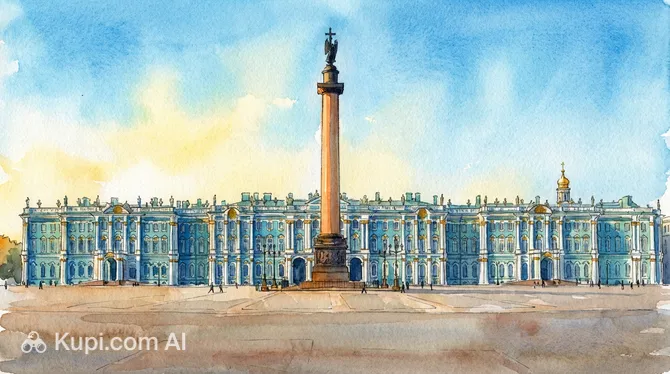
Winter Palace. Illustration.
Source: Kupi.com AI

Traveler photos:

The current palace building was constructed between 1754 and 1762 by order of Empress Elizabeth Petrovna. The project was entrusted to the prominent Italian-born architect Francesco Bartolomeo Rastrelli. The palace became a jewel of the "Elizabethan Baroque" style, characterized by opulence, abundant decoration, and gilding. The grandiose building features over 1,000 rooms, about 1,500 windows, and 117 different staircases, emphasizing its majesty and monumentality.

From 1762 to 1904, the Winter Palace served as the official winter residence of the Russian monarchs. Its halls hosted lavish balls, ceremonial receptions, and the conduct of state affairs. Interestingly, in the 19th century, access to the palace was open to any neatly dressed person—men only needed to wear a tailcoat or military uniform. Following the revolutionary events of 1917, the palace was declared a museum, and today its doors are open to everyone wishing to explore its rich history and culture.

Contacts

Since the Winter Palace is part of the Main Museum Complex of the State Hermitage Museum, you should refer to the museum's official resources to plan your visit, check opening hours, and purchase tickets. All up-to-date information is available on the website and via the information service phone line.

How to contactContact
AddressDvortsovaya Naberezhnaya, 32, Sankt-Peterburg, Russia, 190000
Phone number+7 812 710-90-79
Websitewww.hermitagemuseum.org

What to Do

A visit to the Winter Palace is a unique opportunity to immerse yourself in two worlds simultaneously: the world of imperial luxury and the world of great art. Today, the palace is part of the State Hermitage, one of the largest museum complexes in the world. For visitors, this means that viewing the magnificent interiors of the former royal residence is inextricably linked with discovering priceless masterpieces. You can walk through the halls where court life once bustled while simultaneously enjoying a rich collection of paintings, sculptures, and decorative arts.

The palace's state rooms, each with its own unique appearance, attract particular attention. A journey through the Baroque and Rococo enfilades will leave an unforgettable impression. Among the most famous rooms are the shimmering gold Jordan Staircase, the majestic St. George's (Grand Throne) Hall, and the famous War Gallery of 1812. No less interesting are the private apartments of the imperial family, where you can see the environment in which the Russian monarchs lived and learn about their daily lives and traditions.

Beyond the permanent collection, the Winter Palace maintains an active cultural life. Its halls regularly host temporary exhibitions that allow for a deeper study of specific eras or the work of individual artists. The museum also organizes lectures and educational programs, ensuring that every visit can be a new discovery. This makes the palace not just a repository of history, but a dynamic cultural center that you will want to return to again and again.

Getting There

The Winter Palace is located in the heart of Saint Petersburg, on the famous Palace Square, making it easily accessible for tourists. Thanks to its central location, the main residence of the Russian emperors can be reached from almost any part of the city using various modes of transport.

The most convenient and fastest way is by metro. The closest station to the attraction is "Admiralteyskaya" (Purple Line), which is just a 5-7 minute leisurely walk from the palace. You can also travel to "Nevsky Prospekt" (Blue Line) or "Gostiny Dvor" (Green Line) stations, which are a bit further away. A walk from these stations takes about 15-20 minutes and is a wonderful opportunity to enjoy the architecture of the city's historical center.

Many surface public transport routes also run to Palace Square. Buses No. 7, 10, 24, 191 and trolleybuses No. 1, 7, 10, 11 stop in the immediate vicinity of the palace. Additionally, Hop-On Hop-Off tourist buses are very popular in Saint Petersburg; their routes always include a stop at the Winter Palace, allowing you to combine travel with an exciting tour.

If you prefer comfort, you can always use a taxi or car-sharing service. A trip from the central districts will be quick and efficient. For those who enjoy walking, the route to the Winter Palace along Nevsky Prospekt or the embankments is an unforgettable experience in itself, allowing you to fully feel the majestic atmosphere of the Northern Capital.

Nearest city: Saint Petersburg

History & Facts

The modern Winter Palace, which graces Palace Square in Saint Petersburg, is actually the fifth imperial winter residence. The history of its predecessors began in 1711 with a small Dutch-style wooden house built for Peter the Great. Just a few years later, the first stone palace was erected on its site according to the design of architect Georg Mattarnovi, where the Emperor spent his final years. Thus, the site where one of the world's greatest museums stands today has been constantly transformed, reflecting the growing ambitions and changing tastes of the Russian monarchs.

A new chapter in the palace's history began with the accession of Empress Anna Ioannovna. Finding the existing residence too modest, she commissioned architect Francesco Rastrelli to design a new, more grandiose building. This required purchasing and demolishing neighboring houses on the Palace Embankment. By 1735, a massive four-story palace stood in their place, with its main facade facing the Admiralty. This version of the palace served as the primary imperial residence for about 20 years, but it too was destined for reconstruction.

The fifth and final building of the Winter Palace, which we see today, was commissioned in 1754 by Empress Elizabeth Petrovna and took nearly eight years to build. After the 1917 Revolution, its history took a sharp turn: the former imperial residence was nationalized and became a museum, joining the State Hermitage. Interestingly, from 1918 to 1943, the palace was officially named the "Palace of Arts," emphasizing its new cultural mission, which continues to this day.

Time Needed

When planning a visit to the Winter Palace, it is important to understand that it is not just a single attraction, but part of the massive State Hermitage Museum. For a first, general introduction to the palace's state rooms and the most famous exhibits of the museum's main collection, it is recommended to allocate at least 3-4 hours. This is enough time to walk leisurely through the main enfilades, see the Jordan Staircase and the Throne Room, and admire masterpieces of world art without feeling rushed.

However, if your goal is a deeper immersion into the world of art and history, a few hours will not be enough. Given the colossal size of the museum and the richness of its collections, which number millions of exhibits, it can take several days to explore all the exhibitions in detail. Many art lovers return to the Hermitage again and again, discovering something new every time.

To make the visit as comfortable and informative as possible, many tourists prefer to split their visit into several parts or choose specific halls and collections of greatest interest in advance. For example, you can dedicate one day to Italian Renaissance art and another to exploring ancient collections or the palace's state interiors. This approach helps avoid fatigue and ensures true enjoyment from the visit.

Working Hours

Visiting the Winter Palace, which is part of the Main Museum Complex of the State Hermitage, is possible throughout the year, but opening hours may vary depending on the day of the week. Typically, the museum is open on Tuesday, Thursday, and Sunday from 11:00 to 18:00. On Wednesday, Friday, and Saturday, the hours are extended from 11:00 to 20:00. It is important to remember that ticket offices close one hour before the museum's closing time, and the official holidays are Monday, as well as January 1st and May 9th.

To avoid long queues, especially during the tourist season, it is highly recommended to purchase tickets in advance online on the museum's official website. Visits are organized by time slots, so you will need to choose a convenient time when buying your ticket. Late arrival for a session is allowed for no more than 30 minutes; otherwise, the ticket may be canceled. To get the most accurate and up-to-date information, it is always best to check the official Hermitage website before planning your visit.

DayOpening hours
MondayClosed
Tuesday10:30 – 18:00
Wednesday10:30 – 21:00
Thursday10:30 – 18:00
Friday10:30 – 18:00
Saturday10:30 – 18:00
Sunday10:30 – 18:00

Nearby

A visit to the Winter Palace is just the beginning of your acquaintance with the treasures of Saint Petersburg's historical center. Thanks to its location, you find yourself at the epicenter of the city's cultural life, with iconic landmarks concentrated within a short distance of each other. A walk around the neighborhood will allow you to immerse yourself deeper in the atmosphere of the imperial capital and see other architectural masterpieces.

Exploring nearby places will not only enrich your experience but also help you form a complete picture of this unique district. Famous squares, cathedrals, and museums, each with its own unique history, are just a few minutes' walk away. Below is a list of interesting sites located in the immediate vicinity of the Winter Palace.

NameDistance
State Hermitage Museum0.1 km
Kunstkamera0.5 km
Strelka of Vasilievsky Island0.6 km
Lion Palace0.7 km
St. Isaac's Cathedral0.8 km
State Russian Museum, Mikhailovsky Palace1 km
Peter and Paul Fortress1.1 km

Have you reached the end of the page?

So the route has been studied inside and out