Support

Tunis Clock Tower

About

The Tunis Clock Tower, also known as the Kalef Tower, is one of the prominent architectural landmarks of the capital of Tunisia — the city of Tunis. This monument does not just tell the time; it serves as a vibrant symbol of the city, attracting the attention of both locals and tourists.
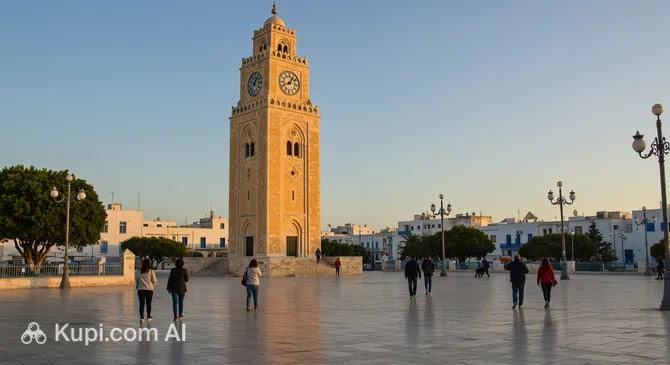
Tunis Clock Tower. Illustration.
Source: Kupi.com AI

Traveler photos:

A tall and slender structure, the tower rises majestically over the historical part of the city, known as the Old Town or Medina. Its characteristic silhouette has become an integral part of the cityscape and serves as an excellent landmark for wandering through the narrow streets of ancient Tunis.

The Clock Tower is an important part of the city's rich historical heritage. It fits harmoniously into the ensemble of medieval fortifications that have partially survived to this day, recalling the centuries-old history of Tunis and its cultural significance. Visiting this attraction allows you to better feel the atmosphere of the old city and its unique architecture.

Contacts

Tunis Clock Tower is a well-known city landmark and, as such, may not have direct contact details. To learn more about its history or possible excursions that include a visit to the tower, it is recommended to contact local tourist information centers in Tunis or visit the city's official tourism websites. Usually, such iconic sites are easy to find by using maps or signs in the city center.

How to contactContact
AddressR52P+3HV, Av. Habib Bourguiba, Tunis, Tunisia

What to Do

The Tunis Clock Tower, sometimes referred to as the local "Big Ben," is not only a notable architectural structure but also an excellent starting point for exploring the historical heart of the capital. Visiting the area around the tower allows tourists to enjoy impressive panoramic views of the Old Town of Tunis and its ancient medieval fortifications. From this point, a magnificent perspective of the historical center opens up, allowing you to see numerous architectural monuments and feel the unique atmosphere of the ancient medina.

Right next to the Clock Tower and in its immediate vicinity, you can spend time exploring the surviving medieval fortifications of the city. These ancient walls and bastions are silent witnesses to the rich and centuries-old history of Tunis. A walk along these historical structures will allow you to literally touch the past and imagine what the city looked like centuries ago, feeling its former power and grandeur.

Strolling through the district surrounding the tower, you will also discover many other historical monuments, each reflecting the unique cultural heritage of the capital of Tunisia. This is a wonderful opportunity to dive deeper into the history and architecture of the city, making leisurely discoveries and enjoying the atmosphere of one of North Africa's most colorful cities. Be sure to set aside some time to simply wander the streets, soaking up the spirit of this amazing place.

Getting There

As one of the capital's iconic landmarks, the Tunis Clock Tower is situated in an easily accessible location, making it convenient for tourists to visit. Located in the heart of the city, it serves as an excellent starting point for exploring Tunis.

There are several ways to reach the Clock Tower. The most convenient option for many tourists is a taxi, which can easily take you from any point in the city directly to the attraction. Public transport is also worth considering. Tunis has a well-developed network of bus routes, and many of them pass through the central districts where the tower is located. Additionally, the city has a light rail system (metro), with the nearest stations possibly within walking distance of the tower.

If you are staying in the central part of Tunis, you will most likely be able to reach the Clock Tower on foot, enjoying the city's architecture and atmosphere along the way. Follow the main streets and squares, and you will find this famous monument without difficulty. It is recommended to check current public transport routes or consult with your hotel reception before your trip.

Nearest city: Tunis

History & Facts

The Tunis Clock Tower is not just a landmark, but a symbol closely linked to the rich history of architectural development and fortifications in the city of Tunis. While the specific details of its construction may be shrouded in time, historians suggest that similar towers originally served as part of the extensive defense system of the capital of Tunisia, reflecting a centuries-old tradition of building fortifications that began as early as the early periods of Islamic rule in the region.

The history of Tunis and its surroundings is full of examples of the construction and reinforcement of city walls and towers. For instance, in the city of Sousse, impressive walls made of ashlar stone were built as early as 859 over the remains of ancient structures. Defensive complexes often included high towers that not only dominated the cityscape but also performed important defensive and signaling functions. It is likely that the Tunis Clock Tower, even if its primary function has changed over time, inherited features from these ancient guardians of the city.

The architectural appearance of the Tunis Clock Tower, like many other historical buildings in the city, may have been influenced by various cultures and ruling dynasties, such as the Aghlabids, Fatimids, and Zirids. These dynasties left a notable mark on the architecture of Tunisia between the 7th and 18th centuries. Such influences typically manifested in construction techniques, decorative elements, and the overall style of structures, making each historic building a unique witness to its era and part of the country's rich architectural heritage.

Time Needed

Visiting the Tunis Clock Tower, an iconic symbol of Tunis, usually doesn't take much time but allows you to touch the modern history of the capital. To admire its architecture, take commemorative photos, and feel the atmosphere of the bustling square where it is typically located, 30 minutes to 1 hour is sufficient for most visitors.

The Tunis Clock Tower is primarily an important landmark and architectural object intended for external viewing. As far as is known, there is no provision for regular public access to the top or the interior, as its main function is to decorate the city and serve as a timekeeping point. Therefore, most of your time will be spent contemplating it from different angles and exploring the surrounding space.

Thus, when planning a visit to the Tunis Clock Tower, expect a relatively short but pleasant introduction to one of Tunis's notable modern attractions. It is a great place for a quick stop during a walk through the city center to take a few photos and then move on to other interesting sites in the capital of Tunisia.

Working Hours

The Tunis Clock Tower, located on Avenue Habib Bourguiba in Tunis, is a well-known landmark and a public monument. Generally, the exterior of the tower can be viewed at any time of day and any day of the week, as it is located in an open space. However, if internal access or visits to any associated exhibits are possible, the exact opening hours may vary.

Currently, specific information about opening hours for internal visits to the Tunis Clock Tower is unavailable. We recommend that tourists check for up-to-date information on the official tourism websites of Tunis or directly at local information centers upon arrival. Typically, such iconic monuments are available for viewing year-round, but special tours or internal access may require advance information or even a reservation.

Open 24 hours

Nearby

A visit to the Tunis Clock Tower is undoubtedly a highlight; however, exploring the nearby attractions can significantly enrich your experience of Tunis. A walk through the surrounding area will allow you to dive deeper into the atmosphere of the capital, discover new interesting places, and gain a more complete understanding of its cultural and historical heritage.

There are other noteworthy sites near the Clock Tower that will help you get to know this amazing city better. Below is a list of some of them, including the distance.

NameDistance
Municipal Theatre of Tunis0.5 km
Central Market of Tunis0.9 km
Bab el Bhar1 km
City of Culture1.2 km
Zitouna Mosque1.4 km
Dar El Jeld1.6 km
Kasbah Square1.8 km

Have you reached the end of the page?

So the route has been studied inside and out