Support

Matenadaran

About

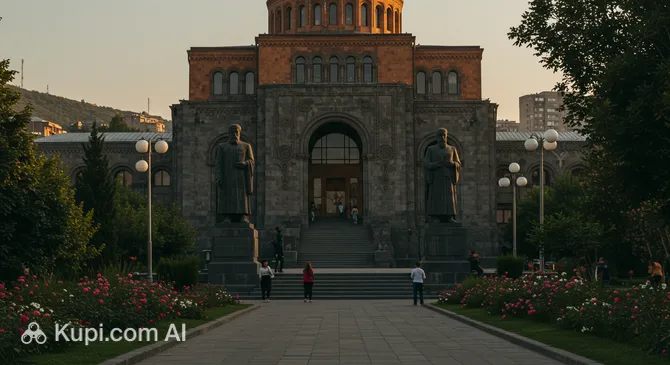
On the high ground crowning one of the main avenues sits one of the most impressive repositories of human thought — the Matenadaran. This unique research institute and museum in the city of Yerevan is a true treasure trove of antiquity, where Armenia carefully preserves its spiritual and cultural heritage.
Matenadaran
Matenadaran. Иллюстрация. Источник: Kupi.com AI

The majestic building made of gray basalt, built in a traditional style, houses an incredible collection of more than 23,000 ancient manuscripts. Collected here are not only Armenian manuscripts but also rare texts in Greek, Arabic, Persian, and other languages, many of which date back to the 5th–6th centuries. The word "matenadaran" literally translates as "repository of manuscripts," and this place fully lives up to its name, being one of the largest centers of its kind in the world.

At the entrance, visitors are greeted by a grand monument to Mesrop Mashtots, the creator of the Armenian alphabet, who seems to invite them to peer into the world of medieval wisdom. The Matenadaran is not just a museum, but a living center of science where ancient books undergo restoration and detailed study, while remaining open to inspire every tourist.

Contacts

To plan your visit, you can use the official contact details of the institution. Please note that advance booking may be required for group tours.

How to contactContact
Address53 Mesrop Mashtoc pokhota, Yerevan 0009, Армения
Phone+374 10 562578
Websitewww.matenadaran.am

What to Do

In the halls of the Matenadaran, visitors can see masterpieces of medieval art firsthand — illuminated manuscripts decorated with gold and incredibly bright colors derived from natural minerals and plants hundreds of years ago. Be sure to look at the Echmiadzin Gospel and compare the giant folios with miniature books that fit in the palm of your hand.

In addition to the permanent exhibition, temporary thematic exhibitions dedicated to ancient medicine, astronomy, or music are regularly held here. For a deeper immersion, it is recommended to use the services of a professional guide or take an audio guide, which provides detailed information about parchment-making techniques and the secrets of ancient scribes.

After touring the inner halls, take some time to walk around the grounds: statues of great Armenian scholars are installed in front of the building, and the observation deck at the entrance offers a wonderful panorama of the central streets. In the museum's souvenir kiosk, you can purchase unique replicas of ancient miniatures and commemorative books that will make a special gift from your trip.

Getting There

Getting to the Matenadaran is quite simple, as it rises majestically at the end of one of the city's main arteries — Mesrop Mashtots Avenue. If you are in the center, for example, near the Opera House, a walk will take about 10–15 minutes heading towards the hill. From Republic Square, the walk is about 20 minutes at a leisurely pace up the avenue.

For those who prefer public transport, take buses No. 10, 15, 49, 63 or trolleybuses No. 7 and 9, which stop right at the foot of the museum. You can also always use taxi services (such as Yandex Go or GG) — a trip from the central part of the city will be quick and budget-friendly.

If you plan to take the metro, the nearest station is "Yeritasardakan". From there, it is about a 10-minute walk to the entrance of the institute. For those deciding to come here directly from Zvartnots Airport, a taxi ride will take 20 to 30 minutes depending on traffic.

Ближайший город: Yerevan

History & Facts

The roots of this unique collection go back to ancient times — to the 5th century, when Mesrop Mashtots and Sahak Partrev founded the first manuscript repository in Vagharshapat. For centuries, monks and scribes carefully expanded and preserved the collection, turning it into a true intellectual center for the region. By the 15th century, the Echmiadzin Matenadaran already possessed thousands of priceless manuscripts.

In 1920, the rich collection was nationalized, and in 1939, it was moved to the capital to ensure better preservation. The construction of the modern building, designed by architect Mark Grigoryan, began in 1945. The structure, built in the style of national architecture from the 12th–13th centuries, was completed in 1959, becoming one of the city's architectural symbols.

The Matenadaran received the official status of a research institute for ancient manuscripts in March 1959, and three years later it was named after Mesrop Mashtots. Today, it not only preserves history but also conducts large-scale work on the restoration and digitization of written monuments recognized by UNESCO as part of the world's heritage.

Time Needed

To fully explore the exhibition and examine the details of the ancient miniatures, a typical visitor needs about 1.5–2 hours. This is enough time to walk through the main halls with a guide or independently study the most significant exhibits.

If you decide to use an audio guide or wish to study the temporary thematic exhibitions in detail, your visit may last longer. At the same time, for a brief introduction to the building's architecture and the most famous manuscripts, one hour may be sufficient.

Working Hours

The Matenadaran is open to visitors from Tuesday to Saturday. The museum's working hours are usually set from 10:00 AM to 5:00 PM. It is important to remember that Sunday and Monday are days off at the institute.

The museum ticket office usually closes 30 minutes before the end of the exhibition. We recommend checking the information on the official website before planning your visit, as the schedule may change on public holidays or during scientific conferences.

DayWorking hours
понедельникЗакрыто
вторник10:00–17:00
среда10:00–17:00
четверг10:00–17:00
пятница10:00–17:00
суббота10:00–17:00
воскресеньеЗакрыто

Nearby

Exploring the surroundings of the Matenadaran significantly enriches the travel experience. The museum's location in the northern part of the central district makes it an excellent starting point for walks through parks and recreation areas popular with both locals and visitors to the capital.

In the immediate vicinity, there are green terraces and entertainment areas where you can relax after immersing yourself in ancient history. Below is a list of interesting sites located nearby:

NameDistance
Victory Park0.4 km
Indian Mehak Restaurant & Bar0.4 km
Mother Armenia Monument0.5 km
Wine Republic0.5 km
The Cascade0.5 km
Cafesjian Center for the Arts0.5 km
France Square0.7 km

Reached the end of the page?

That means the route is fully explored