Support

Kutaisi State Historical Museum

About

Located in the heart of Kutaisi, this museum is a true treasure trove, preserving memories of the centuries-old past of western Georgia. The Kutaisi State Historical Museum, founded in 1921, occupies a majestic late-19th-century building that once served as the National Bank.
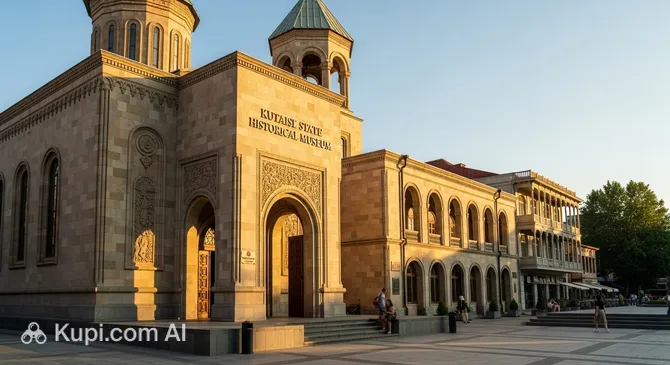
Kutaisi State Historical Museum
Kutaisi State Historical Museum. Иллюстрация. Источник: Kupi.com AI

Its halls house a colossal collection of about 200,000 exhibits. Here, you can see rare artifacts ranging from primitive Paleolithic tools to the exquisite Colchian gold jewelry that made the region famous in antiquity. Named after Academician Niko Berdzenishvili, the museum is rightfully considered one of the country's main research centers.

Of particular value are the medieval manuscripts, ethnographic collections, and the numismatic fund, recognized as one of the richest in the Caucasus. A visit here allows you to trace the evolution of the region's culture from the dawn of humanity to the present day.

Contacts

To clarify visiting details or organize group tours, you can contact the museum administration by phone. We also recommend checking the official social media page for information on current temporary exhibitions and special events.

Below are the main contact details for the institution:

How to contactContact
Address7P93+FJM, Кутаиси, Грузия
Phone+995 431 24 56 91
Websitewww.facebook.com

What to Do

Once inside, be sure to spend some time in the archaeology department. Here, you'll find unique bronze axes, ancient sculptures, and the famous female statue from Geguti. For lovers of antiquity, the items from the Colchian Kingdom—highlighting the wealth and craftsmanship of ancient jewelers—will be a true revelation.

In the numismatic hall, you can examine rare coins: from legendary 5th-century BC Colchian didrachms to gold staters from the era of Alexander the Great. The collection covers a vast period, including Greek, Roman, and Byzantine mints, allowing you to literally see the succession of empires through their currency.

Beyond antiquities, it is fascinating to explore the ethnographic exhibition, which features household items and traditional weapons. The building itself, with its high ceilings and historic interiors, creates a special atmosphere of immersion into the past, while temporary exhibitions often offer a fresh perspective on the history of the region.

Getting There

Finding this attraction is easy, as it is located in the heart of the city at the intersection of Pushkin and Tsereteli streets. If you are staying in the center, a walk from the famous Colchis Fountain or Bagrati Cathedral will take only 10–15 minutes, allowing you to enjoy the atmosphere of the old quarters along the way.

For those who prefer public transport, any minibus or bus going to the "Pushkina" or "Tsereteli" stops will do. If you are coming from Kutaisi Airport, the most convenient way is to take a taxi—the ride takes about 20 minutes and costs approximately 20–30 GEL.

Travelers with their own or a rented car should note that parking is available directly at the museum building. Exact coordinates for navigation: 42.7040445, 42.2687103.

Ближайший город: Kutaisi

History & Facts

The history of this collection of antiquities began back in 1912, when the first exhibits were kept in the private home of Grigol Gvelesiani. The museum received official state status in 1921 and opened its doors to the general public a year later under the leadership of its first director, Tryphon Japaridze.

The museum is named after the prominent Georgian historian Niko Berdzenishvili. Its current residence is a magnificent three-story building constructed at the end of the 19th century (1894–1896), originally for the needs of the National Bank. The building's architecture is considered an important monument of that era in its own right.

Over the decades, the collections have expanded significantly and today include about 200,000 items. This makes the Kutaisi State Historical Museum the second most important and extensive collection in the country after the one in Tbilisi, emphasizing the city's status as an ancient capital and the cultural core of the region.

Time Needed

When planning your visit, it is best to set aside 1.5 to 2.5 hours to explore the exhibition. This is enough time to walk leisurely through the main archaeology, numismatics, and ethnography halls, as well as to examine unique jewelry and ancient manuscripts.

If you are a professional researcher or a passionate coin enthusiast planning to focus on only one specific collection, a visit may take about an hour. Keep in mind that the museum's rich archives can be captivating, so leave yourself some extra time.

Working Hours

The museum welcomes visitors daily, operating without breaks or days off. The doors are open from 10:00 to 18:00 from Monday to Sunday, making it easy to fit a visit into any travel schedule.

Since holiday hours may vary, we recommend checking for the latest information on the museum's official Facebook page or the city's tourism portal before your trip.

10:00–18:00

Nearby

A stroll around the museum will allow you to immerse yourself deeper in the atmosphere of the ancient city. Within walking distance are both cozy squares for relaxation and iconic monuments reflecting the centuries-old history of the Imereti region.

Exploring the central streets of Kutaisi can be combined with a visit to the following sites:

NameDistance
Wine Vibes0.1 km
Karvasla0.1 km
Fleur0.2 km
Kutaisi Bar0.2 km
Colchis Fountain0.3 km
White Bridge0.3 km
Doli0.5 km

Reached the end of the page?

That means the route is fully explored