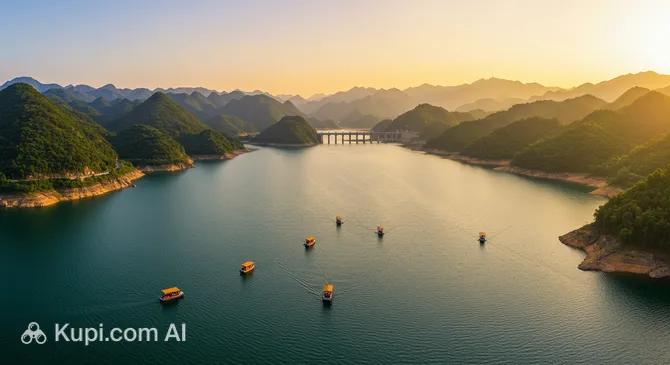
Danjiangkou is an amazing city in Hubei Province, located in the very heart of China. It is known not as a typical tourist metropolis, but as a unique industrial and engineering hub that grew around one of the country's largest hydraulic structures. The city has a special atmosphere of tranquility and practicality, where modern life is closely intertwined with large-scale nature transformation projects.
Geographically, the city is situated at the confluence of the Han and Dan rivers. With a population of about 443,755 people, Danjiangkou serves as a strategically important point: it is here that the central route of the ambitious "South-to-North Water Diversion Project" begins. The modern appearance of the city was formed in the mid-20th century, and the history of its development is inextricably linked with the construction of a giant dam, for which the ancient county center had to be sacrificed.
Danjiangkou. Illustration.
Source: Kupi.com AI
For travelers, the city is primarily attractive for its industrial scale and proximity to the legendary Wudang Mountains—the cradle of Taoism. Here, you can see the endless waters of the Danjiangkou Reservoir and appreciate the power of Chinese engineering. We invite you to visit this region, where the purest water meets majestic mountain peaks, creating a unique landscape in central China.
Weather Overview
In Danjiangkou, a subtropical monsoon climate prevails, significantly influenced by its proximity to the vast water reservoir. This proximity makes the air more humid and temperature fluctuations milder compared to areas far from the water. You can find more detailed information by studying the city's climate.
Summer in the city is usually hot and humid, with abundant rainfall, especially in July and August, when temperatures can reach +31°C. Winter, on the other hand, is mild and relatively dry; the average January temperature fluctuates around +3°C, and frosts are rare. Autumn is one of the most pleasant times to visit, as October and November often bring clear and calm weather, ideal for walks by the reservoir.
The pattern of precipitation in the region is distinctly seasonal: most of the rain falls in the summer months in the form of short but heavy downpours. During the rest of the year, you can expect moderate humidity and many sunny days, which is especially valuable for those planning to visit the nearby mountain peaks.
Average monthly temperature
Average monthly precipitation
Interesting Facts
Danjiangkou holds many amazing facts that reveal its significance for the entire country. Here are a few of them:
The city is the starting point for the central route of the massive "South-to-North Water Diversion Project," which delivers fresh water to Beijing and Tianjin, covering hundreds of kilometers.
The city's name literally translates as "Mouth of the Dan River," accurately describing its position where this river flows into the high-water Han River.
The old historical center of the county, which had a rich centuries-old history, was completely submerged in the 1950s during the construction of the dam, and the modern city was rebuilt from scratch in a new location.
During the Qin Empire, the territory of the modern county was called Wudang—after the very mountains that are today considered a world heritage site and a center for Taoist martial arts.
How to Get There
The transport accessibility of Danjiangkou largely depends on the major neighboring hubs of Hubei Province. There are no direct flights to the city, so travelers usually choose combined routes. You can find out more about logistics and plan your visit on the how to get to the city page.
The nearest air hub is Shiyan Wudangshan Airport (WDS), located about an hour's drive away. From there, Danjiangkou is easily reached by taxi or intercity bus. Another option is flying into Wuhan Tianhe International Airport (WUH), from where the journey by train or bus will take from 5 to 7 hours depending on traffic conditions.
Railway services connect the city to the regional network of the province. The local station receives trains from various cities in China; however, for high-speed trains, it is most convenient to use the stations in Shiyan. The G70 and G59 highways provide good access to the reservoir, but tourists should consider possible traffic due to the abundance of freight transport serving the hydraulic hub.
Although Danjiangkou is largely an industrial center, its main attractions are staggering in their scale. The centerpiece is the Danjiangkou Reservoir. This "artificial sea" with crystal clear water not only feeds the northern regions of the country but also offers magnificent opportunities for walks and panoramic photo sessions. The view of the endless water surface framed by green hills is one of the most peaceful sights in the region.
No less impressive is the Danjiangkou Dam itself. This giant hydraulic hub of national significance symbolizes the triumph of engineering. Visitors can appreciate the power of the structure and learn more about the water diversion project, which is key to the ecology and economy of all China. In the evening, the embankments near the dam become a popular leisure spot where you can feel the unhurried rhythm of local life.
An important feature of the city is its role as the "gateway" to the Wudang Mountains. Just a few dozen kilometers from the city center are famous Taoist shrines, such as the Zixiao Palace and the winding walls of Taizipo. Many tourists use Danjiangkou as a convenient transit point to combine a tour of modern technological wonders with immersion in the ancient spiritual culture of the Celestial Empire.
Local Cuisine
The gastronomic face of Danjiangkou is defined by its proximity to the pristine reservoir. The main local delicacy is fresh reservoir fish. It is prepared in dozens of ways: stewed in spicy sauce, cooked into rich soups, or served delicately steamed. It is also worth trying the local river shrimp, which are considered an environmentally friendly and very tasty product.
In addition to fish, the local cuisine has absorbed the traditions of Hubei Province. Spicy huotiao noodles with aromatic peppers and tofu dishes are popular. Vegetables here are often brought from the foothills of the Wudang Mountains, ensuring their freshness and natural flavor. The overall character of the cuisine can be described as hearty, moderately spicy, and very home-style.
The food culture in the city is concentrated in small family restaurants and street stalls near the dam. There are no elite Michelin-starred establishments here, but it is easy to find authentic food at very pleasant prices. For drinks, be sure to try the local green tea harvested on the slopes of the nearby mountains, or traditional rice wine, which is often served with dinner.
Travel Tips
A trip to Danjiangkou will be a pleasant adventure for you if you consider a few practical points in advance. These tips will help you feel more confident and get the most enjoyment out of visiting the region.
Clothing and Footwear: For walks along the embankments and especially for trips to the Wudang Mountains, comfortable shoes with non-slip soles are essential. The weather can be humid, so bring a light raincoat.
Navigation: Be sure to install the Baidu Maps or Amap application, as familiar Western maps may not work correctly or may give inaccurate information about bus routes.
Finances: In China, mobile payments (Alipay, WeChat Pay) are accepted almost everywhere, but in Danjiangkou, it is better to have a small supply of cash Yuan for paying for taxis or making purchases at markets.
Communication: English is not widely spoken here. It is recommended to have an offline translator handy and to save the names of key places (hotel, station, dam) in Chinese characters in advance.
Connectivity: Wi-Fi is available in many hotels, but for freedom of movement, it is better to buy a local SIM card. Remember that a VPN may be required to access familiar social networks.
Health: Drink only bottled water and avoid ice in street drinks. Humidity near the reservoir is high, so don't forget repellents during the warm season.
Etiquette: Be polite and patient; locals are hospitable but value personal space. When visiting Taoist temples, try to behave quietly and follow the dress code (shoulders and knees covered).
Best Time to Visit: Try to get to the reservoir early in the morning—at this time the air is as clear as possible, and the views of the dam in the rays of the rising sun are simply magnificent.
May your introduction to this industrial heart of China be filled with only positive emotions and bright discoveries!
Entertainment & Nightlife
Entertainment in Danjiangkou is of a calm and contemplative nature. The nightlife here does not have the vibrancy of major metropolises: you won't find noisy nightclubs or conceptual bars here. Instead, locals and visitors prefer to spend their evenings walking along the reservoir embankment or in cozy tea houses where they can enjoy the silence and fresh river air.
For those looking for more active night leisure, including cinemas, karaoke clubs (KTV), and modern shopping centers, it is recommended to head to the neighboring city of Shiyan, which is about an hour's drive away. There, the entertainment infrastructure is much richer and geared toward a younger audience.
Daytime leisure in the city itself is focused on park areas near the water and central squares. In the summer, boat trips on the reservoir are popular, allowing you to see the dam from an unusual angle. It is also worth paying attention to cultural events in the Wudang Mountains area, where Taijiquan (Tai Chi) masters often perform shows demonstrating the harmony of movement and spirit.
Parks & Museums
In Danjiangkou, nature itself around the huge reservoir replaces traditional urban parks. Walking zones along the water are the best places for relaxation in the city. There are no classic European parks with rides here, but there are endless trails offering breathtaking views of the hydraulic structures and mountain ranges on the horizon.
As for museums, their role is fulfilled by information and exhibition centers dedicated to the dam and the water diversion project. Visiting these centers is extremely interesting for those who want to understand the scale of the transformations that have occurred in the region. You can see models of the hydraulic hub and learn about the history of the relocation of thousands of people for the sake of creating this water reservoir.
For deeper cultural immersion, head to the temple complexes of Wudangshan. Although technically a nature reserve, its territory is filled with architectural masterpieces—ancient temples and monasteries that are open-air museums in their own right, preserving the traditions of Taoist philosophy and medicine.
Getting Around
The public transport system in Danjiangkou is mainly represented by an extensive network of buses and minibuses. They connect residential quarters with the railway station, the dam, and the main markets. This is the most budget-friendly way to get around; however, it should be remembered that during morning and evening hours, buses can be very crowded with workers and students.
For tourists, the most convenient and affordable option is a taxi. Ride-hailing services (such as Didi) are active in the city. A trip around town usually costs between 10–20 yuan, making this mode of transport an excellent alternative to buses. Due to the terrain and abundance of hills, traveling by bicycle can be tiring, although bike-sharing services are present in the city.
Practical tip: when planning trips to the dam or remote areas, allow extra time for possible traffic jams. Traffic near the hydraulic structures often slows down due to the movement of heavy freight transport. Payment on buses is usually made in cash (coins) or through mobile payment systems popular throughout China.
Accommodation
Accommodation options in Danjiangkou are primarily focused on practicality and affordability. The city is dominated by mid-range hotels (2-3 stars) and budget guest houses, often chosen by specialists working at the hydraulic hub or transit travelers. Prices for accommodation are quite democratic, usually starting from 150–300 yuan per night.
The most convenient area for tourists is the city center and the zones adjacent to the reservoir. Staying here puts you within walking distance of the embankments and main transport hubs. The city also has a popular segment of apartments for long-term rent, which is convenient for those planning to explore the surroundings and the Wudang Mountains in detail.
When planning your trip, it is best to book accommodation in advance through major services such as Trip.com, where you can find current reviews and photos of the rooms. Keep in mind that during Chinese public holidays, the demand for housing rises sharply, so you should take care of booking at least a couple of weeks before your visit.
Nearby Cities
Thanks to its location, Danjiangkou is an excellent base for exploring the surroundings of central China. From here, you can easily go on short trips to interesting cities and natural parks in the region.
First of all, it is worth visiting the city of Shiyan, which is the administrative center of the district. It is a modern city with developed infrastructure, excellent shopping centers, and restaurants. Also within an hour's drive is Laohekou, a small city with its own history and cozy atmosphere. If you have time for a longer trip, you can head to Xiangyang, famous for its ancient city walls and historical heritage.
We recommend not limiting yourself only to city walks, but definitely visiting neighboring counties to fully experience the diversity of Hubei Province and see how people live outside of major industrial hubs.
Shopping & Souvenirs
Shopping in Danjiangkou is primarily about exploring local markets and small shops. The city is not famous for huge shopping malls, but here you can find unique goods that are difficult to encounter in metropolises. Main trading activity is concentrated in the central districts and at markets near the railway station.
As souvenirs from the trip, it is worth bringing back local green tea, which is grown in ecologically clean mountain areas. Also very popular are Taoist amulets and souvenirs related to Wudang culture: rosaries, fans, and traditional clothing for Tai Chi practice. Gourmets should visit the food markets for dried fish and local spices.
Shops and supermarkets usually operate from early morning until 21:00-22:00. In most places, it is most convenient to pay via mobile apps (Alipay or WeChat Pay), which are accepted even in the smallest shops. You should have cash on hand for taxi rides or purchases at spontaneous street markets. Tax Free returns in local shops are generally not provided.