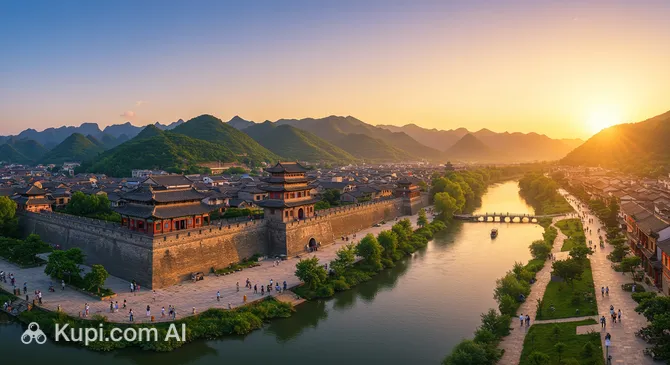
Located in the heart of Hubei Province, Dangyang is a fascinating blend of booming industry and deep historical heritage. This city in China is primarily known as the setting for key events of the Three Kingdoms era, attracting fans of ancient legends and Eastern philosophy.
Geographically, the city occupies a strategic position in the east of the country, serving as an important economic hub. With a population of about 560,000 people, Dangyang manages to maintain an atmosphere of tranquility in its park zones, despite its status as one of the major regional centers. Dangyang. Illustration.
Source: Kupi.com AI
Travelers here will find a rich cultural heritage: from the ancient tombs of great generals to picturesque mountain landscapes. The city invites you to dive into a world where a modern industrial rhythm exists alongside the meditative spirit of Buddhist temples and majestic monuments of the past.
Weather Overview
Dangyang is characterized by a subtropical monsoon climate, which dictates a clear change of seasons. Summers here are usually hot and humid: in July and August, the average daytime temperature often exceeds 30°C, and high humidity can make walking tiring. Winters, by contrast, are quite mild and dry, with average temperatures around 4-6°C in January, although frosts are possible at night.
The highest amount of precipitation falls in June and July, when monsoon rains cover the region. During this time, there can be up to 17 wet days per month. If you are planning a visit, it's worth noting that the weather in the city is most favorable during the spring months (April–May) and in autumn (September–October), when the temperature is a comfortable 18-24°C.
Travelers are advised to bring light clothing made of natural fabrics for summer and windproof jackets for the transitional seasons. In winter, warm layered clothing will come in handy, as indoors can be cool due to the lack of central heating typical of the southern and central regions of the country.
Average monthly temperature
Average monthly precipitation
Interesting Facts
Optical Capital: Dangyang is considered one of the world's largest centers for the production of eyeglass lenses; more than 1,600 optics-related enterprises operate here.
Land of Heroes: Many of the city's landmarks are named after characters from the classic novel "Romance of the Three Kingdoms," turning the city into a living history book.
Economic Leap: In 2014, Dangyang officially entered the list of Chinese cities whose GDP exceeded the 100 billion yuan mark.
Iron Relic: A local temple houses one of the tallest and best-preserved iron pagodas in the country, dating back to the Song Dynasty period.
How to Get There
The transport accessibility of Dangyang is driven by its role as an important industrial center in Hubei Province. The city is integrated into the regional network, allowing tourists to choose from several modes of travel. Most travelers arrive in the city via the nearest major transport hubs, from where it is easy to plan the rest of the way to the city.
The city does not have its own major airport, so air passengers most often use terminals in Yichang or more distant metropolises such as Wuhan. From there, Dangyang can be reached by high-speed trains or intercity buses, which run regularly and provide comfortable travel across the province.
Railway communication is the most convenient and popular way to travel. The city's stations receive trains from various directions, connecting it with key cities in the region. This allows for quick and budget-friendly access to the historical monuments of the Three Kingdoms era.
The main attractions of Dangyang are inextricably linked with the heroes of the Three Kingdoms era. One of the most revered sites is the Guan Yu Mausoleum—the tomb of the legendary general whose spirit, according to legend, still protects these lands. No less significant is Changbanpo Park, where the dramatic events of the rescue of the heir to the throne by the brave Zhao Yun took place.
For those seeking solitude and natural beauty, the scenic Yuquan Mountain area is a must-visit. This area is often called the "cultural calling card" of the region. It is home to the ancient Yuquan Temple, founded during the Sui Dynasty, and the unique Lengjin Iron Pagoda, which has survived since the Northern Song Dynasty.
Also of interest is the Yide Cultural Park, dedicated to Zhang Fei. A grand statue of the hero stands here, and interactive events are often organized for visitors, including traditional craft workshops and historical costume fittings. In the city's surroundings, it is also worth visiting the ruins of the ancient city of Maicheng and Mopan Mountain.
Local Cuisine
The gastronomic face of Dangyang is closely linked to the culinary traditions of Hubei Province, although influences from neighboring regions can also be found. The cuisine is distinguished by rich flavors and the use of local seasonal products, making every dish unique in its own way.
The main local delicacy, which is highly recommended for every guest to try, is Guochang Chicken. This signature dish is famous for its special preparation method and aroma, which has become a culinary trademark of the city. Traditionally, it is served in local restaurants specializing in classic home cooking.
The food culture here is simple and soulful: locals prefer to dine in small establishments with open kitchens or visit markets where you can find the freshest snacks. As for beverages, pay attention to the local tea, which perfectly complements the hearty meat dishes of Hubei cuisine.
Travel Tips
A trip to Dangyang will be a pleasant and easy experience if you take into account a few practical nuances typical of this historical and industrial center.
Clothing and Essentials: Choose your wardrobe according to the season—summers here are humid and hot, and winters can be quite cool. Be sure to bring comfortable shoes for walking in the hilly terrain of Yuquan Mountain and an umbrella in case of sudden rain.
Transport: The most convenient way for a tourist to get around is by taxi or specialized apps. High-speed trains are ideal for regional travel, and tickets are best purchased in advance.
Finance: The main currency is the yuan. International cards are rarely accepted, so set up Alipay or WeChat Pay linked to your card. Cash will only be useful for small expenses in remote areas.
Health and Safety: The city is safe for walking, but it's always worth having a hotel card with the address in Chinese. Pharmacies are easy to find in the center, but it's better to bring specific medications with you.
Communication: English is not widely spoken here. Download an offline translator and buy a local SIM card for access to maps and navigation.
Local Etiquette: Be polite and patient. A greeting with a nod or a slight bow is always welcome. Taking photos in temples should only be done where explicitly permitted.
What to Avoid: Do not attempt to discuss sensitive political topics and try not to plan visits to popular sites during national holidays, when queues can be enormous.
Specific Tip: Visit the optics markets—it is a unique Dangyang experience where you can order high-quality glasses for a fraction of their cost in other countries.
Dangyang will give you many vivid impressions if you allow yourself to stray a little from the standard routes and soak in the spirit of ancient China.
Entertainment & Nightlife
Evening Dangyang is more of a place for quiet walks and soaking in the local atmosphere than a center of bustling nightlife. Most entertainment is concentrated around theme parks and cultural centers. For example, Yide Cultural Park often hosts evening events with a historical theme, where you can see theatrical performances dedicated to the Three Kingdoms era.
Daytime leisure is diversified by interactive zones where tourists can try on the armor of ancient warriors or take part in folk craft workshops. In the city center, you can find cozy tea houses and restaurants that stay open until late evening, offering guests traditional hospitality.
Those accustomed to the format of megacities with their noisy clubs and bars should take into account the city's industrial profile. For large-scale parties and modern concert venues, travelers usually head to neighboring major administrative centers, returning to Dangyang for cultural enrichment and the silence of historical parks.
Parks & Museums
The green zones of Dangyang are not just places for relaxation, but true landscape monuments. The central feature is the picturesque Yuquan Mountain area, where dense forests surround ancient temple buildings. This is an ideal place for those who want to combine a walk in the fresh air with a tour of historical relics, such as the famous iron pagoda.
For family vacations and educational walks, Changbanpo Park is excellent. It is laid out on the site of a legendary battle and offers visitors not only well-maintained paths and shady alleys but also many monuments dedicated to the deeds of ancient heroes. This place literally allows you to touch the pages of Chinese classical literature.
Yide Cultural Park also deserves attention as an open-air museum. The atmosphere of old China is recreated here, and the exhibitions are dedicated to the daily life and military art of the past. The combination of natural beauty and museum elements makes the city's parks the main points of attraction for tourists seeking quiet and informative leisure.
Getting Around
The public transport system in Dangyang is mainly represented by a network of bus routes that connect the main residential areas with industrial zones and the railway station. Buses are the most economical way to get around, but tourists may need a translator app or a route map in Chinese for navigation.
For trips to remote attractions, such as Yuquan Mountain, it is most convenient to use taxis or car-hailing services via mobile apps. The cost of trips around the city is quite affordable, and drivers are generally happy to take tourists to the main historical sites.
Bicycle and electric scooter rental services are actively developing in the city, which is convenient for short trips along the central streets. When planning trips, you should consider the rush hours in the morning and evening, when transport may be crowded due to the activity of industrial workers.
Accommodation
The hotel stock in Dangyang caters to both business travelers and tourists arriving for the historical sites. You can find high-quality mid-range hotels offering a decent level of service and modern amenities, which is particularly relevant for an industrial center.
For those planning to explore the Three Kingdoms monuments, staying in the central areas or near major transport arteries is most convenient. Budget accommodation options are represented by small hotels and guest houses, which allow you to save money while maintaining basic comfort.
During peak tourist seasons, especially during Chinese holidays, it is recommended to book accommodation in advance through international search systems. As the city is actively developing economically, business delegations often stay here, so it is better to check for availability a couple of weeks before your trip.
Nearby Cities
Thanks to its location, Dangyang serves as an excellent base for exploring central China. A developed transport network allows you to reach neighboring cities in a short time, each with its own unique character and set of attractions.
Just 50 kilometers away is Yichang, famous for its majestic hydraulic structures and scenic views of the Yangtze River. It is also worth visiting Jingzhou—an ancient city with massive fortress walls, which also plays an important role in the history of the Three Kingdoms. For short trips, Zhijiang and Yidu are suitable, where you can feel the atmosphere of provincial China.
The city's surroundings are rich in cultural discoveries. Each trip to neighboring Shayan or other nearby centers will allow you to deeper understand the history of this region and enjoy the variety of local landscapes and traditions.
Shopping & Souvenirs
Shopping in Dangyang has a very specific character. The city is world-renowned as a giant center for optics production. Therefore, the most popular items here are eyeglass lenses and various accessories. Specialized markets and shopping pavilions offer a colossal choice—from budget frames to high-tech anti-reflective lenses at very attractive prices.
If you are looking for traditional souvenirs, it is worth checking out the shops at cultural parks such as Yide. There, you can purchase products from local artisans, commemorative figurines of Three Kingdoms heroes, and calligraphy. Typical Hubei products, such as local tea or silk goods, are also available in stores in the city center.
Shops usually operate from morning until 8–9 PM. The main method of payment is mobile payment systems (Alipay, WeChat Pay), which are accepted almost everywhere—from large shopping malls to small street kiosks. Cash should only be kept on hand as a reserve for trips to remote rural areas.