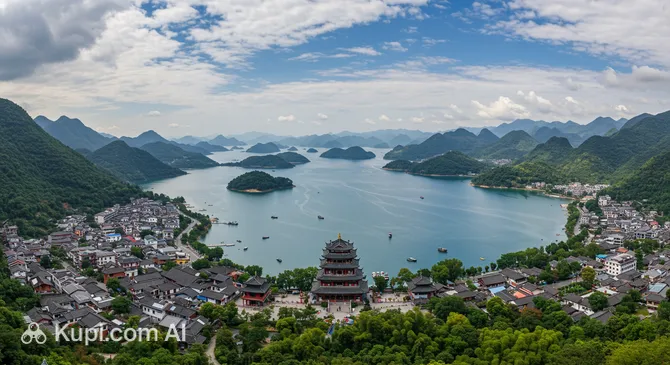
Zhijiang is a dynamic county-level city located in Hubei Province, in the very heart of China. Situated just 60 kilometers from the major prefectural center of Yichang, Zhijiang serves as an important link and a cozy residential area on the banks of the great Yangtze River. With a population of about 496,000 people, the city maintains the atmosphere of a typical Chinese industrial center, where modern urban life is closely intertwined with the region's agricultural way of life.
Zhijiang. Illustration.
Source: Kupi.com AI
The city's geographical position in a fertile plain and hilly zone makes it attractive for those who want to see the real, non-touristic China. The history of this place is inextricably linked to important events of the 20th century: it was here that the act of surrender of Japanese troops was signed in 1945, turning this modest county into a symbol of the end of World War II in Asia.
Although Zhijiang is not a world-renowned resort, it charms with its sincerity: lively markets, a picturesque Yangtze waterfront, and the hospitality of the locals. It is an excellent place for those who appreciate practicality and want to explore provincial Hubei, using the city as a convenient base for trips to the region's famous natural attractions.
Weather Overview
The climate of Zhijiang is classified as subtropical monsoon, which is typical for all of central Hubei. The weather here is largely determined by the proximity of the Yangtze River, which brings high humidity and frequent fogs. Expect truly hot and humid summers with occasional heavy rain, when temperatures in July and August often exceed +30°C, and cool, relatively dry winters with an average January temperature around +5°C.
The most comfortable times to visit the city are spring (April-May) and autumn (September-October), when pleasant warmth sets in and rainfall is moderate. In winter, despite the absence of severe frosts, the high humidity can make it feel colder than it actually is. To better plan your visit, you can study the detailed Zhijiang climate by month.
During the summer months, be prepared for the rainy season—June is usually the wettest month of the year, with up to 200–225 mm of precipitation. In the fall, the weather stabilizes and the number of sunny days increases, which is ideal for long walks along the embankment and exploring the city's surroundings.
Average monthly temperature
Average monthly precipitation
Interesting Facts
Symbol of Peace: It was in Zhijiang on September 18, 1945, that the act of surrender of the 100,000-strong Kwantung Army was signed, making the city an important point on the world's military-historical map.
Orange Country: Thanks to its mild climate and proximity to the Yangtze River, Zhijiang is one of the leading centers for orange cultivation in Hubei Province; the local fruits are famous for their sweetness.
Transport Hub: Despite its status as a county-level city, Zhijiang is connected to China's largest cities by a high-speed railway, allowing you to reach Wuhan in just a couple of hours.
Population Density: The city covers an area of about 585 km², with a fairly high population density of about 850 people per square kilometer.
Agrarian Roots: Despite active development, the city's urbanization rate is about 60%, allowing it to maintain a close connection with agriculture and the traditional way of life.
How to Get There
The transport accessibility of Zhijiang makes it a convenient stop when traveling through Hubei Province. Although the city itself does not have its own airport, it is within the influence zone of a major aviation hub. The primary way to reach Zhijiang by air is via a flight to Yichang Sanxia Airport, located about an hour's drive away. From there, the city can be quickly reached by taxi or intercity bus.
Rail travel is the most practical option for travelers. Zhijiang Railway Station (GJN) is located in the city center. This station serves modern high-speed trains connecting the city with the country's key hubs. For example, the journey from Yichang takes no more than 30 minutes, while a trip from Wuhan takes between 2 and 3 hours.
For those who prefer road transport, the G50 expressway passes through Zhijiang. Buses from Yichang run every 15–30 minutes; however, it's worth noting that traffic jams are possible during morning and evening rush hours, increasing travel time by 20–40 minutes. You can find more detailed information on routes in the section how to get to Zhijiang.
Main Attractions
Even though Zhijiang is not overflowing with classic tourist sites, there are several places worth visiting. The city's main historical site is rightfully considered the Zhijiang Surrender Memorial Hall. This landmark site is dedicated to the events of September 1945; the museum halls house rare documents, photographs, and artifacts telling the story of the final chords of the war in Asia.
For quiet walks, the Yangtze River embankment is ideal. This is a center of attraction for locals, where you can watch the movement of ships along one of the world's greatest rivers, do morning exercises, or simply enjoy the evening breeze. The waterfront is especially colorful at sunset, when the city lights begin to reflect in the water.
Fans of modern urban aesthetics and shopping should check out the central quarters, which house large shopping complexes such as Wal-Mart. These are not just stores, but true centers of social life, surrounded by bustling trade and numerous street food stalls offering the authentic flavors of Hubei Province.
Local Cuisine
The gastronomic scene in Zhijiang is a feast for lovers of the bold and rich flavors characteristic of Hubei cuisine (often influenced by Sichuan styles). The main hit of the local table is fish caught in the Yangtze. Be sure to try "hot pot" (huǒguō) with river fish, which is prepared here with a generous addition of Sichuan pepper and local herbs.
For breakfast, Zhijiang residents usually choose reganmian—the famous hot dry noodles with sesame paste—or doupi—unique multi-layered "cakes" made of tofu, rice, and meat. Another local specialty not to be missed is dishes using local oranges, such as tender braised beef with orange peel (chenpi niurou).
The food culture in the city is concentrated in small family cafes and street food stalls where the food is always fresh and affordable. The best gastronomic experiences can be found at the markets near the waterfront, where rows of street food stalls open up in the evenings. For drinks, locals prefer green tea from the plantations of Hubei Province or a cold beer, which perfectly complements the spicy dishes.
Travel Tips
A trip to Zhijiang will allow you to see the real China without the tourist gloss. To ensure your trip goes smoothly and leaves only pleasant impressions, check out these practical tips.
Clothing by Season: Humidity is very high in Hubei. In summer, bring light cotton clothing, and in winter, wear layered items and a windproof jacket, as the humidity makes the cold feel more intense. Comfortable shoes are essential for walks along the waterfront.
Transport and Navigation: Install the Didi app (similar to Uber) for calling taxis. This is more convenient and often cheaper than hailing a car on the street. Use high-speed trains for trips to Yichang—this will save you a lot of time.
Finances and Payment: Cash is gradually becoming a thing of the past. Be sure to link a card to Alipay or WeChat Pay. International cards are only accepted at very large ATMs, so having a small supply of yuan in your pocket won't hurt.
Health: Drink only bottled water. Air quality in the industrial district can vary, so during heavy winter fogs, a protective mask might be useful.
Communication: English is a rarity in Zhijiang. Download an offline translator and save your hotel address in Chinese characters to show to the taxi driver.
Local Etiquette: Chinese people are very friendly but value politeness. Greet people with a slight nod. In restaurants, do not leave chopsticks standing vertically in a bowl of rice—this is considered a bad omen.
What to Avoid: Do not plan important trips during peak hours (7:00–9:00 AM and 5:00–7:00 PM), when public transport is overcrowded. Also, try to avoid walking in remote industrial zones after dark.
Connectivity: Buy a local SIM card at the airport or a major communication center in Yichang. Wi-Fi is available in hotels, but you will need a VPN to access many familiar services.
Following these simple rules will help you feel confident in Zhijiang and enjoy the authentic atmosphere of central China!
Entertainment & Nightlife
Nightlife in Zhijiang is characterized by its tranquility and is primarily focused on local residents. You won't find noisy international clubs or European-style pubs here; however, karaoke lovers won't be bored. Numerous KTV centers are scattered throughout the city and are the main venue for evening leisure. Young people and active tourists often prefer to spend their evenings in billiard halls or playing board games, which are popular in China.
For those looking for larger-scale entertainment, cinemas, or concept bars, the best solution is a trip to neighboring Yichang. Thanks to the high-speed rail link, the journey to the entertainment venues of the large metropolis takes only about 30 minutes, allowing you to return the same evening.
Daytime entertainment in the city is centered around outdoor activities in the park areas by the Yangtze. These are popular spots for family picnics and outdoor sports. On weekends, you can often find local festive events in the central squares and markets, allowing you to immerse yourself in the everyday culture and life of a modern Chinese county.
Parks & Museums
The main place for outdoor recreation in the city is Zhijiang Riverside Park. Stretching along the Yangtze River over an area of about 10 hectares, the park offers residents and visitors well-maintained walking paths, green lawns, and beautiful river views. It is the perfect place to escape the city bustle and watch the slow flow of life on this great water artery.
The city's cultural and historical memory is concentrated in the Zhijiang Surrender Memorial Hall. This is a unique institution of regional significance that attracts attention with its austere architecture and the importance of its exhibits. Visitors can see historical photographs and documents capturing one of the most important moments in 20th-century Chinese history. The museum is an important educational center and a must-visit for those interested in military history.
While Zhijiang does not yet have major world-class art galleries, the city is gradually developing its public spaces. Small squares and green zones in the city center provide the necessary coziness, and the proximity to the larger Yichang allows residents to easily visit large-scale museums and national parks in the neighboring metropolis.
Getting Around
The public transport system in Zhijiang is simple and straightforward. The basis of intra-city transport is buses, which cover all residential and industrial areas. The fare is fixed and costs only 1–2 yuan. Headways in the center are 10–20 minutes; however, it's worth considering that during peak hours buses can be overcrowded, and travel time may increase due to traffic jams.
Taxis and ride-hailing services via the Didi app are excellent alternatives to public transport. A trip around the city usually costs between 10 and 30 yuan, making this method of travel very popular among tourists. In the city center, many prefer to use electric scooters or bicycles—this is a convenient way to quickly reach the waterfront or the market, bypassing traffic congestion.
It is important to remember that there is no metro or tram system in Zhijiang, so plan your routes with bus schedules or taxi availability in mind. Payment on buses is often made in cash (via a coin box) or using QR codes on your phone. Do not count on English signs, so it is useful to have the names of the necessary stops in Chinese with you.
Accommodation
Accommodation options in Zhijiang are mainly geared towards business travelers and transit tourists, so luxury five-star hotels should not be expected here. Nevertheless, the city offers a wide selection of high-quality mid-range chain hotels and budget inns. Popular Chinese chains such as Hanting or 7 Days Inn are represented near the railway station and in the central part of the city, providing comfortable lodging at affordable prices (usually from 100 to 300 yuan per night).
For those planning to stay in the city for a long period, renting an apartment in modern residential complexes can be an interesting option. This allows you to feel the local rhythm of life and significantly save on accommodation. Rental costs here are much lower than in major metropolises, starting from 1,500–3,000 yuan per month for a fully equipped apartment.
When choosing accommodation, it is better to focus on the central areas or the vicinity of the station—this will provide easy access to shops, markets, and transport. Given the region's specifics, it is recommended to book accommodation in advance through Chinese services or international aggregators, as staff in small hotels rarely speak English, and having a confirmed booking will simplify the check-in process.
Nearby Cities
Zhijiang serves as an excellent starting point for exploring the picturesque surroundings of Hubei Province, offering travelers a variety of routes for day trips. Just 54 kilometers away is the major city of Yichang, where you can see the grand Three Gorges Dam—the world's largest hydroelectric power station—and enjoy cruises along the Yangtze.
For history buffs, a trip to the ancient Jingzhou is an excellent choice. This city is famous for its magnificently preserved city walls and rich cultural heritage from the Three Kingdoms era. It's also worth paying attention to neighboring Yidu, which attracts visitors with its natural landscapes and peaceful atmosphere.
Exploring nearby cities such as Dangyang or Songzi will allow you to dive deeper into the authentic life of central China. Most of these destinations are accessible by high-speed trains or buses, making regional travel easy and exciting.
Shopping & Souvenirs
Shopping in Zhijiang is predominantly practical and everyday in nature, reflecting the needs of a modern county city. The main center of attraction for shoppers is the area around the Wal-Mart supermarket in the city center, where you can find a wide range of goods—from food to household appliances and clothing from popular brands. It is always busy here, and prices are quite reasonable.
If you are looking for something more authentic, head to the local markets near the banks of the Yangtze. This is the ideal place to buy the freshest fruits the region is famous for—especially the renowned Zhijiang oranges. At the markets, you can also find local tea, spices, and simple handmade souvenirs. Moderate bargaining is appropriate here, and the atmosphere allows you to feel the true flavor of Chinese trade.
City shops usually stay open until 9:00 PM or 10:00 PM, while markets open early in the morning. The primary payment methods are the mobile apps Alipay and WeChat Pay, so tourists are recommended to set them up in advance. Cash is accepted almost everywhere, but finding change can sometimes be difficult. For luxury brands and large shopping malls, residents usually head to neighboring Yichang.