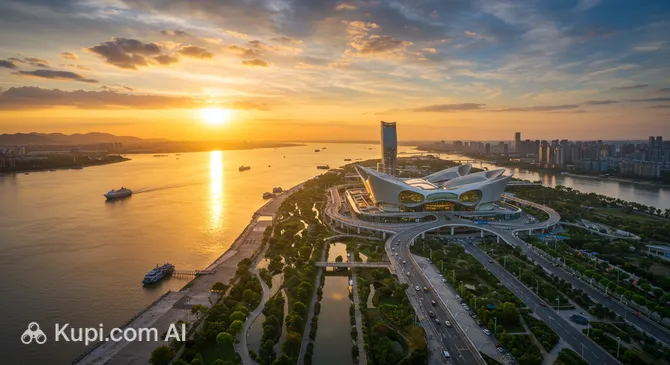
Located at the confluence of the majestic Yangtze River and its tributary, the Huangpu, Wusong represents a unique blend of industrial power and China's deep maritime heritage. Serving as the historical "gateway" to Shanghai, this district maintains the atmosphere of a port city, where massive cargo liners and container terminals sit alongside quiet parks and ancient fortifications.
Geographically, the city occupies a strategic position in northeastern Shanghai, serving as a vital logistics hub. With a population of over 1.3 million people, Wusong has evolved from a small fortress into a large-scale industrial center while preserving evidence of its heroic past. Getting to know the rich history of the region provides a better understanding of how maritime trade and the defense of the East Coast developed.
Wusong. Illustration.
Source: Kupi.com AI
For tourists, the city is primarily attractive for its historical forts and the opportunity to see one of the world's largest ports in action up close. Here, you can stroll along the embankments, which offer breathtaking views of the river expanses, and visit unique themed museums dedicated to brewing and shipbuilding. Wusong is a place for those looking for more than just traditional pagodas in China, but also the living history of modern industry and the navy.
A visit to Wusong is an excellent addition to a trip to Shanghai, offering a calmer but equally important perspective on the life of this metropolis. We invite you to discover this "Key to the Yangtze" and enjoy its industrial romance.
Weather Overview
Wusong is dominated by a subtropical monsoon climate, characteristic of the entire East China Sea coast. This means that travelers can expect hot and humid summers, with temperatures in July and August often reaching +32...+35°C, and mild but windy winters with temperatures around +3...+8°C. The most comfortable periods for a visit are considered spring (April-May) and autumn (October-November), when pleasant warm weather sets in.
Precipitation is unevenly distributed: peak rainfall occurs in June and July during the "plum rain" season. At this time, humidity increases significantly, so it's worth checking the detailed city climate before your trip. Winters here are mostly dry, and frosts are extremely rare, making riverside walks possible even in January with a warm windbreaker.
Average monthly temperature
Average monthly precipitation
Interesting Facts
Wusong is historically considered the "Key to the Yangtze" and the "Throat of Shanghai" due to its critical location at the mouth of the rivers, making it the city's main defensive point for centuries.
It was here in 1850 that one of the first serious encounters between the British fleet and Chinese coastal fortifications took place, forever etching the district into world maritime history.
The local brewery, founded in 1900 as the Shanghai Brewery, is one of the oldest in China and still maintains the production traditions started at the beginning of the last century.
The district is home to one of Asia's largest cruise terminals, capable of receiving the most modern ocean liners from around the world.
The Wusong Paotai fort, which survives to this day, was built back in 1553 to protect against Japanese "Wokou" pirates.
How to Get There
Wusong's transport accessibility is closely linked to the infrastructure of Shanghai, of which it is a part. The city is very conveniently located for those arriving in the region on international or domestic flights, thanks to its proximity to Asia's largest transport hubs. To plan your route as efficiently as possible, it is recommended to study general information in advance on how to get to this coastal district.
Although Wusong itself does not have its own airport, travelers use Shanghai's two main air gateways. Pudong International Airport (PVG) handles most international flights, while Hongqiao Airport (SHA) focuses on domestic routes and high-speed trains. From both airports, Wusong can be reached by taxi or metro in 60–90 minutes, depending on traffic.
Railway connections are also excellently developed. The nearest important point is Baoshan station, where trains from neighboring provinces arrive. Additionally, high-speed trains from across the country arrive at Shanghai's main stations, from which Wusong is easily accessible by metro (Line 3 or 7). This makes the trip fast and comfortable even for those traveling from remote regions of China.
Station
Passenger traffic
Distance
Shanghai University station
8
12 km
South Waigaoqiao Free Trade Zone station
8
14 km
Shanghai West railway station
10
16 km
Shanghai Hongqiao railway station
19
27 km
South Lingyan Road station
10
27 km
Shanghainan Railway Station
16
27 km
Buses and private transport via the G40 highway are actively used for moving between districts. If you prefer public transport, the metro remains the most reliable way to avoid traffic jams and quickly find yourself in the heart of the port district.
Main Attractions
One of the city's most impressive sights is the historical Wusong Paotai fort. Founded in the mid-16th century to protect the coast from pirates, this defensive complex still houses ancient cannons and massive walls that witnessed key naval battles. For tourists, it is not only an open-air museum but also a wonderful observation deck overlooking the river.
Fans of industrial aesthetics should pay attention to Wusongkou Park. This is a picturesque green area located right at the confluence of the Huangpu and Yangtze rivers. The park is ideal for long walks, during which you can observe the endless movement of massive ocean liners and cargo ships. The atmosphere of the grandeur of the water element and human progress is felt especially strongly here.
Another iconic spot is the Wusong Brewery, which is considered one of the oldest in the country. It houses a beer museum where visitors can learn about the history of beer production in China dating back to 1900. The tour concludes with a tasting of local varieties, making it a popular stop on many travelers' itineraries.
While Wusong remains largely an industrial district, its maritime soul is revealed in the details: from port docks to memorials dedicated to naval glory. Visiting these places allows you to see China from an unusual perspective, far from the familiar polish of Shanghai's central neighborhoods.
Local Cuisine
Wusong's gastronomic identity is inextricably linked to classic Shanghai cuisine, which is famous for its delicate flavor with light sweet notes. The main hit that you must try is the famous xiaolongbao—steamed dumplings with a juicy filling and hot broth inside. Equally popular are shengjianbao—pan-fried pork buns, which are often sold at small street stalls and are perfect for a quick snack.
Seafood holds a special place in the local diet. Since Wusong is a port city, you can always find fresh fish and the famous hairy crab, which is considered an exquisite autumn delicacy. Crab dishes appear on the menus of almost every restaurant during the season, attracting gourmets from all over the region.
As for drinks, Wusong is proud of its historical beer. A local lager from the Wusong Brewery is an excellent choice for a hot day. Among non-alcoholic options, Longjing green tea is a must-try, brewed here in the best traditions of the Chinese tea ceremony. Locals prefer to have lunch in small family restaurants or at food courts in the Baoshan district's shopping centers.
The street food culture in Wusong is thriving: at evening markets, you can find a huge variety of chuan’r skewers and fragrant noodles. This is a great opportunity to get to know the true taste of the city in a relaxed and lively atmosphere.
Travel Tips
Planning a trip to Wusong requires considering some local peculiarities that will make your visit more comfortable and interesting. These practical tips will help you find your way around the port district and enjoy its atmosphere without unnecessary hassle.
Clothing and Seasonality: The best time to visit is spring and autumn, when the weather is mild. In summer, Wusong is very hot and humid, so be sure to bring light clothing made of natural fabrics and sunscreen. Comfortable shoes will come in handy for walks by the river, as you will have to walk a lot.
Transport and Navigation: Be sure to download the Baidu Maps or Amap app, as standard Western maps may not work correctly. For paying for the metro and buses, it is most convenient to use the transport function in Alipay.
Finances: Cash is increasingly rarely accepted in China. Install and link your international card to Alipay or WeChat Pay before you arrive. This will allow you to pay for everything—from street food to museum tickets.
Communication: English is not widely spoken in Wusong, so install an offline translator in advance. A few basic phrases in Chinese (for example, "Ni Hao"—hello) will help you win over the locals.
Connectivity: To access your usual social networks and services, you may need a VPN. You can buy a local SIM card at the airport or official carrier offices by presenting your passport.
Local Etiquette: Chinese people value politeness highly. A slight nod of the head is sufficient when meeting. Avoid loud conversations on public transport and always ask for permission before taking photos of local residents.
What to Avoid: Do not attempt to enter the territory of industrial docks or closed port zones without an official tour—these are restricted facilities, and security treats the rules very strictly.
Additional Tip: Try to combine a visit to Wusong with a cruise on the Huangpu River—this will allow you to see the scale of the port from the best vantage point.
Wusong is an amazing place where history meets the future. By following these simple tips, you can focus on the main thing—your new impressions of this industrial heart of Shanghai!
Entertainment & Nightlife
The entertainment scene in Wusong is characterized by its tranquility and is oriented more toward contemplative relaxation than noisy parties. The main spot for evening leisure for both locals and visitors is the embankment and Wusongkou Park, where it is pleasant to walk after sunset when the port cranes and ships are illuminated by thousands of lights, creating a futuristic landscape.
There isn't much in the way of classic nightlife with an abundance of clubs in the district itself; for active clubbing and world-class bars, travelers usually head to the center of Shanghai, which is easily accessible by metro. However, in Wusong itself, you can find cozy local bars and authentic karaoke halls (KTV), which are an integral part of Chinese leisure culture.
Safety in the area is at a high level, and night walks along the lit streets are quite comfortable. If you need to return to your hotel late at night, it is best to use an official taxi or the Didi mobile app—it is reliable and inexpensive. During the day, you can diversify your leisure time by visiting local parks or small theaters where folk groups sometimes perform.
Parks & Museums
The main place for outdoor recreation in this district is Wusongkou Park. This is not just a park, but a real panoramic platform stretching along the coastline. It features well-maintained paths for walking and cycling, and from the embankment, you can spend hours watching the waters of two great rivers meet. It is an ideal place for those who want to take a break from the city bustle while enjoying the sea breeze.
The cultural program should start with a visit to the Baoshan Art Museum. The museum is known for its exhibitions of contemporary art and the interesting architectural solutions of the building itself. It often hosts exhibitions of both local masters and famous Chinese artists, allowing guests to experience current trends in Eastern art.
The Wusong Beer Museum holds special historical value. Located at the old brewery, the museum tells the story of the evolution of industrial production in China and Wusong's role in this process. Visitors can see ancient equipment and learn the recipe secrets used over a century ago. These museums and parks create a balanced image of Wusong as a city where history is respected and modern comfort is valued.
Getting Around
The public transport system in Wusong is fully integrated into Shanghai's overall network, making moving around the district extremely easy for tourists. The backbone of the transport framework is the Shanghai Metro: Lines 3 and 7 connect Wusong with the center of the metropolis and key railway stations. Metro stations operate approximately from 5:30 to 23:00, and trains run at intervals of a few minutes.
Surface transport is represented by an extensive network of buses and electric buses. Routes such as No. 165 and No. 729 allow you to reach parts of the district where there is no metro. Fares are paid using transport cards, which can be purchased at any metro station, or via QR codes in mobile applications. The cost of a metro ride depends on the distance but remains very affordable for travelers.
As an alternative, many prefer to use taxis, particularly the popular Didi service (the Chinese equivalent of Uber). Taxi rides within the district are inexpensive, and cars arrive very quickly. For those who prefer active movement, short-term bike rental services are available at every turn, which is very convenient for trips along the embankment or into park areas.
Accommodation
The choice of accommodation in Wusong is mainly represented by mid-range hotels and budget options catering to business travelers and those connected to the port industry. Here you can find high-quality chain hotels, such as the Holiday Inn Shanghai Baoshan, offering international standards of service, or more economical options like the Ibis Baoshan, which are ideal for short stays.
The most convenient areas to stay are considered the surroundings of the Baoshan Road metro station or areas near the seaport. Proximity to transport arteries allows for quick access to both local attractions and central Shanghai. It should be noted that the choice of elite five-star hotels directly in Wusong is limited, so luxury seekers are sometimes advised to stay in the city center and visit the district on day trips.
The general price range in the area is lower than in the tourist center of Shanghai, making Wusong attractive for budget travelers. We recommend booking accommodation in advance, especially during major exhibitions or active cruise liner seasons. For finding and paying for rooms, it is most convenient to use popular international services or local Chinese platforms.
Nearby Cities
Due to its location within one of the world's largest metropolises, Wusong serves as an excellent starting point for exploring the East Coast. The transport network allows you to find yourself in completely different worlds within minutes or hours—from futuristic skyscrapers to ancient "Venices of China."
Just 18 kilometers away lies the heart of the metropolis—Shanghai. This is the number one destination for a day trip: here you will find the famous Bund, Yu Garden, and endless shopping opportunities. The city center can be reached by metro in less than an hour, making such trips extremely simple and accessible.
It is also worth checking out the historical Huangpu district, where much of the colonial architecture is concentrated, or heading to modern Pudong to see the famous Oriental Pearl TV Tower. If you want to see a more traditional China, high-speed trains will quickly take you to Suzhou or Nanjing.
The region around the city offers a huge number of attractions for every taste. We strongly recommend not limiting yourself to the port zone and taking the time to explore neighboring cities, each of which possesses a unique character and history.
Shopping & Souvenirs
Shopping in Wusong is more practical and modern in nature, typical of a dynamically developing district. The main points of attraction for shoppers here are large shopping centers, such as Baoshan Wanda Plaza. These malls feature a wide selection of international and Chinese brands of clothing, electronics, and cosmetics, as well as numerous relaxation areas and cinemas.
If you are looking for something unique, look for maritime-themed souvenirs. In small shops, you can find detailed ship models and nautical accessories, which will be a great reminder of your visit to one of the world's largest ports. A local beer in gift packaging or elite varieties of Chinese tea is also considered a traditional gift from this district.
Shops in shopping centers usually operate from 10:00 to 22:00. Mobile payment systems Alipay and WeChat Pay are accepted everywhere for payment, having practically replaced cash in China. While Wusong doesn't claim to be a fashion capital, its proximity to central Shanghai allows you to head to the famous Nanjing Road for luxury goods at any time.