Support

Palais-Musée des Archevêques, Palais Vieux

About

In the heart of the historic center of Narbonne stands a majestic ensemble known as the Archbishop's Palace and Museum (Palais des Archevêques). This unique structure in France served for centuries as the residence of high-ranking clergy; today, it combines the functions of the city's town hall and a rich museum space.
Archbishops
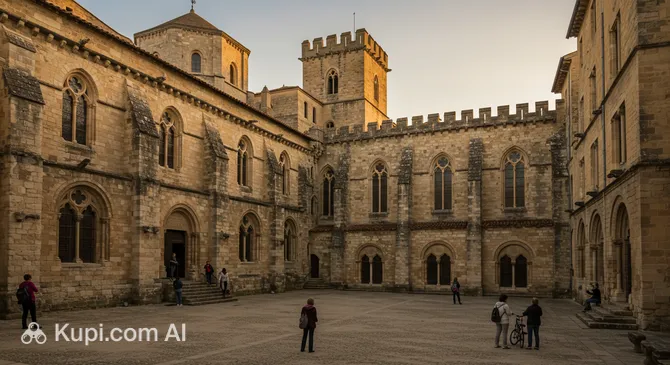
Archbishops' Palace and Museum (Palais Vieux). Иллюстрация. Источник: Kupi.com AI

The architectural complex is divided into two main parts: the Old Palace (Palais Vieux), built in the 12th–14th centuries, and the New Palace (Palais Neuf), whose appearance took shape through the 19th century. The dominant feature of the entire Place de l'Hôtel de Ville is the 42-meter Gilles Aycelin Tower, which offers panoramic views of the city. Since 1840, the building has been recognized as a national historic monument and is considered one of the most significant examples of medieval civic architecture.

Beyond its impressive facades with Gothic arches and towers, the palace hides the Museum of Art and History within its walls. Here, visitors can see not only ceremonial halls with painted ceilings but also rare collections of European painting, exquisite faience, and unique Orientalist canvases. This is a place where the power of a medieval fortress harmoniously blends with the sophistication of museum exhibits.

Contacts

To confirm the latest exhibition information or to plan a group visit, you can use the following contact details:

The complex staff are always ready to help tourists find their way through the schedules of individual halls and temporary exhibitions.

How to contactContact
AddressPalace of the Archbishops, 16 Pl. de l'Hôtel de Ville 13, 11100 Narbonne, France
Phone+33 4 68 90 31 34
Websitewww.narbonne.fr

What to Do

Start your visit to the complex with a leisurely walk through the inner courtyard, paved with rare pink marble from Minerve and black stone. Be sure to notice the facade of the New Palace with its elegant balconies and clock tower—the result of a large-scale 19th-century reconstruction. For the more active visitors, the main goal will be the climb up the Gilles Aycelin Tower, which offers the best views of the old city's tiled roofs.

Inside the Museum of Art and History (Palais Neuf), a true aesthetic treat awaits. It is worth spending time in the halls featuring paintings by European masters such as Veronese and Tintoretto, as well as examining a collection of Oriental-themed paintings that is unique for France. Don't miss the room with Roman mosaics and apothecary jars, which tell the story of daily life in past eras.

As the Old Palace is currently undergoing renovation for future archaeological exhibitions, most tourist attention is focused on the ceremonial interiors of the town hall. For convenience, it is recommended to purchase the Monumentale Narbonne Pass, which is valid for an entire year and allows you to comfortably visit all key sites of the complex, including the treasury of the neighboring cathedral.

Getting There

The historic ensemble is located at 16 Pl. de l'Hôtel de Ville, right in the heart of the city's pedestrian zone. If you arrive at the central station, Narbonne Gare, the walk to the site will take no more than 15–20 minutes (about 1.2 km) through the picturesque streets of the old town.

For those who prefer public transport, city buses going to the Hôtel de Ville stop are ideal. If you are traveling by car, it is most convenient to leave your vehicle at the Place aux Herbes parking lot, as vehicle access directly to the palace is restricted.

Travelers arriving from other regions via the Carcassonne or Béziers airports can easily reach their destination by regional train or via the A9 motorway. The entire historic city center is highly walkable, making a visit to the palace very convenient.

Ближайший город: Narbonne

History & Facts

Construction of this majestic residence began in the 12th century when Narbonne was a major religious center. The most recognizable part of the complex—the 42-meter-high Gilles Aycelin Tower—was built in 1308 and served as a symbol of the archbishops' power. The Saint-Martial and Madeleine towers, added in the 14th century, completed the look of this formidable medieval fortress.

The building's fate changed dramatically after the events of the late 18th century, when it ceased to be a spiritual sanctuary. Over the years, it housed military barracks and even a prison, until the city authorities purchased the complex in 1842 for use as a town hall. The reconstruction of the facades was handled by the famous architect Eugène Viollet-le-Duc, who gave the building features that blend austere Gothic style with Neoclassical elements.

One of the most emotional moments in the building's history occurred in 1907. At the height of a massive wine crisis, the city's mayor, Ernest Ferroul, addressed thousands of protesting winemakers directly from the palace balcony, announcing his resignation in a sign of solidarity with the people. Today, this site serves as a reminder of how closely religion, politics, and culture are intertwined within these walls.

Time Needed

To leisurely admire the architectural details of the facades, stroll through the courtyard, and climb to the observation decks, it is recommended to set aside about 1 hour. This is enough time for a general introduction to the exterior of the complex and a photo session.

If you plan to visit the Museum of Art and History located in the New Palace, allow another 1.5–2 hours. The collections here are quite extensive, and the interiors of the halls deserve thoughtful inspection. If you decide to combine your visit with a tour of the neighboring cathedral, the total walking time can be up to 4 hours.

Working Hours

The complex is open to visitors daily; however, it is worth noting the lunch break. On Monday and from Wednesday to Sunday, the palace is open from 10:00 AM to 12:30 PM and from 2:00 PM to 5:00 PM.

On Tuesdays, the museum operates on an extended schedule in the afternoon—until 6:00 PM. Please note that access to certain halls of the Old Palace may be temporarily restricted due to ongoing restoration work.

DayWorking hours
Понедельник10:00 – 12:30, 2:00 – 17:00
Вторник10:00 – 12:30, 2:00 – 18:00
Среда10:00 – 12:30, 2:00 – 17:00
Четверг10:00 – 12:30, 2:00 – 17:00
Пятница10:00 – 12:30, 2:00 – 17:00
Суббота10:00 – 12:30, 2:00 – 17:00
Воскресенье10:00 – 12:30, 2:00 – 17:00

Nearby

The Archbishop's Palace is at the epicenter of the city's cultural life, so a walk outside its walls promises to be just as interesting. The surrounding neighborhoods preserve traces of the Roman past and medieval grandeur, turning a simple stroll into a journey through time.

Exploring the nearby streets will allow you to see unique archaeological finds and ancient mansions that complement the historical context of the main palace complex.

NameDistance
Via Domitia0 km
Narbonne Cathedral0.1 km
Roman Horreum Museum0.2 km
Chez Bebelle0.3 km
Chez Lulu0.4 km
Karaoke Le Live0.5 km
Charles Trenet's Birthplace0.6 km

Reached the end of the page?

That means the route is fully explored