Support

St. Pauli Piers

About

St. Pauli Landungsbrücken is one of the most famous and iconic historical landmarks in Hamburg. Located on the right bank of the Elbe River in the lively St. Pauli quarter, this major river terminal is the true heart of the port and a popular tourist attraction in Germany. Landungsbrücken is a floating pier, or pontoon dock, that stretches for almost 700 meters along the embankment and serves as an important transport hub.
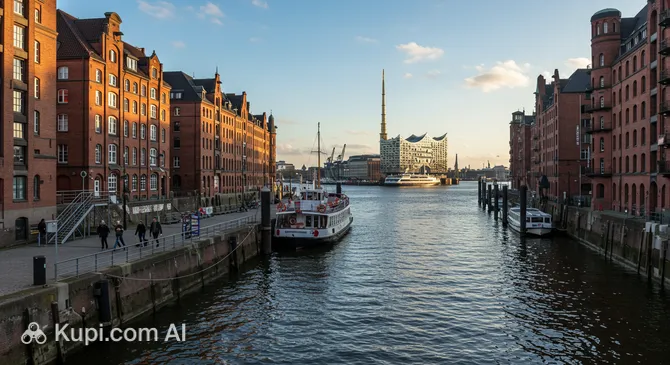
St. Pauli Piers. Illustration.
Source: Kupi.com AI

Traveler photos:

It is not just a pier, but a whole complex that plays a key role in the city's maritime life. Numerous port excursions, ferries, and pleasure boats depart from here, including shuttles to the famous "The Lion King" musical. Originally built in 1839 for mooring steamboats, today's pontoons were restored in the 1950s after the destruction of the Second World War. Thanks to its unique design, connected to the shore by movable bridges, the pier adapts to the tides of the Elbe.

The architectural center of the ensemble is the Pegelturm (Tide Tower), located in the eastern part of the complex. On its wall is a water level indicator that clearly demonstrates the current tidal phase. Additionally, the tower is equipped with a clock and a ship's bell that strikes every half hour, filling the harbor with authentic sounds. The pier offers magnificent panoramic views of the port of Hamburg, making it an ideal spot for photography and experiencing the city's maritime spirit. The entrance to the famous Old Elbe Tunnel, built in 1911, is also nearby.

Contacts

Since St. Pauli Landungsbrücken is a major public pier and transport hub, it does not have a single contact center. For information about specific services, such as river tours or restaurant operations, it is best to contact the companies located on the piers directly. The piers themselves are located at Bei den St. Pauli-Landungsbrücken and are easily accessible by public transport—it is most convenient to take the metro or suburban train to the Landungsbrücken station (lines U3, S1, S2, S3).

How to contactContact
AddressBei den St. Pauli-Landungsbrücken 8, 20359 Hamburg, Germany
Phone number+49 171 6840932
Websitewww.landungsbruecken-st-pauli.de

What to Do

St. Pauli Landungsbrücken is, first and foremost, the gateway to the maritime world of Hamburg. The main activity here is various water tours. You can embark on a grand sea cruise on a luxury liner, choose a sightseeing tour of the port area on a traditional barge, or take a romantic evening trip through the canals. The best views of the city open up from the water, and the location itself is a real find for photographers and those who want to take panoramic shots of the port. If you are lucky, you can catch giant cruise ships passing by, which is a spectacular sight in itself.

In addition to maritime entertainment, the St. Pauli district where the pier is located offers many options for leisure on land. It is a center of nightlife and culture known far beyond Germany. There is a huge concentration of bars, theaters, music halls, and clubs for every taste. The district gained special fame for Reeperbahn street, nicknamed the "sinful mile," with its famous red-light district and vibrant nightlife.

For lovers of architecture, a walk around Landungsbrücken will also be a pleasure. Many buildings in this area are built in the Art Nouveau style, or Jugendstil as it is called in Germany, and feature unique, distinct designs. Among the notable structures are the local Capitol and the Orthodox Church of St. John of Kronstadt, built in a strict Neo-Romanesque style. These architectural monuments add another interesting touch to the multifaceted image of this vibrant district.

Getting There

Getting to St. Pauli Landungsbrücken is very easy, as it is one of the largest transport hubs in Hamburg. The most convenient and popular way is to use public transport. Right by the pier is the Landungsbrücken station, which combines the metro (U-Bahn) and the suburban train (S-Bahn). Metro line U3, as well as S-Bahn lines S1, S2, and S3, arrive here, allowing you to reach your destination from almost anywhere in the city without transfers. A trip on the U3 ring line is a mini-excursion in itself, as most of it runs on an elevated track, offering picturesque views of the port and cityscapes.

In addition to rail transport, several bus routes run to Landungsbrücken. This is a great option for those who prefer ground travel. The stop is in the immediate vicinity of the piers. A unique way to arrive at the pier is by water. Landungsbrücken is the central station for HADAG port ferries, which are part of Hamburg's unified public transport system (HVV). This means you can take a ferry, such as line 62, on the other side of the Elbe and not only reach your destination but also enjoy a mini-cruise through the port using a regular transit pass.

If you prefer comfort, you can take a taxi. A trip from the central station (Hauptbahnhof) or from the city center will not take long, but you should consider potential traffic jams, especially during peak hours and on weekends. For those traveling by car, there are several parking lots in the area, but finding a free spot can be difficult due to the high popularity of this tourist site. Finally, the pier can be reached on foot from many central attractions, such as the historic Speicherstadt warehouse district or the modern HafenCity, turning the trip into a pleasant walk along the Elbe embankment.

Nearest city: Hamburg

History & Facts

The history of St. Pauli Landungsbrücken is inextricably linked with the district in which it is located. The St. Pauli quarter itself appeared as early as the beginning of the 17th century and was originally called "Hamburger Berg" (Hamburg Mountain). This name was given because of the hill where artillery had been stationed since 1620 to protect the city. At that time, this territory was outside the city walls of Hamburg, and businesses whose activities created loud noise or unpleasant odors—unacceptable in the main part of the city—were moved here.

The quarter received its modern name in honor of the Church of St. Paul (St. Paul), which was once located here. Over time, the area became an integral part of port life. The famous Reeperbahn street also ran through here; its name literally translates as "rope walk." This name is a direct legacy of the past, as it was on this street in the 17th century that masters lived and worked, making strong ship ropes for the sailing fleet. Later, with the development of the port, the Landungsbrücken piers were built here, becoming a vital transport hub and the city's maritime gateway.

Notably, St. Pauli transformed from an area for sailors and workers into one of the most prestigious and desirable places to live in the world. In January 2012, the authoritative British publication "The Guardian" included St. Pauli in the top five best places to live on the planet, awarding it second place. This fact speaks volumes about the incredible transformation of the district, which today attracts not only tourists with its vibrant nightlife and cultural diversity, but also residents of Germany who appreciate its unique atmosphere of freedom and creativity.

Time Needed

You should set aside 1 to 3 hours to visit St. Pauli Landungsbrücken. This will be enough time for most tourists to fully experience the atmosphere of this iconic location. If you just want to walk along the floating piers, enjoy the views of the port, take photos against the backdrop of the Elbe and the ships docked at the piers, then one hour will be quite enough. During this time, you can leisurely stroll along the embankment, look into souvenir shops, and have a coffee with a view of the water.

However, if you plan a deeper dive into Hamburg's maritime life, allow for more time. Most port sightseeing tours that start from here last from 1 to 2 hours. Thus, a walk and a water excursion together will take about 2-3 hours. It is also worth considering time to visit the museum ships located here or to descend into the historic Old Elbe Tunnel, which can add another hour or an hour and a half to your visit. If Landungsbrücken becomes your starting point for exploring the entire St. Pauli district, you could easily spend half a day here.

Working Hours

St. Pauli Landungsbrücken is essentially a public pier and transport hub, not an attraction with restricted access. Therefore, the piers themselves are open for visiting and walking 24 hours a day, year-round. You can come here at any time to enjoy the port atmosphere, watch the ships, and admire the views of the Elbe River. Entrance to the embankment and pontoons is free.

At the same time, various establishments located at Landungsbrücken operate on their own schedules. This applies to ticket offices for port tours, souvenir shops, cafes, and restaurants. The schedules for tour boats and ferries departing from the piers also vary and are particularly dependent on the season. Before planning a boat trip, it is recommended to check departure times and booking availability on the websites of specific shipping companies in advance, as some popular tours may require advance ticket purchase.

Open 24 hours

Nearby

Visiting St. Pauli Landungsbrücken is just the starting point for exploring the multifaceted Hamburg. The surroundings of the famous pier are packed with interesting places, and a short walk will significantly enrich your impressions of the city. Historical monuments and modern cultural centers are within walking distance, making this area ideal for exploration.

The St. Pauli district and its adjacent quarters offer entertainment for every taste: from diving into maritime history to discovering avant-garde art and vibrant nightlife. To help you plan your route, we have compiled a list of nearby attractions located very close to Landungsbrücken.

NameDistance
Old Elbe Tunnel0.1 km
Panik City0.4 km
The Madison Bar1 km
Feldstrasse Bunker (Flak Tower IV)1.3 km
Tortue Hamburg1.5 km
Miniatur Wunderland1.5 km
Edmondo1.7 km

Have you reached the end of the page?

So the route has been studied inside and out