Support

Beautiful Fountain

About

Schöner Brunnen, which translates from German as the "Beautiful Fountain," is one of the most iconic and photographed attractions in Nuremberg, Germany. This magnificent fountain adorns the historical Market Square (Hauptmarkt), located in the heart of the old town, near the city's Town Hall.
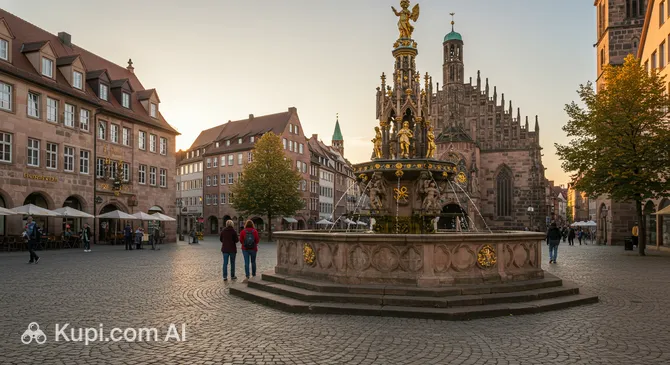
Beautiful Fountain. Illustration.
Source: Kupi.com AI

Traveler photos:

Built at the end of the 14th century, Schöner Brunnen is an impressive 19-meter structure in the Gothic style, shaped like a church spire. The fountain is richly decorated with tiers of gilded and painted figures—there are about 40 in total. Among them, you can see allegorical representations of philosophy and the seven liberal arts, the four evangelists, the four Church Fathers, the seven Prince-electors, the nine worthies, Moses, and the seven prophets. Every detail of the fountain is executed with incredible skill, turning it into a true open-air work of art.

Special attention is drawn to the intricately crafted grate surrounding the fountain. It features the famous "golden ring," which, according to legend, brings good luck and fulfills wishes when turned. Schöner Brunnen is not just a water source, but an important part of the "Nuremberg Historical Mile," attracting tourists with its beauty, rich history, and the beliefs associated with it. A visit to this fountain leaves an unforgettable impression and allows you to touch the medieval charm of the city.

Contacts

Since Schöner Brunnen is a public historical monument, it does not have specific contact details. For the most up-to-date information on fountain access and events taking place on Nuremberg's Market Square where it is located, it is recommended to check the city's official tourism resources. In particular, useful information can be found on the following website:

How to contactContact
AddressHauptmarkt, 90403 Nürnberg, Germany
Phone number+49 9352 9341
Websitewww.nuernberg.de

What to Do

When visiting Schöner Brunnen, you can fully enjoy its magnificent Gothic architecture. Take some time to look closely at the numerous sculptures that decorate the fountain. It will be especially interesting to examine the skillfully crafted depictions of historical kings and biblical characters that "inhabit" this multi-tiered structure, each figure telling its own story.

One of the most famous traditions associated with the fountain is finding and turning the "lucky ring", which is skillfully integrated into its ornate grate. According to local lore, this simple act brings good luck and helps wishes come true. Many visitors specifically look for this ring to touch it and make a heartfelt wish, following the ancient custom.

No less remarkable is the fact that Schöner Brunnen is not just a static monument of the past. The fountain is still functional, and water continues to flow from it, just as it did many centuries ago. This allows you to see the landmark in its original, living form and experience the same atmosphere that the residents of Nuremberg have enjoyed for centuries, watching the play of water and the gleam of the gilded figures.

Getting There

Getting to Schöner Brunnen is easy, as it is located in the heart of Nuremberg on the famous Main Market Square (Hauptmarkt). This central location makes the fountain easily accessible for all tourists exploring the city's historic center. It is in close proximity to other key attractions, such as the Old Town Hall and the Church of Our Lady (Frauenkirche), allowing you to combine your visit with these iconic sites.

If you are already in the historical center of Nuremberg, the simplest and most pleasant way to reach the fountain is on foot. The narrow streets and medieval architecture of the old town create a unique atmosphere on your way to the Market Square. Thanks to the compactness of the central area, you can reach Schöner Brunnen in a short time while enjoying the views.

For those who prefer public transport or are traveling from more distant parts of the city, the Main Market Square can be easily reached by bus or tram. Many public transport routes pass through the city center or have stops in the immediate vicinity of the Hauptmarkt, making the trip to the fountain quick and convenient.

Nearest city: Nuremberg

History & Facts

The history of Schöner Brunnen begins at the end of the 14th century. Its construction took place between 1385 and 1396, and the project was designed by the talented master Heinrich Beheim. Interestingly, the original sketch for this magnificent fountain was created by Emperor Charles IV himself, and the construction was commissioned by the Nuremberg city council, highlighting the structure's significance for the city from its very inception.

One of the most remarkable facts in the fountain's history is its miraculous preservation. Despite the fact that Nuremberg suffered extensive damage in the past, when about 80 percent of the city's buildings were destroyed, Schöner Brunnen remained intact. This fact alone makes it a symbol of resilience. The high cultural value of the fountain over the centuries is evidenced by numerous depictions in engravings and paintings. For example, it was captured in a copperplate engraving from the 1664 book "Architectura Curiosa Nova," in a drawing by architect Carl Alexander Heideloff for his edition "Nürnbergs Baudenkmale der Vorzeit," and in a watercolor by Friedrich Perlberg created before 1921.

The location of Schöner Brunnen also plays an important role in its historical perception. The fountain is located in the immediate vicinity of the famous Frauenkirche (Church of Our Lady), a Catholic church built between 1352 and 1362. Together, they form a unique architectural ensemble that conveys the spirit of medieval Nuremberg. This harmonious composition of two iconic structures on the Market Square makes a visit to the fountain even more impressive, allowing for a deeper immersion into the city's rich history.

Time Needed

A visit to Schöner Brunnen itself does not take much time. To approach the fountain, examine its main elements, admire the skillful craftsmanship, and, of course, turn the famous "golden ring" for good luck, a typical visitor will need about 20-30 minutes. This is enough time to take a few photos and get a general impression of this magnificent structure.

However, if you want to study all 40 figures decorating the fountain in more detail, try to decipher their symbolic meaning, or simply enjoy the atmosphere of the Market Square (Hauptmarkt) where it is located, it is worth setting aside a bit more time—perhaps up to one hour. Given that Schöner Brunnen is located in the heart of historical Nuremberg, next to other iconic attractions like the Frauenkirche and the Town Hall, a visit to it is often part of a longer city walk. Therefore, although the fountain itself can be seen relatively quickly, it serves as a wonderful starting or continuing point for your exploration of Nuremberg.

Working Hours

Schöner Brunnen is a public monument located on Nuremberg's Market Square, so it is available for viewing at any time of day, year-round. No tickets or prior booking are required. You can freely approach the fountain, examine its details, and, of course, try turning the famous "golden ring" for good luck whenever it is convenient for you.

Since the fountain is outdoors, its splendor can be admired in any season. It is important to note that while the structure itself is constantly accessible, the operation of the water cascades may be seasonal (for example, they may be turned off during the winter to prevent freezing). For the most up-to-date information on any temporary restrictions related to events on the square or maintenance, it is recommended to check the official tourism resources of Nuremberg, but as a rule, access to the fountain is always open.

Open 24 hours

Nearby

Exploring an iconic site like Schöner Brunnen is certainly a highlight of any trip to Nuremberg. However, to make your journey even more enriching and complete, it is worth paying attention to the attractions located in the immediate vicinity. Exploring the surroundings will allow you to dive deeper into the city's atmosphere, discover new interesting corners, and gain a more comprehensive understanding of its history and culture.

The Market Square, where the fountain stands proudly, is itself a historical center surrounded by many other notable sites. A short walk from Schöner Brunnen can lead you to unique museums, ancient churches, and other iconic landmarks of Nuremberg. Below is a list of some of them, along with their distances.

NameDistance
Nuremberg Toy Museum0.2 km
Nuremberg Deutsches Museum – Museum of the Future0.2 km
Nuremberg Historic Rock-Cut Cellars0.3 km
Travolta Nuremberg0.3 km
The Flower of Hawaii0.3 km
Nuremberg Castle0.4 km
Historic Art Bunker0.4 km

Have you reached the end of the page?

So the route has been studied inside and out