Support

Congress Hall

About

The Congress Hall (German: Kongresshalle) is a monumental and imposing structure located in Nuremberg, Germany. It is the largest preserved monumental building of the National Socialist era in the country and is currently a protected historical monument.
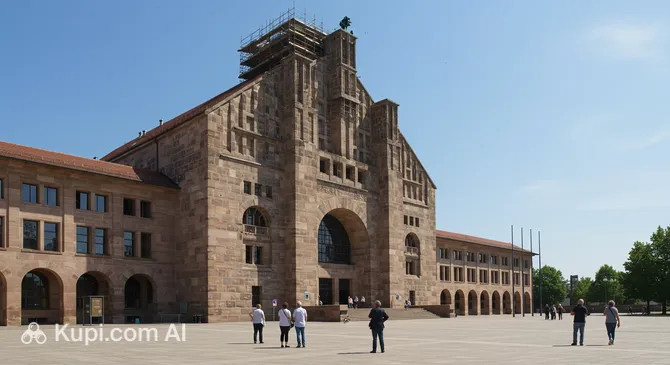
Congress Hall. Illustration.
Source: Kupi.com AI

Traveler photos:

The building is easily recognizable due to its characteristic U-shape and its location on the banks of the picturesque Dutzendteich pond. The architectural style of the Congress Hall clearly references the Roman Colosseum, which was quite typical for monumental structures of that era aimed at emphasizing grandeur and power.

The Congress Hall project was designed by Nuremberg architects Ludwig and Franz Ruff. Originally, the structure was intended for Nazi Party rallies and was supposed to accommodate up to 50,000 people. One of the most ambitious features of the project was a planned self-supporting glass roof that was meant to cover the massive inner atrium. However, this grandiose plan was never fully realized, and the building remained unfinished.

Contacts

To get up-to-date information about visiting the Congress Hall, including potential tours, opening hours, and access, it is recommended to consult the official tourism resources of Nuremberg or check details at local tourist information centers. As this is a major historical site, information on how to reach it by public transport is usually available on city transit maps and online navigation services.

How to contactContact
AddressBayernstraße 100, 90471 Nürnberg, Germany
Phone number+49 911 2317538

What to Do

Visiting the Congress Hall in Nuremberg offers several interesting opportunities for tourists. The north wing of this monumental building houses the Documentation Center Nazi Party Rally Grounds (Dokumentationszentrum Reichsparteitagsgelände). Here, visitors can delve into history by exploring the permanent exhibition "Fascination and Terror," which details the causes, context, and consequences of the National Socialist dictatorship. The museum offers extensive historical materials, photographs, documents, and multimedia installations, making it an essential site for those interested in 20th-century history.

Beyond the historical aspect, the Congress Hall also attracts music lovers. The south wing of the building has been home to the Nuremberg Symphony Orchestra since 2000. Visitors have the chance to attend a classical music concert held in this unique historical space, which will undoubtedly add a special touch to the visit. It is recommended to check the orchestra's schedule for planned performances before your trip.

Even if you don't plan to visit the museum or attend a concert, the Congress Hall building itself is of significant architectural interest. Its unfinished yet grandiose construction, inspired by the Roman Colosseum, allows you to see firsthand the scale and ambition of the monumental architecture of that period. A walk around the building and the surrounding grounds provides an opportunity to appreciate its size and reflect on the complex historical heritage of this site.

Getting There

The Congress Hall is located in Nuremberg and is quite convenient to reach using the city's public transport system. This makes it accessible for those staying in the city center as well as travelers in other parts of Nuremberg.

The building is situated near the scenic Dutzendteich pond, which is a good landmark in itself. If you are in the historic center of Nuremberg, for instance, in the Altstadt (Old Town) district, which is about 3.5 kilometers away, you can reach the Congress Hall via public transport routes or by taxi. The trip usually doesn't take much time.

Since the Congress Hall is relatively close to other significant sites in Nuremberg, such as St. Lorenz Church or the Germanic National Museum (both about 3.1 km away), a visit here can easily be combined with these attractions. The nearest major landmark—the Grosser Dutzendteich pond—is only 0.9 km away, allowing for a pleasant walk in the area.

Nearest city: Nuremberg

History & Facts

The history of the Congress Hall in Nuremberg is inextricably linked to the ambitious plans of its time. The foundation stone of this grandiose structure was laid in 1935, yet its construction was never completed. About 1,500 people worked on the Congress Hall, but in the four pre-war years from 1935 to 1939, they only managed to raise the walls to a height of 39 meters. This was significantly less than the planned 70 meters, and the start of World War II brought the work to a halt.

Primarily brick was used for construction, and the facade was intended to be clad in massive granite slabs. The idea was that this granite would be delivered "from all regions of the empire," symbolizing its power and unity. In the vast party rally complex, the Congress Hall was to be the second largest structure. It would have been smaller only than the "German Stadium" (Deutsches Stadion), which was conceived as the largest stadium in the world but also remained largely an unrealized project.

A surprising fact is that the Congress Hall has reached us today in almost the same state it was in when construction stopped during the war. This incompleteness is itself a powerful historical testimony. Today, it is not just the ruins of an ambitious project, but an important historical monument and a significant cultural site in Nuremberg, serving as a place to reflect on history and reminding us of Germany's complex past.

Time Needed

When planning a visit to the Congress Hall in Nuremberg, you should allow 2-3 hours for a full experience of this iconic site. This time is usually enough to view the impressive building itself and visit the exhibitions at the Documentation Center (Docucenter) located inside. You will be able to leisurely explore the materials and soak in the atmosphere of this historical site.

If your plans include attending a concert by the Nuremberg Symphony Orchestra, which is also based in the Congress Hall, feel free to add another 2-3 hours to your total visit. Thus, a full immersion into the history and culture offered by the Congress Hall can take anywhere from two hours to about half a day, depending on your interests and chosen program.

Working Hours

Since the Congress Hall in Nuremberg includes the Documentation Center and serves as a venue for the Nuremberg Symphony Orchestra, opening hours can vary depending on which part of the complex you plan to visit. Generally, museums and exhibition centers have a set schedule that may change depending on the season. Symphony orchestra concerts follow a separate schedule.

For the most accurate and up-to-date information on the Documentation Center's opening hours, as well as concert schedules and ticket booking requirements, it is highly recommended to visit the official Congress Hall website or the Nuremberg tourism portal. It is also helpful to check if the complex is open year-round or if there are seasonal variations, especially if your trip is planned during public holidays.

Nearby

Visiting the Congress Hall is undoubtedly a highlight, but exploring its surroundings can make your trip to Nuremberg even more fulfilling and memorable. Often, hidden near such significant sites are other interesting spots that help you gain a deeper understanding of the city's history, culture, and modern life.

A short walk or a brief ride from the Congress Hall will give you access to a variety of attractions: from historical memorials and cultural centers to picturesque parks and modern entertainment venues. By taking the time to explore these nearby treasures, you will certainly enrich your experience of Nuremberg.

NameDistance
Documentation Center Nazi Party Rally Grounds0.2 km
Zeppelinfeld0.9 km
Nuremberg Arena1 km
Nuremberg Zoo2.8 km
New Museum Nuremberg2.9 km
Kokono Nürnberg2.9 km
Padelle d'Italia3 km

Have you reached the end of the page?

So the route has been studied inside and out