Support

Documentation Center Nazi Party Rally Grounds

About

The Documentation Center Nazi Party Rally Grounds (Dokumentationszentrum Reichsparteitagsgelände) is an important historical museum located in the city of Nuremberg, Germany. It is housed in the north wing of the grandiose yet unfinished Congress Hall, which was modeled after the Roman Colosseum for the purpose of holding NSDAP rallies. Today, this center is one of the most significant places in the country for studying and reflecting on the complex past of the 20th century.

The museum's architectural design is deeply symbolic. A modern glass and steel structure literally pierces the massive stone walls of the historical building, representing a critical look at the past and the victory of enlightenment over totalitarian ideology. This bold architectural gesture immediately sets visitors up for a serious and thoughtful engagement with the exhibition. The center is part of an extensive open-air museum that covers the entire former rally grounds.
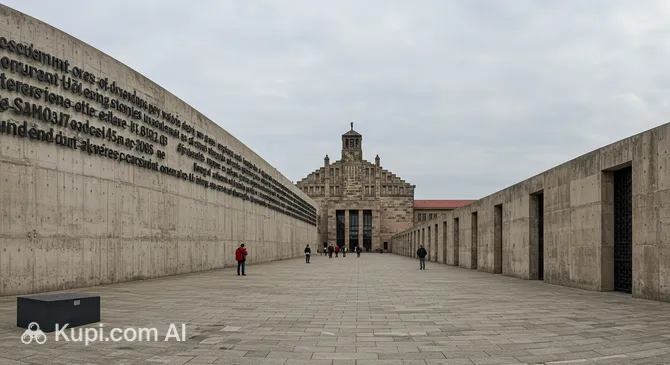
Documentation Center Nazi Party Rally Grounds. Illustration.
Source: Kupi.com AI

Traveler photos:

The museum's main permanent exhibition is titled "Fascination and Terror" (Faszination und Gewalt). It explores the causes, context, and consequences of the National Socialist dictatorship in detail and in chronological order. Through numerous documents, photographs, and audiovisual materials, the exhibition tells the story of the party rallies, propaganda mechanisms, and the Nuremberg Trials held after the war. A visit to the center is not just a tour, but an opportunity to delve deep into history and understand how past events continue to influence the present.

Contacts

To plan your visit and check current opening hours and ticket prices, it is recommended to consult official sources. All necessary visitor information is generally available on the museum's website.

How to contactContact
AddressBayernstraße 110, 90478 Nürnberg, Germany
Phone number+49 911 2317538
Websitemuseen.nuernberg.de

What to Do

A visit to the Documentation Center offers two main avenues for exploration: the indoor exhibition and the extensive open-air territory. Currently, due to the renovation of the main exhibition, an interim exhibition is open to visitors. Located in the Great Exhibition Hall, it tells the history of the Nazi Party rallies and the grounds where they took place in a concise yet informative way. This exhibition serves as an excellent starting point for understanding the scale and ideology behind these events.

After familiarizing yourself with the indoor displays, visitors can embark on a self-guided walk through the former Nazi Party Rally Grounds. This vast space is essentially an open-air museum covering more than eleven square kilometers. Here, you can see the remains of grandiose but unfinished structures that stand as silent witnesses to the megalomania of the Nazi regime. Information panels located at key points help with orientation and provide historical context and photographs.

Key sites to visit on the grounds include the Congress Hall itself, which houses the Documentation Center and features a facade reminiscent of the Roman Colosseum, as well as the Zeppelin Field with its monumental grandstand. Walking through these sites allows you to physically sense the scale of the architectural plans and immerse yourself in the complex history of the area. This activity takes time, so it is worth setting aside several hours to walk through the main surviving structures and experience their somber atmosphere without rushing.

Getting There

Getting to the Documentation Center Nazi Party Rally Grounds is quite easy, as it is conveniently located in the southeastern part of Nuremberg, about 4 kilometers from the historic city center. Public transport is the most convenient and popular way to travel, providing a direct link between the city center and the museum. This allows visitors to avoid searching for parking and focus entirely on their upcoming visit.

The quickest and simplest option is the tram. Trams No. 8 and No. 9 run from Nuremberg Main Station (Nürnberg Hauptbahnhof). You need the stop that is actually called "Doku-Zentrum," which is located right across from the museum entrance. The tram ride takes only about 10 minutes. Alternatively, you can take bus No. 36, which also stops at the Documentation Center. If you are arriving at Nuremberg Airport, you first need to take the U-Bahn (line U2) to the main station and then transfer to the tram.

For those who prefer more comfort, a taxi ride from the city center takes approximately 5-7 minutes. Traveling by car is also possible, but it is worth noting that public transport is often a more convenient choice, especially if you are already in the city. Additionally, in good weather, you might consider walking, which takes about 35-40 minutes from the central station, or renting a bike, as Nuremberg is a cyclist-friendly city with convenient paths.

Nearest city: Nuremberg

History & Facts

The historical significance of this site is inextricably linked to the role Nuremberg played in the ideology of the Third Reich. The city was chosen by Adolf Hitler as the permanent location for the NSDAP party rallies, the first of which took place here as early as 1927. In the 1930s, a vast area in the southeast of the city began to transform into a giant stage for propaganda events designed to demonstrate the power and unity of the Nazi movement.

The centerpiece of the complex was to be the Congress Hall (Kongresshalle), where the Documentation Center is located today. Its construction began in 1935, based on a design by Nuremberg architects Ludwig and Franz Ruff; however, the building was never completed. The project was incredibly ambitious: a U-shaped structure inspired by the Roman Colosseum, designed to seat 50,000 people. It was planned to reach a height of 70 meters, with the inner courtyard covered by a free-standing glass roof, but by the time work stopped, the walls had only been built to a height of 39 meters. Granite blocks were used for the facade cladding to symbolize the regime's intended longevity.

The entire Rally Grounds covered a colossal area of eleven square kilometers and served as a monumental backdrop for demonstrating the NSDAP's power. However, most of the planned giant structures, including the massive German Stadium, remained only on paper or as foundations. At the end of the first decade of the 21st century, this territory was reimagined and turned into an open-air museum, with the Documentation Center at its core, telling the story of the "fascination and terror" of National Socialism.

Time Needed

When planning a visit to the Documentation Center, it is worth considering that it is not just a museum but a whole complex consisting of an indoor exhibition and an extensive open-air territory. For a thoughtful viewing of the interim exhibition "Nuremberg – Site of the Nazi Party Rallies," which currently replaces the main exhibition during its renovation, it is recommended to set aside about 1.5–2 hours. This will be enough time to familiarize yourself with the key displays, photographs, and documents telling the history of this place.

However, a full immersion into the history requires much more time. After viewing the indoor exhibition, be sure to walk through the Former Nazi Party Rally Grounds itself, which serves as a massive open-air museum. Exploring sites such as the Zeppelin Field, the remains of the grandstands, and the unfinished Congress Hall will take at least another 1-2 hours. Thus, for a complete and leisurely visit to the entire complex, you should plan for at least 3–4 hours, or even a full half-day. For those with a deep interest in history, even this amount of time may not be enough.

Working Hours

The Documentation Center is open to visitors year-round, allowing you to plan your visit at any convenient time. Standard opening hours are daily from 10:00 AM to 6:00 PM. Nevertheless, it is worth noting that the schedule may change on public holidays. For example, the center is traditionally closed on December 24 and 25, and may operate on a special schedule on other holidays, so checking current information on the museum's official website before your trip is highly recommended.

For individual visitors, advance ticket booking is usually not mandatory, but it can be done online for convenience. For groups of 10 or more and school classes, online ticket purchase is not available, and they must contact the museum administration to organize their visit. It is important to remember that the main exhibition is currently closed for renovation, and a specially created interim exhibition, "Nuremberg – Site of the Nazi Party Rallies," is open to visitors.

10:00 – 18:00

Nearby

A visit to the Documentation Center is a deep dive into history, but exploring the surrounding area can significantly enrich your experience. The center itself is part of a vast historical complex — the former Nazi Party Rally Grounds, spanning an area of more than 11 square kilometers. A walk through this area allows you not only to see other monumental structures of that era but also to better understand the scale and ideology behind their creation.

Exploring nearby sites helps build a complete picture of Nuremberg's role in 20th-century events. Many of these locations are within walking distance and are an integral part of the open-air museum. In addition to historical monuments, there are other interesting places nearby, offering a chance to switch gears and see different aspects of modern city life.

NameDistance
Congress Hall0.2 km
Zeppelinfeld0.9 km
Nuremberg Arena1.1 km
Nuremberg Zoo2.6 km
New Museum Nuremberg2.8 km
Padelle d'Italia2.9 km
Kokono Nürnberg2.9 km

Have you reached the end of the page?

So the route has been studied inside and out