Support

Nuremberg Historic Rock-Cut Cellars

About

The Nuremberg Historical Rock Cut Cellars are a unique and extensive complex of underground tunnels, galleries, and spacious halls masterfully carved into the rock directly beneath the famous Nuremberg Castle. These impressive structures, also known as the Burgberg cellars, originally played a key role in the life of Nuremberg, located in Germany. They served not only for the production and long-term storage of excellent local beer but also for providing the city with vital water supplies.
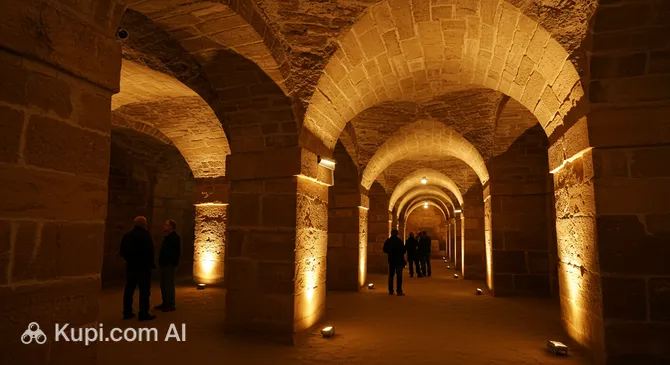
Nuremberg Historic Rock-Cut Cellars. Illustration.
Source: Kupi.com AI

Traveler photos:

Over the centuries, the functional purpose of these historical cellars changed repeatedly. At various periods, they were used as large-scale warehouses for various goods and as reliable shelters during historical conflicts. It is particularly noteworthy that at certain points in history, the Nuremberg Historical Rock Cut Cellars served as secret vaults for priceless city treasures and unique works of art, protecting them from potential threats and destruction.

Today, these mysterious and atmospheric cellars are hospitably open to visitors and are rightfully considered one of the most fascinating and significant historical attractions in Nuremberg. Captivating tours through the intricate labyrinths allow guests to immerse themselves in the authentic atmosphere of the medieval city. During such a journey into the past, you can learn many interesting facts about ancient crafts, everyday life, and the centuries-old traditions of bygone eras, literally feeling the breath of history beneath your feet.

Contacts

To plan your visit to the Nuremberg Historical Rock Cut Cellars, use the following location information. As finding direct contact details such as a phone number or email can sometimes be difficult, we recommend checking the official website of the attraction or visiting tourist information centers in Nuremberg for the most up-to-date information on opening hours (an adult ticket costs approximately €4.50) and other details.

How to contactContact
AddressBergstraße 19, 90403 Nürnberg, Germany
Phone number+49 911 2449859
Websitewww.historische-felsengaenge.de

What to Do

The main thing to do at the Nuremberg Historical Rock Cut Cellars is to take an educational guided tour with an experienced guide. During the walk through the branched network of tunnels and spacious halls, you will immerse yourself in the history of medieval brewing, learn about the methods of beer storage and production, and see authentic old beer cellars. Guides will share fascinating facts about how these underground structures have been used throughout the centuries.

Beyond the history of beer, the tours highlight another important role of the cellars. You will learn how they served as shelters during the Second World War and how priceless city relics and artworks were hidden here. Some of the former bunkers now house exhibition halls where historical items are presented, telling the story of the fate of cultural values during turbulent times. This allows for a deeper understanding of the multifaceted history of this unique site.

During the tour, visitors can see preserved elements of the past, such as original barrels and the remains of old ventilation and water supply systems, providing insight into the engineering solutions of previous eras. A tour of the Nuremberg Historical Rock Cut Cellars is an opportunity not only to see unique structures but also to learn the secrets of the underground city, touching its centuries-old history.

Getting There

The Nuremberg Historical Rock Cut Cellars are conveniently located in the heart of Nuremberg's historical center, in the immediate vicinity of the famous Nuremberg Castle. Thanks to this central position, the cellars are easy to reach on foot while strolling past the main sights of the Old Town.

The main entrances to the cellars are located at Bergstraße 19 and Obere Schmiedgasse 52. If you prefer public transport, the stops closest to the cellars can be reached by city buses or trams. From there, it is only a short walk to the entrance.

For the convenience of tourists, detailed signs are installed on the streets of Nuremberg leading to the cellars, making it easy to find your way. Most tours begin at the main entrance, which also simplifies navigation for visitors once they arrive.

When planning your visit, especially during the peak tourist season, it is recommended to check the current tour schedule in advance and, if possible, book tickets. This will help you avoid long waits and guarantee your visit to one of the city's most intriguing landmarks.

Nearest city: Nuremberg

History & Facts

The history of the Nuremberg Historical Rock Cut Cellars dates back centuries, with documentary evidence indicating that these vast underground spaces have been actively used since at least 1380. Initially, their primary function was the production and storage of beer, as Nuremberg has been famous for its brewing traditions since ancient times. Unique geological conditions—specifically the strength of the local rock—allowed for the creation of impressive multi-level cellar spaces reaching several stories in height. This feature provided the ideal conditions for the maturation and storage of the local brew.

Over time and with changing historical circumstances, the role of the cellars transformed. An especially significant period in their history was the Second World War. During this difficult time, the Nuremberg Historical Rock Cut Cellars served not only as reliable air-raid shelters for the townspeople but also became invaluable storage facilities for Nuremberg's most significant cultural treasures. Here, away from the destructive bombings, relics such as Martin Behaim's famous globe, the Imperial Regalia, unique copper engravings by Albrecht Dürer, sculptures by the outstanding master Veit Stoss, and many other historical values that are the pride of the city were carefully preserved.

After the end of the war, a new chapter began for these underground structures. Part of the premises, which previously served as a shelter and storage, was meticulously reconstructed and converted into exhibition spaces. Thanks to this, the Nuremberg Historical Rock Cut Cellars became accessible to the general public, turning into one of the most interesting tourist attractions. Today, visitors can embark on fascinating tours to see these man-made labyrinths with their own eyes and touch the centuries-old history hidden beneath the streets of ancient Nuremberg.

Time Needed

To fully experience the Nuremberg Historical Rock Cut Cellars, it is usually recommended to set aside 1 to 1.5 hours. This time is generally sufficient to take part in a standard guided tour and explore the main exhibition halls that tell the story and various functions of these unique underground structures.

The standard tour covers the most interesting sections of the cellars, introducing visitors to the history of brewing and the use of the catacombs as shelters and storage for artworks. The planned 1–1.5 hours will allow you to get a good general overview of this iconic Nuremberg site without feeling rushed, allowing you time to immerse yourself in the atmosphere of the past.

Thus, if you are planning your itinerary through Nuremberg, you can comfortably allow about an hour and a half for a visit to the Nuremberg Historical Rock Cut Cellars. This is the optimal time for an engaging and informative introduction to one of the city's most intriguing attractions.

Working Hours

The Nuremberg Historical Rock Cut Cellars offer regular tours for visitors. According to available information, tours of the cellars themselves are held daily at the following times: 11:00, 13:00, 15:00, and 17:00. Separate tours of the bunker exhibition hall, which is part of the complex, are also available daily at 14:00. This allows you to choose a convenient time to explore this unique site.

Although tours are held daily, it is strongly recommended to check the current schedule and any possible changes on the official website of the Nuremberg Historical Rock Cut Cellars or to confirm the information at tourist information centers in Nuremberg directly before your visit. It is also advisable to find out in advance if pre-booking is required, especially during the peak tourist season, to guarantee your spot. The daily schedule suggests that the attraction is open for visits year-round, but it is always useful to confirm this information.

DayOpening hours
Monday11:00 – 17:30
Tuesday11:00 – 17:30
Wednesday11:00 – 17:30
Thursday11:00 – 17:30
Friday11:00 – 17:30
Saturday9:30 – 17:30
Sunday9:30 – 17:30

Nearby

A visit to the Nuremberg Historical Rock Cut Cellars is undoubtedly a fascinating journey into the depths of history, but Nuremberg has much more to offer! Exploring the attractions located nearby will allow you to get a more complete picture of the rich cultural heritage of this ancient city. Many iconic sites are within walking distance, making a stroll through the surrounding area particularly pleasant and educational.

After exploring the cellars, you can easily continue your discovery of Nuremberg by uncovering other gems of its architecture and history. This will enrich your impressions and make your trip even more fulfilling and memorable. Below is a list of some interesting places located near the Nuremberg Historical Rock Cut Cellars.

NameDistance
Nuremberg Castle0.1 km
Historic Art Bunker0.1 km
Albrecht Dürer House0.1 km
The Flower of Hawaii0.2 km
Beautiful Fountain0.3 km
Nuremberg Toy Museum0.3 km
Nuremberg Deutsches Museum – Museum of the Future0.3 km

Have you reached the end of the page?

So the route has been studied inside and out