Support

Acropolis of Thessaloniki

About

The Acropolis of Thessaloniki is an impressive ancient fortification crowning the upper part of the city of Thessaloniki in Greece. This historical complex consists of powerful fortress walls, built primarily during the Byzantine era, which served as a reliable defense for the city against numerous enemy sieges for centuries. A walk through the Acropolis allows you to touch centuries of history and enjoy panoramic views of the city and the Thermaic Gulf.
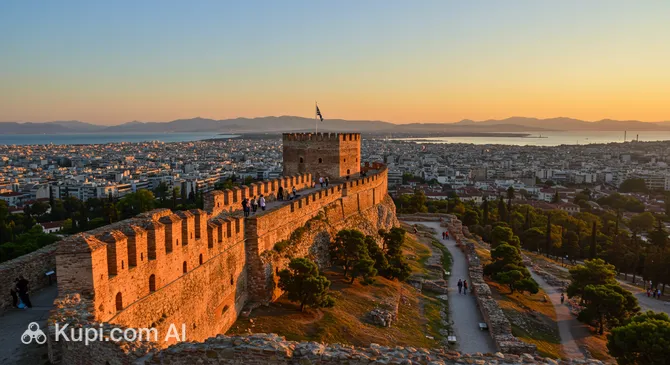
Acropolis of Thessaloniki. Illustration.
Source: Kupi.com AI

Traveler photos:

The jewel of the Acropolis is the Heptapyrgion citadel, also known by its Turkish name Yedi Kule, which translates as the "Fortress of Seven Towers." Interestingly, despite its name, the complex actually features ten towers—both triangular and quadrilateral—as well as intermediate towers integrated into the overall line of the fortress wall. This citadel is located in the northeastern corner of the Acropolis and is its most recognizable and well-preserved part.

The Heptapyrgion is not just a fortress, but a true architectural palimpsest, where every stone holds traces of different eras. Various construction stages are intertwined within its walls, starting from the early Byzantine period and ending with the times of Turkish rule. Visiting this place offers a unique opportunity to trace how the fortress's appearance and purpose changed over the centuries, making it particularly attractive for history and architecture enthusiasts.

Contacts

The Acropolis of Thessaloniki is primarily an extensive open-air historical complex, so it does not have a single office with contact telephone numbers for general tourist inquiries. You can reach the Acropolis, which crowns the upper part of Thessaloniki, by public transport heading to the Ano Poli district or by taxi. Many tourists also prefer walking to enjoy the atmosphere of the old town on their way to the summit.

How to contactContact
AddressEptapirgiou 130, Thessaloniki 546 34, Greece
Phone number+30 231 331 0400

What to Do

Visiting the Acropolis of Thessaloniki is, above all, an opportunity to enjoy breathtaking panoramic views. From its high walls, a magnificent view opens up over the city of Thessaloniki and the Thermaic Gulf, making it an ideal spot for photography and quiet contemplation. A walk through the Acropolis territory allows you to immerse yourself in the atmosphere of antiquity by exploring its historical corners.

The main activity for visitors is exploring the well-preserved fortifications. You can walk along the massive fortress walls and see ancient towers and gates. Of particular note is the Trigoniou Tower (also known as the Chain Tower or Pyrgos Alyseos), located at the corner of the northern and eastern walls. Also of interest are the so-called "Portares" (Great Gates), leading into the Acropolis, and a small passage named after Anna Palaiologina, opened as far back as 1355.

In addition to historical exploration, the Acropolis of Thessaloniki, and specifically the inner courtyard of the Heptapyrgion citadel, often serves as a venue for various cultural events. If your visit coincides with one of these, you will have the chance to see concerts, theatrical performances, or exhibitions, which will add a special touch to your walk through this significant historical site of Thessaloniki.

Getting There

The Acropolis of Thessaloniki rises majestically above the city, occupying its upper historical part known as Ano Poli. There are several ways to reach this iconic landmark. If you enjoy walking and want to immerse yourself more deeply in the atmosphere of old Thessaloniki, the climb to the Acropolis through narrow, cobbled streets will be an exciting adventure. For those who value time and comfort, taxi services are available to take you directly to the foot of the ancient walls from any point in the city. Additionally, city public transport routes serve the Ano Poli district, which is also a convenient option.

According to historical records, two large gates known as "Portares" serve as key access points to the Acropolis territory. These impressive entrances are located in the northern part of the defensive wall. The Vlatadon Monastery (14th century), located nearby, serves as a reliable landmark for finding them. It is through these gates that you can step onto land that holds centuries of history.

To better orient yourself and plan your route to the Acropolis, it is useful to know that the fortress, which historically separated the Acropolis from the rest of the upper city, began approximately opposite the Vlatadon Monastery. From there, it stretched to the famous Trigoniou Tower (the Chain Tower). Understanding this layout will not only help you find your way but also allow you to appreciate the scale and strategic significance of this ancient fortification even before you reach it.

Nearest city: Thessaloniki

History & Facts

The Acropolis of Thessaloniki preserves centuries of history within its stones, dating back to its foundation. The powerful fortifications, which still make an indelible impression today, were erected in the 4th-5th centuries AD. Their main task was to protect the city from numerous enemy raids, and for centuries they successfully fulfilled this role. Notably, a significant part of these ancient fortifications, including the remains of the walls of the famous Heptapyrgion fortress, has survived to this day. The restoration and strengthening of the acropolis during the Late Antique period are associated with the activities of the Roman Emperor Theodosius I, who ruled from 379 to 395 AD.

The central element of the Acropolis is the Heptapyrgion fortress, also known as Eptapyrgiou. Its construction history is multi-layered and fascinating. It is believed that the five northern towers of the fortress, along with the connecting wall forming the northern corner of the Acropolis, date back precisely to the reign of Theodosius I. Later, presumably in the 12th century, the southern five towers and adjacent walls were added, forming an additional fortified redoubt within the citadel. The Heptapyrgion fortress acquired its final appearance, much of which has reached us today, during the reign of the Byzantine Palaiologos dynasty.

The history of the Heptapyrgion is not limited to its defensive function. During the Ottoman rule, the city garrison command was stationed within the fortress, emphasizing its continued strategic importance. However, one of the most famous stages in the life of the Heptapyrgion began in the 19th century, when the ancient walls were converted into a prison. The fortress served in this capacity for a remarkably long time—until 1989—leaving a deep mark on the history of Thessaloniki and the memory of its inhabitants.

Time Needed

When planning a visit to the Acropolis of Thessaloniki, you should expect that a general overview of this extensive historical complex will likely take 1 to 2 hours. This time will be enough to walk along the main fortress walls, enjoy panoramic views of Thessaloniki and the Thermaic Gulf, and see the most significant sections, such as the famous Heptapyrgion citadel from the outside and perhaps a peek into the inner courtyard if it is open to the public.

However, if you want to explore all the corners of the Acropolis in more detail, carefully study the architectural features of the various towers and walls, and visit the interior of the Heptapyrgion (if accessible and of interest to you as a former prison or exhibition venue), your visit time may increase. History and photography buffs wishing to slowly immerse themselves in the atmosphere of antiquity and capture the best angles can spend up to 3-4 hours or even half a day here. It's also worth considering the time it takes to climb to the Acropolis, especially if you choose a walking route.

Working Hours

The Acropolis of Thessaloniki, being largely an open-air historical complex, is generally accessible for walks around its main territory during daylight hours year-round. However, for visiting specific sites within the Acropolis, such as the Heptapyrgion citadel (which previously functioned as a prison and may have specific opening hours for its internal exhibitions), the hours may be strictly regulated and vary depending on the season.

Since exact information about opening hours and the need for advance ticket booking for all parts of the Acropolis can change, it is highly recommended to clarify these details before your visit. You can find the most up-to-date information on the official Thessaloniki tourism portal, the website of the Ministry of Culture of Greece, or directly at local tourist information centers. This will help you plan your visit in the best way possible and avoid potential inconveniences.

Open 24 hours

Nearby

Exploring the surroundings of the Acropolis of Thessaloniki can significantly enrich your visit to this historical site. Located in the heart of Ano Poli, the old town of Thessaloniki, the Acropolis is surrounded by many other significant monuments and interesting locations within walking distance. This allows you to create a rich itinerary, combining a tour of the ancient fortifications with immersion in the atmosphere of the Byzantine and Ottoman eras.

Strolling through the nearby attractions will not only complement the historical picture of Thessaloniki's past but also allow you to see the city from different angles, revealing new panoramas and cozy corners. Each of these places has its own unique history and atmosphere, making the journey through time even more exciting.

NameDistance
Heptapyrgion0.1 km
Triangular Tower0.4 km
Vlatadon Monastery0.7 km
Latomos Monastery (Church of Hosios David)0.9 km
Atatürk Museum1.1 km
Rotunda of Galerius1.4 km
Church of Saint Demetrios1.4 km

Have you reached the end of the page?

So the route has been studied inside and out