Support

Heptapyrgion

About

The Heptapyrgion, also known as Eptapyrgio, is an impressive historical fortress standing proudly in the northeastern part of the acropolis in Thessaloniki, Greece. This iconic landmark draws travelers with its rich history and imposing architecture, serving as one of the region's key attractions.
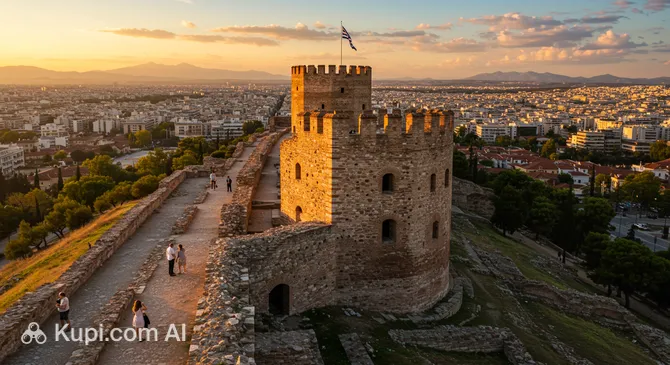
Heptapyrgion. Illustration.
Source: Kupi.com AI

Traveler photos:

The name "Heptapyrgion" translates from Greek as "Seven Towers," though this is more of a historical nickname than a precise description. In reality, the fortress complex consists of ten towers connected by massive walls, forming an imposing fortified ensemble. This architectural feature gives the fortress a unique and memorable appearance.

The Heptapyrgion originally served as the main citadel of the Thessaloniki acropolis and played a crucial role in the city's defense system for centuries. It is believed the fortress might have been named after the famous Yedikule Fortress in Constantinople (modern-day Istanbul). Later, during the Ottoman period, the site gained a different, darker reputation as it was used as a prison, adding another significant layer to its multifaceted and long history.

Contacts

As the Heptapyrgion is a historic fortress and a significant tourist site, it is best to check official tourism portals for the city of Thessaloniki or Greece for precise information on opening hours, available tours, or entry requirements. You can also find useful information at local tourist information centers upon arrival.

Typically, the Heptapyrgion, located in the upper part of the city, can be reached by public transport, taxi, or as part of a walking tour, which allows you to enjoy the views of Thessaloniki.

How to contactContact
AddressΕπταπύργιο, Επταπυργίου 40, Θεσσαλονίκη 546 34, Greece
Phone number+30 231 331 0400
Websitewww.thessalonikitourism.gr

What to Do

Visitors to the Heptapyrgion can embark on a fascinating journey through time, exploring its ancient walls and numerous towers. Here, you can touch history while observing unique architectural elements preserved from the Byzantine and Ottoman eras. Don't miss the chance to climb the fortress walls—they offer breathtaking panoramic views of Thessaloniki and its picturesque surroundings.

Your visit to the Heptapyrgion can be perfectly complemented by exploring nearby attractions. The Trigoniou Tower (Pyrgos Alyseos) is located very close by; often, a ticket purchased for the Heptapyrgion also grants entry here. From its roof, you can see magnificent views, including the Agios Pavlos district and the Heptapyrgion itself from a unique perspective. Additionally, a walk along the ancient city walls will lead you to other historical sites, such as the Church of Saint Paul, allowing for a deeper immersion into the rich past of Thessaloniki.

Getting There

The Heptapyrgion is conveniently located in the northeastern part of the Thessaloniki acropolis. One of the most pleasant and scenic ways to reach this historic fortress is a walk from the city center. Your route will take you through the charming streets of the old town, known as Ano Poli. This walk usually takes about 20-30 minutes, depending on your starting point in the center of Thessaloniki, and allows you to enjoy the authentic atmosphere of this ancient district.

If you prefer to use public transport, city buses run regularly to the Ano Poli district. From the nearest bus stop, it is just a short walk to the Heptapyrgion fortress itself. For those who value maximum comfort or are traveling with limited time, a taxi is an excellent option. A driver can take you directly to the entrance of the fortress, which is especially convenient if you want to avoid the uphill climb on foot.

Nearest city: Thessaloniki

History & Facts

The history of the Heptapyrgion dates back to late antiquity. Fragments of the fortress wall visible today date to the reign of the Roman Emperor Theodosius I (379-395 AD). It was during this time that significant efforts were made to fortify Thessaloniki, and it is believed that the five northern towers of the Heptapyrgion, along with the connecting wall, were built during this early period, laying the foundation for the future fortification complex.

Much later, presumably in the 12th century, the fortress's defensive capabilities were expanded. The five southern towers and their corresponding walls were added, turning the Heptapyrgion into a powerful fortified redoubt within the city citadel. Throughout the Byzantine period, the fortress remained strategically vital: it was repeatedly repaired, maintained, and rebuilt to adapt to changing military requirements and ensure the city's reliable defense.

Interestingly, despite its obvious importance, the Heptapyrgion is not always clearly identified in ancient written sources. Early texts contain almost no direct references to this specific fort. Later chronicles from the 13th century mention a "kastellion" (fortress) in 1208-1209 and a "kastellion with the castle of Tsakones" in 1235. In documents from the 14th and 15th centuries, the name "Koulas of Thessaloniki" appears, though researchers still debate whether this referred exclusively to the Heptapyrgion or the entire city citadel. This slight ambiguity in historical records adds a touch of mystery to this ancient structure.

Time Needed

For a thorough exploration of the Heptapyrgion and its immediate surroundings, visitors are recommended to set aside approximately 1.5-2 hours. This is usually enough time to leisurely inspect the impressive walls and towers of the fortress itself, enjoy the panoramic views of Thessaloniki from above, and perhaps look into the neighboring Trigoniou Tower (Pyrgos Alyseos) if it is on your itinerary.

If you wish to immerse yourself deeper in the atmosphere of this historical site, plan a long walk along the fortress walls, or want to explore other nearby attractions in the Ano Poli district, you should expect your visit to take about half a day. This approach will allow you to explore all the corners that interest you without rushing and get the most out of your visit to this iconic part of Thessaloniki.

Working Hours

The exact opening hours of the Heptapyrgion may vary depending on the season. Generally, historical sites like this are open to visitors year-round, but hours may be shorter during the winter. To get the most up-to-date information on visiting times, ticket prices, and whether advance booking is required, it is highly recommended to check the attraction's official website or the tourism portals for Thessaloniki.

Sometimes, for popular tourist destinations, especially during the high season, advance registration or online ticket purchase may be necessary to avoid queues. Check this information in advance to ensure your visit to the Heptapyrgion is as comfortable as possible and free of surprises.

DayOpening hours
Monday8:00 – 20:00
TuesdayClosed
Wednesday8:00 – 20:00
Thursday8:00 – 20:00
Friday8:00 – 20:00
Saturday8:00 – 20:00
Sunday8:00 – 20:00

Nearby

A visit to the Heptapyrgion is undoubtedly a highlight for any traveler interested in the history and architecture of Thessaloniki. However, to make your discovery of this fascinating area even more complete, it is worth exploring other nearby attractions. Investigating the surroundings will allow you to immerse yourself deeper in the atmosphere of the ancient city and gain a more comprehensive understanding of its rich past.

Many interesting sites are within walking distance of the fortress, making it easy to combine them with a visit to the Heptapyrgion. These can range from other historical monuments to cozy corners of the old town, each holding its own piece of Greece's history.

NameDistance
Acropolis of Thessaloniki0.1 km
Triangular Tower0.4 km
Vlatadon Monastery0.7 km
Latomos Monastery (Church of Hosios David)0.8 km
Atatürk Museum1.1 km
Church of Saint Demetrios1.3 km
Rotunda of Galerius1.4 km

Have you reached the end of the page?

So the route has been studied inside and out