Support

Arch of Galerius

About

The Arch of Galerius, known among locals as "Kamara," is one of the most recognizable and significant historical monuments in the city of Thessaloniki. This majestic Roman-era monument was erected between 298 and 305 AD to commemorate Emperor Galerius' triumphant victory over the Sassanid Empire (Persia). Located in the heart of the modern city, the arch serves as a vivid reminder of the rich history of Greece and its imperial past.

Initially, the arch was not just a standalone structure but a key element of a grand imperial complex that connected Galerius' palace with his mausoleum, known today as the Rotunda. The structure featured a complex four-façade plan, though only its western part has survived to this day. Of particular interest are the marble reliefs decorating the pillars. They depict scenes of military campaigns, triumphal processions, and figures of the emperor himself in incredible detail, making the arch a true stone chronicle of that era.
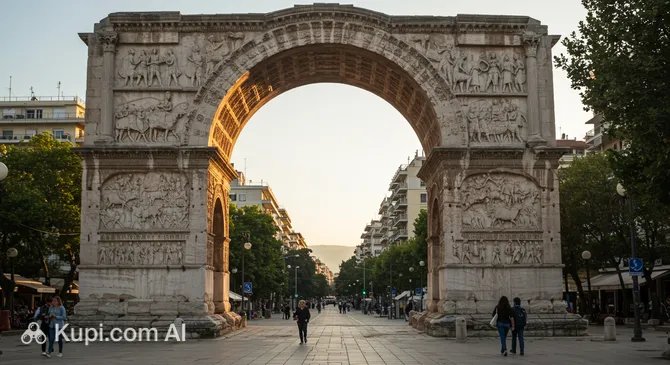
Arch of Galerius. Illustration.
Source: Kupi.com AI

Traveler photos:

Today, the Arch of Galerius is not only an important historical site included in the UNESCO World Heritage list but also a popular meeting place for residents and tourists. It sits at the intersection of busy pedestrian streets, near the university and many cafes. Walking under the ancient vaults of Kamara allows you to literally touch history and feel the connection across time, experiencing the atmosphere of the Roman past in the middle of a modern European city.

Contacts

Since the Arch of Galerius is a public open-air historical monument, it does not have a dedicated phone number or website; access is free and available 24/7. The arch is located in the very heart of the city at the intersection of major streets, making it very easy to find. You can reach it via many city bus routes, such as No. 78 from the airport or Nos. 8, 12, and 31 from the KTEL Makedonia bus station to the stop of the same name.

How to contactContact
AddressEgnatia 144, Thessaloniki 546 22, Greece
Phone number+30 231 331 0400
Websiteodysseus.culture.gr

What to Do

Visiting the Arch of Galerius is an opportunity to touch the history of the great Roman Empire in the heart of modern Thessaloniki. The main highlight to look for is the detailed marble bas-reliefs on the pillars of the structure. Getting closer, you can examine the scenes of Emperor Galerius' Persian campaign carved in stone. Of particular interest are the depictions showing not only the ruler's grandeur and triumph but also his mercy, for instance, in scenes of pardoning or negotiations with enemies. These reliefs are a true stone chronicle that lets you literally see history frozen in time over 1,700 years ago.

Exploring the arch is just one part of a fascinating walk through the historical complex. The arch was designed as a ceremonial entrance connecting the imperial palace with the Rotunda—Galerius' monumental mausoleum, located just a few steps away. Visiting the Rotunda, which is also on the UNESCO World Heritage list, will provide a complete picture of the grand design of the Roman architects. It is a unique chance to follow the entire path of the imperial procession and feel the scale of this ancient ensemble.

Beyond studying historical details, the Arch of Galerius, or "Kamara" as the locals call it, offers a very modern experience. It is a popular meeting spot and an iconic landmark surrounded by vibrant life. Near the arch, there are numerous cafes, taverns, and shops where you can relax after your walk and observe the city's lively student atmosphere. Of course, don't miss the chance to take impressive photos against the backdrop of this majestic monument that bridges the past and present of Greece.

Getting There

Reaching the Arch of Galerius, popularly known as "Kamara," is very simple as it is located in the heart of Thessaloniki. The monument stands at the intersection of the main Egnatia Street and the pedestrian Dimitriou Gounari Street, making it easily accessible on foot if you are staying in the center. Due to its central location, the arch serves as an excellent landmark and starting point for exploring other iconic sites, including the Rotunda, located just a couple of minutes' walk away.

The most convenient and popular way to get around the city is by public transport. Many city bus routes pass directly by the landmark. You need the "Kamara" stop, which is located right by the arch. From almost anywhere in Thessaloniki, you can take a bus heading along Egnatia Street, and you will arrive at your destination. This makes visiting the arch extremely convenient and hassle-free.

If you are arriving in the city, reaching the arch is also straightforward. From Thessaloniki International Airport "Macedonia" (SKG), express buses No. 01X (daytime) and No. 01N (nighttime) run through the city center to the bus station. You should get off at the "Kamara" stop. The journey takes about 40-50 minutes. From the main railway station and the KTEL Makedonia bus station, you can also reach the arch by many city buses heading toward the center. Of course, you can always use taxi services, which are particularly convenient if you have a lot of luggage. A ride from the airport costs approximately 20-25 euros and takes about 35 minutes depending on traffic.

Nearest city: Thessaloniki

History & Facts

The history of the Arch of Galerius is closely linked to one of the key moments in the history of the late Roman Empire. Its construction began around 298–299 AD to commemorate the grand victory of Emperor Galerius over the Sassanid Empire (Persia) and the capture of its capital, Ctesiphon, in 298. At that time, Galerius was not the sole ruler but one of four co-rulers in a system known as the Tetrarchy. The arch was intended to immortalize his triumph and demonstrate Rome's power on the eastern borders.

The structure was not merely a monument but a vital part of a vast imperial complex built in Thessaloniki. The arch served as a ceremonial entrance through which a road passed, connecting Galerius' palace with other key structures: reception halls, the hippodrome, and, of course, the majestic Rotunda, which was originally intended as a mausoleum for the emperor himself. Like the Rotunda, the arch was constructed using brick, and the original design rested on six columns—four in the center and two on the sides.

The arch's bas-reliefs, which have been the subject of intensive study, are of particular historical value. The first scientific research on these images was published as early as 1890 by the Danish archaeologist Karl Frederik Kinch. Later, 20th-century researchers established that the reliefs on the central part facing the palace depicted the most important scenes, and the overall message of the decoration was perfectly clear—a demonstration of the invincibility and greatness of Emperor Galerius. Every scene was meticulously designed to glorify the ruler and his military successes.

Time Needed

Seeing the Arch of Galerius itself won't take much time. As it is an open-air monument available 24/7, you can quickly view it while walking through the city of Thessaloniki. However, to truly appreciate the historical significance of the structure, it is worth staying a bit longer to carefully examine its famous bas-reliefs. A detailed study of the scenes of Emperor Galerius' military campaigns carved in marble usually takes about 20–30 minutes. This allows enough time to walk around the arch and take memorable photos without rushing.

For a more immersive historical experience, it is recommended to view the arch not as a standalone object, but as part of the grand Roman complex. Just a few steps away is the Rotunda of Galerius—originally a mausoleum and later one of the oldest Christian churches in the world. If you plan to visit both of these monuments, which are included in the UNESCO World Heritage list, you should set aside about 1–2 hours for the entire walk. This will be enough time to leisurely explore both the arch and the Rotunda, taking in the scale and grandeur of the imperial design.

Additionally, it's worth noting that the Arch of Galerius, or "Kamara" as the locals call it, is located in one of the liveliest districts of Thessaloniki, which is an attraction in its own right. It is a popular meeting spot surrounded by numerous cafes, bars, and shops where student life is in full swing. Many travelers enjoy setting aside extra time to relax with a cup of coffee after seeing the antiquities and soak up the dynamic atmosphere of modern Thessaloniki.

Working Hours

Since the Arch of Galerius is an open-air monument integrated into the urban space, it does not have specific operating hours. Access to the arch is free and available 24/7 throughout the year, allowing tourists to view it at any convenient time, whether during the day in the sunlight or in the evening when the lighting is turned on.

No ticket booking or advance registration is required to visit the arch—viewing it is completely free. This makes it one of the most accessible historical attractions in the city. While no preparations are needed to see the arch itself, keep in mind that nearby sites within the Galerius complex, such as the Rotunda, have their own opening hours and may require a ticket, so it is best to check that information separately.

Open 24 hours

Nearby

Visiting the Arch of Galerius is not just about seeing an individual monument, but a wonderful opportunity to start exploring the historical center of Thessaloniki. Thanks to its location, the arch serves as a kind of gateway to the city's past and present, from which it is convenient to begin walking tours. Exploring the surrounding area will enrich your experience and allow you to dive deeper into the multilayered and fascinating atmosphere of this place.

Many key attractions are within walking distance of the arch, making it an ideal starting point for a busy day of sightseeing. By walking through the nearby streets, you can get a full sense of the cultural and historical wealth of Greece, which is so vividly represented in Thessaloniki.

NameDistance
Rotunda of Galerius0.2 km
Atatürk Museum0.4 km
Agia Sofia Square0.5 km
Selfie Museum0.6 km
White Tower of Thessaloniki0.7 km
Roman Forum of Thessaloniki0.8 km
Archaeological Museum of Thessaloniki0.8 km

Have you reached the end of the page?

So the route has been studied inside and out