Support

Rotunda of Galerius

About

Rotunda Galerius, also known as the Rotunda of Saint George, is a majestic ancient structure located in the heart of Thessaloniki, Greece. This impressive cylindrical building with a massive dome was originally built in the late 3rd or early 4th century AD as part of the grand funerary (or, according to another version, palatial) complex of the Roman Emperor Galerius. The Rotunda was designed as a key element of an architectural ensemble that also included the Triumphal Arch of Galerius and his palace, and was connected to the arch by a gallery and a colonnaded portico.
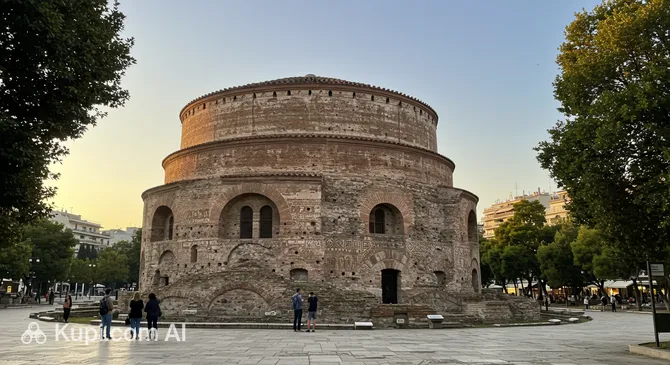
Rotunda of Galerius. Illustration.
Source: Kupi.com AI

Traveler photos:

Over its long and eventful history, Rotunda Galerius has undergone numerous transformations reflecting the change of eras and cultures. In the early 5th century, this monumental building was converted into a Christian church dedicated to Saint George the Triumphant, which gave it its second, widely known name. From 1590, during the period of Ottoman rule, the building served as a mosque. After the liberation of Thessaloniki in 1912, the Rotunda was returned to the Christian community and later turned into a museum of Christian art, housing priceless artifacts and unique mosaics.

Today, Rotunda Galerius is one of the most significant and visited historical landmarks in Thessaloniki. In 1988, along with the Arch of Galerius and other early Christian and Byzantine monuments of the city, it was rightfully included in the prestigious UNESCO World Heritage list. It is a unique example of Roman architecture, perfectly preserved to this day, attracting tourists and researchers from all over the world with its rich history, impressive size, and monumental beauty, serving as a witness to the city's centuries-old history.

Contacts

Rotunda Galerius is an outstanding historical monument located in the very heart of Thessaloniki. To find out the current opening hours, admission conditions, or information about guided tours, it is best to consult the official tourism portals of Thessaloniki or check the details on-site at tourist information centers. Reaching the Rotunda is easy: it is within walking distance of many key points in the city, and public transport is also available.

How to contactContact
AddressPlatia Agiou Georgiou Rotonta 5, Thessaloniki 546 35, Greece
Phone number+30 231 020 4868
Websitewww.thessalonikitourism.gr

What to Do

A visit to Rotunda Galerius is an immersion into history and art. Once inside, you can examine the unique architecture of the ancient Roman period in detail and admire the magnificent Byzantine mosaics decorating the interior. The interior decoration, executed using a rare wall mosaic technique dating from the 4th to 6th centuries AD, is particularly striking. In the arch of the southern apse, where the main entrance was once located, you can see an image of a large gilded cross—a testament to the Christian period in the history of this majestic structure.

Currently, Rotunda Galerius functions as a museum of Christian art. It features a variety of artifacts and exhibits that tell the story of the building itself and the Christian culture of the region. For a deeper understanding of this monument, you can join a fascinating guided tour. Guides will share interesting details about the construction process of the Rotunda, which is known to have involved three architects. Although the Rotunda is primarily a museum, religious services are held here on major holidays, adding a special atmosphere to the place.

A tour of Rotunda Galerius can be easily combined with a visit to other significant sites nearby. Close by is the small Church of Saint George, from which one of the Rotunda's names originates, and which is under the jurisdiction of the Gregoriou Monastery on Mount Athos. Additionally, the famous Arch of Galerius is located nearby, which originally formed a single architectural complex with the Rotunda, allowing for a better appreciation of the scale of the imperial design.

Getting There

Rotunda Galerius is conveniently located in the heart of Thessaloniki, making it easily accessible for visitors. You will find this historical monument near the busy Egnatia Street and the picturesque Navarinou Square, in the central part of the city.

One of the easiest ways to reach the Rotunda is by public transport. Numerous city buses running through the center of Thessaloniki stop on Egnatia Street, in the immediate vicinity of the landmark. Additionally, taxis are always easy to find in the city to take you directly to this ancient structure.

If you prefer walking and are staying in central Thessaloniki, walking to Rotunda Galerius is quite simple. The walk from the central Aristotelous Square will take you about 15-20 minutes. This stroll allows you to not only enjoy the city's atmosphere but also see other interesting spots along the way.

For those arriving in Thessaloniki via Macedonia International Airport, reaching the Rotunda is also straightforward. First, you'll need to get to the city center—you can take bus No. 78 or a taxi. From the center, you can then choose any of the methods mentioned above to reach this unique architectural monument.

Nearest city: Thessaloniki

History & Facts

The mysterious past of Rotunda Galerius dates back to the beginning of the 4th century AD. It is believed that this monumental structure was built by order of the Roman Emperor Gaius Galerius Valerius Maximianus, presumably between 305 and 311. This dating links the Rotunda to the period when Galerius reached the height of his power. The foundation is thought to have been laid around the year 300, during the active construction of the emperor's grand palace complex in Thessaloniki, Greece. Initially, the Rotunda was most likely intended as a majestic mausoleum for Galerius himself or as a temple dedicated to the imperial cult, emphasizing its close connection to the palace. Although an alternative hypothesis attributes the construction to the era of Constantine the Great, most researchers favor the Galerius version.

However, fate had a different purpose in store for Rotunda Galerius. Shortly after its construction, at the dawn of the Byzantine Empire (a period spanning 330-1453), this structure, pagan in its original intent, underwent a significant transformation. It was converted into a Christian church, a landmark event for Thessaloniki, one of the early centers of Christianity. For liturgical needs, an altar was added to the Rotunda on the east side, changing its interior space and symbolic meaning. This conversion reflected the deep religious shifts occurring in the Roman Empire during that important historical period.

Throughout its centuries-long history, Rotunda Galerius, along with the nearby Arch of Galerius from the same imperial period, became a silent witness to the changing eras and cultures in Thessaloniki. After the Christian period, during Ottoman rule, the building was converted into a mosque. Yet, even these changes could not erase its original grandeur. Remarkably, despite all historical upheavals and shifts in function—from a pagan sanctuary or mausoleum to a Christian church, then a mosque, and finally to a museum and occasionally an active church today—the Rotunda has managed to preserve its impressive architectural integrity. Today, it stands before us as a unique monument, captivating with its scale and ancient beauty, telling the city's rich history.

Time Needed

To fully enjoy your visit to Rotunda Galerius and carefully examine its features, it is recommended that the average visitor set aside about 1-2 hours. This time is usually enough to see the impressive ancient Roman architecture of this unique circular building, admire the surviving fragments of the magnificent Byzantine mosaics decorating its interior, and browse the collection of the Christian art museum now housed inside.

When planning your visit, it's worth noting that Rotunda Galerius is part of a larger historical ensemble. If you also wish to see the famous Arch of Galerius located very close by, and perhaps other remaining elements of the former palace complex, it's better to allocate extra time for exploring the entire historical space. In this case, for a fuller immersion into the history of this Thessaloniki district, your total visit time might be around 3-4 hours.

Thus, the length of your stay at Rotunda Galerius will depend on the depth of your interest and your desire to explore surrounding attractions. But even if you only have an hour, you will have time to get a vivid impression of this iconic monument in Thessaloniki.

Working Hours

The exact opening hours of Rotunda Galerius may vary depending on the season and day of the week. Generally, the attraction is open to visitors year-round, but schedules may change during the winter and summer periods. To get the most up-to-date information on opening hours, ticket prices, and potential schedule changes, it is strongly recommended to check the official Rotunda Galerius website or the tourism portals of Thessaloniki before your visit.

Usually, for visiting popular historical sites like Rotunda Galerius, advance ticket booking is not strictly required, but during the peak tourist season or for group tours, it can be a good idea to avoid queues. Check this information on official resources or at local tourist information centers, especially if you plan to visit the landmark on public holidays or during special events.

DayOpening hours
Monday8:00 – 20:00
Tuesday8:00 – 20:00
Wednesday8:00 – 20:00
Thursday8:00 – 20:00
Friday8:30 – 20:00
Saturday8:00 – 20:00
Sunday8:00 – 20:00

Nearby

After exploring the majestic Rotunda Galerius, don't rush to leave this historically rich area of Thessaloniki. Exploring the surroundings will allow you to dive deeper into the city's atmosphere and discover other gems located just a few steps away. Each nearby attraction tells its own unique story, complementing the experience of visiting the Rotunda and painting a more complete picture of Thessaloniki's rich past and present.

A stroll around Rotunda Galerius is a wonderful opportunity to see how different eras intertwine in the city's architectural face. Ancient Roman and Byzantine monuments sit alongside more modern buildings, creating a unique character. Below is a list of some interesting places located nearby, along with the distance to each.

NameDistance
Arch of Galerius0.2 km
Atatürk Museum0.3 km
Agia Sofia Square0.6 km
Selfie Museum0.7 km
White Tower of Thessaloniki0.8 km
Roman Forum of Thessaloniki0.8 km
Church of Saint Demetrios0.8 km

Have you reached the end of the page?

So the route has been studied inside and out