Support

Vlatadon Monastery

About

The Vlatadon Monastery (Greek: Μονή Βλατάδων) is an active Orthodox Stavropegic male monastery of the Ecumenical Patriarchate of Constantinople, located in the city of Thessaloniki, Greece. It is situated near the old city walls, at the corner of Eptapirgiou and Akropoleos streets, and serves as a significant spiritual and historical center.
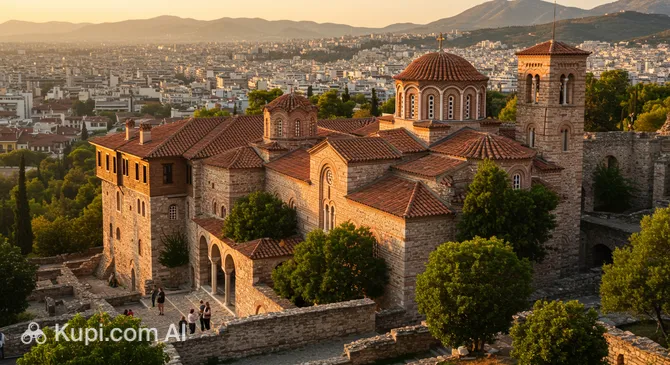
Vlatadon Monastery. Illustration.
Source: Kupi.com AI

Traveler photos:

The monastery rises majestically on a picturesque elevation near the fortress walls of the Acropolis, opposite the tower of Andronikos Lapardas. The uniqueness of the Vlatadon Monastery lies in the fact that it is the only one of the numerous Byzantine monasteries in Thessaloniki that continues its operations to this day, carefully preserving centuries-old Orthodox traditions.

The central church of the monastery is one of the city's prominent Christian landmarks from the Byzantine period and has been perfectly preserved. Its architecture and interior decoration attract both pilgrims and enthusiasts of history and art who wish to connect with the spiritual heritage.

In 1988, the Vlatadon Monastery was rightfully included in the UNESCO World Heritage list, highlighting its immense cultural and historical value. A visit to this wonderful place allows you to immerse yourself in the atmosphere of the Byzantine era and feel the connection across time.

Contacts

To obtain up-to-date information on the opening hours of the Vlatadon Monastery, as well as to clarify contact details such as a phone number or email address, it is recommended to visit the monastery's official website or contact the local tourist information centers in Thessaloniki. There, you will be able to find the most accurate and current information needed for planning your visit.

How to contactContact
AddressEptapirgiou 64, Thessaloniki 546 34, Greece
Phone number+30 231 020 9913

What to Do

Visitors to the Vlatadon Monastery can first and foremost explore its heart—the central Cathedral. This church, dedicated to the Transfiguration of our Lord and Savior Jesus Christ (it was originally consecrated in honor of Christ Pantocrator), is the only surviving part of the original monastery complex. Its architecture, a cross-in-square type with an arcade ending in parakklesia, represents a brilliant example of Byzantine construction that will be of interest to connoisseurs of church art and history.

The unique wall paintings inside the cathedral deserve special attention. These frescoes, dating from the period of 1360–1380, are of genuine artistic and historical value. Observing them allows you to immerse yourself in the atmosphere of the 14th century and appreciate the mastery of Byzantine icon painters, preserved through the centuries.

On the monastery grounds, there is also a site of special spiritual significance. According to tradition, this is where Apostle Paul preached during his stay in Thessaloniki. Visiting this spot allows you to touch the early history of Christianity and imagine the events that unfolded many centuries ago.

Although many of the buildings that once surrounded the main church fell into disrepair, were destroyed, or were radically rebuilt over time—such as the Church of the Assumption of the Virgin—the Vlatadon monastery complex itself remains a most valuable example of Byzantine architecture. A walk through its territory provides an opportunity not only to see ancient walls but also to feel the spirit of history that permeates this holy place.

Getting There

There are several ways to reach the Vlatadon Monastery in Thessaloniki, depending on your location and preferences. The monastery is situated in the upper part of the city (Ano Poli), making it accessible by both public transport and taxi.

One of the most convenient options is to use city buses. Thessaloniki has a well-developed public transport network, and there is sure to be a route that brings you close to the monastery. It is recommended to check the appropriate bus numbers and their schedules on the official website of the Thessaloniki transport company or at local information points. From the bus stop, you will likely need to walk a short distance while enjoying the views of the old town.

If you prefer a more comfortable and faster way to get around, you can always take a taxi. A taxi ride from the center of Thessaloniki to the Vlatadon Monastery does not take much time, especially if there is no traffic. This is particularly convenient if you are traveling with luggage or in a small group. Simply tell the driver "Vlatadon Monastery" (Μονή Βλατάδων), and they will take you to this historical site.

For those who enjoy walking and want to dive deeper into the atmosphere of Thessaloniki, you might consider walking up to the monastery, especially if you are already in the Ano Poli district. This will allow you not only to reach your destination but also to enjoy the picturesque streets and the views opening up from the hill.

Nearest city: Thessaloniki

History & Facts

The history of the Vlatadon Monastery dates back to the mid-14th century. Precise founding dates vary in sources, but most researchers agree on the period between 1350 and 1371. There are several versions regarding its founders. One, based on an 1801 inscription above the church entrance, attributes the foundation to the Vlatis brothers, who came from Crete. However, later research points to the hieromonks Dorotheus and Marcus Vlatis, natives of Thessaloniki and disciples of Saint Gregory Palamas, as the founders of the cloister between 1351 and 1371. There is also information that the monastery might have been founded by Empress Anna Palaiologina and named after the monks Dorotheos and Markos Vlattis.

The foundation of the monastery occurred during an extremely difficult period in the history of the Byzantine Empire. The 14th century was marked by a deep economic, political, and moral crisis. The empire was torn by internal turmoil, including three civil wars within one century, as well as constant external threats. At this time, the city of Thessaloniki was also experiencing religious unrest, especially following the suppression of the Zealot uprising (1341–1347) and other civil riots. It was in this turbulent atmosphere that the Vlatadon Monastery was established, becoming a bastion of spirituality and hope.

Despite all the historical vicissitudes, including natural disasters and numerous wars that shook Greece and the region over the centuries, the Vlatadon Monastery has remarkably survived. It has not only been preserved to this day but continues to be an active Orthodox male monastery. This fact in itself is noteworthy, testifying to the indomitability of faith and the immense spiritual significance of the cloister for many generations of believers and for the cultural heritage of Thessaloniki.

Time Needed

To fully enjoy the atmosphere and see the main attractions of the Vlatadon Monastery in Thessaloniki, most visitors will need approximately 1–2 hours. This time will allow you to leisurely get to know this unique historical and spiritual center of Greece.

During this time, you will be able to examine the monastery's main cathedral in detail, famous for its ancient 14th-century frescoes, which are true works of art. You will also have the opportunity to stroll through the well-kept grounds of the monastery complex, which offer impressive panoramic views of the city, and visit a landmark site traditionally associated with the preaching of Apostle Paul. Immersing yourself in the calm and peaceful atmosphere of the monastery is an essential part of the visit.

Of course, the final duration of your visit will depend on your personal interests and the depth of your engagement. If you are short on time, even one hour might be enough to get a general impression and see the key shrines. However, if you are a connoisseur of Byzantine art, interested in the history of Orthodoxy, or simply wish to spend more time in this spiritual place for reflection, you can safely plan for a longer stay.

Working Hours

The Vlatadon Monastery in Thessaloniki is generally open to visitors; however, the exact opening hours may vary depending on the day of the week and church holidays. Typically, monasteries have specific hours for pilgrims and tourists, which may differ from the times of religious services. There is generally no information regarding the need for advance ticket booking for individual visits, but clarifying this point for group tours can be helpful.

As the monastery is active, access hours may change. The most reliable way to find out the current visiting schedule is to check the official website of the Vlatadon Monastery, if available, or to contact the tourist information centers in Thessaloniki directly before your visit. Monasteries are often open year-round, but opening hours may be reduced during the winter period. It is recommended to verify this information in advance to ensure your visit is as comfortable as possible.

8:00 – 11:00, 6:00 – 20:00

Nearby

A visit to the Vlatadon Monastery is undoubtedly a highlight, but Thessaloniki has much more to offer. Exploring the surroundings of the monastery will allow you to delve deeper into the rich history and culture of this amazing city, complementing your impressions with new discoveries. Many iconic sites are located very close by, and visiting them will make your trip even more fulfilling and memorable.

Don't miss the opportunity to explore other treasures of Thessaloniki located in the immediate vicinity of the Vlatadon Monastery. This will allow you to gain a more complete understanding of the many facets of this ancient city, feel its unique atmosphere, and take even more vivid memories home with you.

NameDistance
Latomos Monastery (Church of Hosios David)0.2 km
Triangular Tower0.5 km
Heptapyrgion0.7 km
Acropolis of Thessaloniki0.7 km
Atatürk Museum0.7 km
Church of Saint Demetrios0.7 km
Roman Forum of Thessaloniki0.9 km

Have you reached the end of the page?

So the route has been studied inside and out