Support

Victor Vasarely Museum

About

In the quiet and cozy city of Pécs lies one of Europe's most unusual art spaces — the Victor Vasarely Museum. This place is entirely dedicated to the work of the brilliant Hungarian artist, who is considered the father of Op-art, or optical art. The museum is located in the historic building where the master himself was born, which gives the visit a special atmosphere of continuity and personal history.
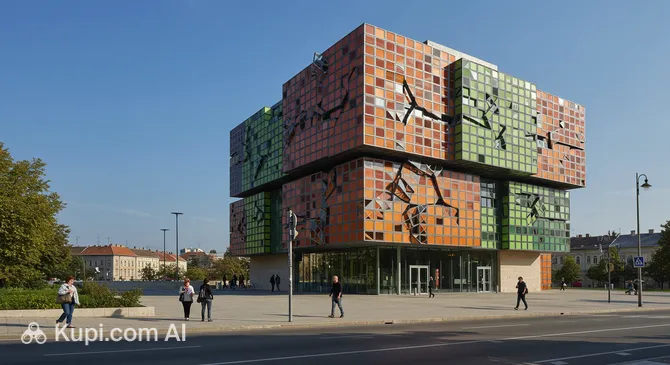
Victor Vasarely Museum
Victor Vasarely Museum. Иллюстрация. Источник: Kupi.com AI

The exhibition is a fascinating journey into a world of geometric shapes, bright contrasts, and incredible visual effects. Hungary is rightfully proud of Vasarely's legacy: a rich collection of his paintings, graphics, and sculptures is gathered here. The artist's works are built on scientific principles of perception, making static images "come alive," vibrate, and gain depth right before the viewer's eyes.

Today, this museum is a must-visit for all lovers of modern art and design. It clearly demonstrates how art can be combined with mathematics and psychology to create a unique sensory experience. The Victor Vasarely Museum is not just a gallery, but a true laboratory of vision that changes the way we look at the space around us.

Contacts

To check the latest information about events or group tours, you can use the following contact details:

How to contactContact
AddressPécs, Káptalan u. 3, 7621 Hungary
Phone+36 30 934 6127
Websitewww.jpm.hu

What to Do

The main activity in the museum halls is visual exploration. You shouldn't just walk past the paintings here; Vasarely's works require movement. Try moving slowly along the canvases, changing your viewing angle: you will notice how flat geometric patterns begin to move, pulse, and turn into three-dimensional figures. This amazing interaction between the eye and the canvas forms the core of the visiting experience.

The collection features about 150 works, including his famous grids, rhombuses, and kinetic installations. Be sure to notice how the artist uses contrasting colors to create the illusion of infinite space. For those who want to understand the author's philosophy more deeply, the museum often offers interactive elements and information stands explaining the principles of how optical illusions are formed.

In addition to the main exhibition, thematic exhibitions of Vasarely's followers and other masters of the geometric style are regularly held here. Families with children will be interested in creative workshops inspired by the Bauhaus legacy. In these classes, visitors of all ages can try creating their own optical compositions, experimenting with form and color under the guidance of specialists.

Getting There

Getting to the museum is quite easy, as it is located in the historic city center at Káptalan u. 3. If you are already strolling through the central quarters, the walk from the cathedral or the Palace Square will take only a few minutes. From the city's main railway station, you can reach it on foot in about 15–20 minutes, enjoying the old architecture along the way.

For those who prefer public transport, the Káptalan utca bus stop is within walking distance, served by local buses. If you are arriving from the capital, Hungary has an excellent rail connection: trains from Budapest get passengers to the destination in about 3 hours. You can also use FlixBus intercity services.

Travelers by car should keep in mind that the museum is located in a pedestrian or restricted traffic zone. It is recommended to leave your car in one of the paid parking lots around the perimeter of the historic center. A taxi from the station to the museum entrance is inexpensive and will take no more than 5–7 minutes.

Ближайший город: Pecs

History & Facts

The history of this place is inextricably linked with the name of Victor Vasarely (born Győző Vásárhelyi), who was born in this city in 1906. Although he began his career by studying medicine, his passion for art soon took over. Moving to Paris in 1930, Vasarely evolved from a graphic designer in advertising agencies to the recognized leader of world Op-art.

The museum in Pécs became a symbol of the master's return to his roots. Unlike his foundation in Provence, the collection in his hometown was formed largely thanks to the artist's personal gifts to his homeland. Vasarely sought to make art accessible to the masses, believing that geometry and color are a universal language understood by everyone without translation.

Vasarely's ideas gained special recognition in the mid-1960s, when a landmark exhibition at the New York Museum of Modern Art (MoMA) finally cemented his status as the "grandfather of optical art." Today, the museum carefully preserves works from different periods, demonstrating how simple black-and-white contrasts transformed over time into complex, multi-dimensional worlds of color.

Time Needed

To leisurely explore all the halls and fully experience the magic of optical illusions, most visitors need 1 to 2 hours. This is quite enough time to view the permanent collection and get acquainted with the temporary exhibitions that often take place within the museum walls.

If you plan to participate in educational programs or workshops, or if you are traveling with children who will surely want to stay longer at the interactive exhibits, it's worth budgeting about 2.5 hours for the visit. Deep immersion into the theory of color and form requires a certain level of contemplation, so there is no need to rush.

Working Hours

The museum welcomes guests according to a schedule standard for most cultural institutions. Please note that Monday is a day off, so plan your visit in advance.

From Tuesday to Sunday, the museum doors are open to visitors from 10:00 to 18:00 without a lunch break. The last entry is usually half an hour before closing, but we recommend arriving earlier to have time to see all the halls without rushing.

DayWorking hours
ПонедельникЗакрыто
Вторник10:00 – 18:00
Среда10:00 – 18:00
Четверг10:00 – 18:00
Пятница10:00 – 18:00
Суббота10:00 – 18:00
Воскресенье10:00 – 18:00

Nearby

Thanks to its location in the historical heart of the city, a visit to the museum can easily be combined with exploring other iconic sites. A walk through the quiet streets of this area will allow you to get acquainted with the region's centuries-old heritage in just a few hours.

Below are the sites located in the immediate vicinity of the Vasarely exhibition:

NameDistance
Zsolnay Porcelain Museum0 km
Pécs Candlemas Church of the Blessed Virgin Mary0.2 km
Csontváry Museum0.2 km
Pécs Cathedral0.2 km
Széchenyi Square0.3 km
Blöff Bistro0.4 km
Zsolnay Fountain0.4 km

Reached the end of the page?

That means the route is fully explored