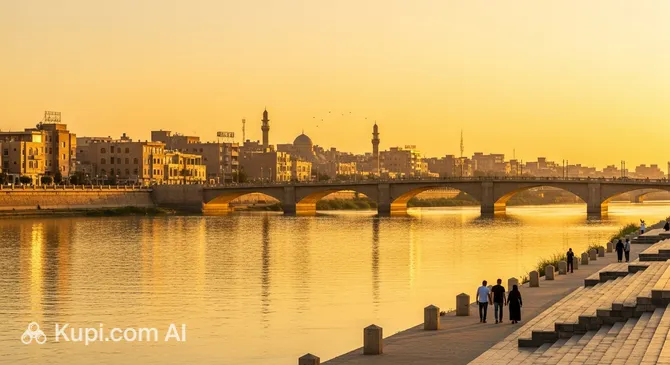
As-Samawah is a colorful city in the southern part of Iraq, serving as the important administrative center of the Muthanna Governorate. The city features a unique layout, spanning both banks of the majestic Euphrates River and connected by four bridges that serve as both vital transport arteries and key architectural landmarks. Located 280 km southeast of Baghdad, As-Samawah acts as a strategic transit hub between the capital and the port city of Basra.
With a population of approximately 215,000, As-Samawah maintains the atmosphere of a quiet provincial center focused on daily life and agriculture. Life here is closely intertwined with the river, which softens the harsh desert landscape and creates conditions for dense urban development along its banks. The rich history of the region is rooted in deep antiquity, as it was in the vicinity of this city that the great civilizations of Mesopotamia once flourished.
Samawah. Illustration.
Source: Kupi.com AI
For tourists, the city is primarily attractive for its authenticity and proximity to major archaeological sites, such as the ruins of ancient Uruk. As-Samawah invites those who wish to see the real, non-touristic Iraq, stroll through vibrant markets, and enjoy the leisurely flow of life on the banks of the Euphrates.
Weather Overview
As-Samawah is characterized by a typical hot desert climate, which dictates the rhythm of life for the entire region. Summers here are long and extremely hot: from June to August, average daytime temperatures often reach +45°C, sometimes even exceeding the +50°C mark. Precipitation is virtually non-existent during the summer months, and air humidity remains minimal.
The winter period, by contrast, is pleasantly mild and comfortable. From December to February, average daytime temperatures range between +15...+20°C, though nights can cool down to +7°C. This time is considered the most favorable for visiting the archaeological sites in the vicinity. If you are planning a trip, be sure to check the current weather forecast for the city, as strong dust storms are possible in spring and autumn.
Average monthly temperature
Average monthly precipitation
Interesting Facts
City on Bridges: As-Samawah is divided into two parts by the Euphrates and connected by four large bridges, which is a key feature of its urban structure.
Cradle of Civilization: Just a few dozen kilometers from the city lie the ruins of Uruk—one of the oldest and most important cities of Sumer and the home of the legendary King Gilgamesh.
Transit Hub: Due to its position exactly halfway between Baghdad and Basra, the city has historically played the role of a vital stop for caravans and travelers crossing Mesopotamia.
Agricultural Center: Despite its desert surroundings, the region around As-Samawah is an important producer of grains and dates, thanks to the irrigation systems of the Euphrates.
How to Get There
As-Samawah enjoys a convenient transit position, connecting the central and southern regions of the country. The main way to get here is by road. From Baghdad, the route southeast is about 280 km and takes between 4 to 6 hours depending on road conditions. You can use private taxis, intercity buses, or shared taxis, which depart regularly from the capital's stations.
There is no direct air service to the city. Travelers should plan a flight to Baghdad or Basra International Airport and then use ground transfer. More detailed information on routes and logistics can be found in the section describing how to get to the city.
Rail connections in the region are moderately developed, and trains traveling from Baghdad to Basra may stop at stations in the Muthanna Governorate. However, for tourists, road transport remains the most reliable and flexible option.
Station
Passenger traffic
Distance
Baghdad railway station
10
238 km
Al Maqal Railway Station
3
254 km
Khorramshahr railway station
1
292 km
Main Attractions
The primary magnet for travelers visiting this region is the legendary ruins of ancient Uruk. Located east of modern As-Samawah, this site is considered one of the world's first urban civilizations. A walk among the remains of temples and city walls founded around 4000 BCE allows you to touch the origins of human writing and statehood.
Within As-Samawah itself, the four bridges over the Euphrates are the key points of interest. They not only connect the two parts of the city but also serve as the best vantage points offering picturesque views of the river and the riverside architecture. In the evenings, the bridges become a place for locals to stroll, creating a special atmosphere of connection with nature and the city.
The central city markets can also be considered attractions that reflect the spirit of provincial Iraq. There are no specially created tourist zones here, so visiting the markets along the river allows you to see the real life of the region, get acquainted with local crafts, and observe the traditional trading ways that have remained virtually unchanged for decades.
Local Cuisine
The cuisine of As-Samawah is a classic embodiment of the gastronomic traditions of southern Iraq, where the main ingredients are rice, meat, and fresh fish. The absolute favorite is Masgouf—fish (usually from the Euphrates) grilled over an open fire in a special way. This dish has a unique smoky aroma and is served with lemon, herbs, and freshly baked flatbreads.
Traditional meat dishes such as lamb kebabs and dolma, which is prepared here with an abundance of spices, are also worth trying. Rice is often served as a pilaf with raisins, nuts, and saffron. In the city's markets, you can find many types of street food, including falafel and various stuffed flatbreads, which are very popular with locals.
It is customary to finish a meal with strong and very sweet Iraqi tea, served in small glass cups called "armudu." Fragrant Arabic coffee with cardamom is also popular. Given the nature of the region, restaurants and markets offer an exclusively Halal menu, and pork is entirely absent from the diet.
Travel Tips
A trip to As-Samawah is a chance to see authentic Iraq, and a few practical tips will help make your visit more comfortable and safe.
Clothing and Essentials: Choose clothing made of natural fabrics that covers the shoulders and knees—this helps protect against the sun and complies with the local dress code. Don't forget sunglasses, a hat, and comfortable shoes for walking through dusty archaeological zones.
Transport: Within the city, it is most convenient to move around by taxi. For trips to Uruk, it is better to arrange a round-trip transfer with a driver in advance, as finding transport at the excavation site can be difficult.
Finances: The main currency is the Iraqi Dinar. Cards are rarely accepted, so always carry a cash reserve. It is better to exchange money at official exchange offices in Baghdad or the center of As-Samawah.
Health and Safety: Always drink only bottled water. In the summer months, avoid being in the sun from 12:00 to 16:00 due to extreme heat.
Communication: The primary language is Arabic. English is not widely spoken, so it is useful to learn basic phrases or carry an offline translator. Locals are very friendly and always ready to help.
Local Etiquette: Be sure to remove your shoes when entering a home or a mosque. It is customary to greet people with the right hand. Showing respect for elders is the foundation of communication in the region.
What to Avoid: Do not take close-up photos of government buildings, military sites, or bridges without permission—this may raise unnecessary questions from security.
Connectivity: Purchase a local SIM card (Zain or Asiacell) immediately upon arrival in the country, as Wi-Fi in As-Samawah hotels can be unstable.
Following these simple rules will allow you to enjoy the city's hospitality and get the most out of your encounter with the cradle of civilization.
Entertainment & Nightlife
Entertainment in As-Samawah is calm and traditional in nature. There are no noisy nightclubs, bars, or large concert venues, which is typical for conservative provincial cities in southern Iraq. Evening life is centered around central squares and the Euphrates embankments, where locals gather in tea houses (Chai Khana) for leisurely conversations over strong, sweet tea.
For family vacations and daytime walks, small park areas along the river are ideal, where you can watch the boats and enjoy the coolness from the water. The crowd in local establishments is predominantly local, and the atmosphere is friendly and welcoming. It is worth noting that most public places close by midnight, and the city quietens down fairly early.
If you are looking for more modern entertainment centers or theaters, locals recommend heading to neighboring Nasiriyah or Baghdad. In As-Samawah itself, the emphasis is on quiet evening gatherings and walks across the bridges, which are illuminated at night, becoming the main points of attraction for residents.
Parks & Museums
The park system in As-Samawah is currently under development, with most greenery concentrated along the Euphrates embankment. This is the city's main recreational area, where residents escape the heat. Despite the lack of large-scale landscaped parks, the riverside areas offer a pleasant atmosphere for walks by the water, especially during the sunset hours.
There are currently no major historical or art museums in the city itself. The primary role of an "open-air museum" is played by the nearby archaeological sites. The cultural heritage of the region is represented more in the traditions and crafts found in the local markets and the architecture of the old quarters.
For those seeking educational leisure, Uruk is the most interesting site. Although it is located outside the city limits, it is often called the province's main "museum." Excavations are ongoing here, and the scale of the ancient structures is impressive even in their ruined state, vividly demonstrating the greatness of the first Sumerian cities.
Getting Around
The transport system of As-Samawah consists mainly of buses and shared taxis that run between the main districts and connect the city with nearby settlements. Shared taxis are the most popular and cheapest way to get around, though they can be crowded during peak hours, especially on routes crossing the bridges.
For tourists, taxis remain the most convenient and comfortable option. Private carriers operate in the city, and cars can be easily hailed on the street or called through local services. It is best to agree on the price of the trip in advance, as meters are rarely used. A ride within the city is usually inexpensive and allows you to avoid walking under the scorching sun.
Walking is possible in the central part of the city and along the embankment, but you should take into account the narrow sidewalks and active traffic. Bicycles and car rentals are not very popular among guests, so for trips out of town to archaeological sites, it is best to hire a driver for the day.
Accommodation
The hotel infrastructure in As-Samawah is primarily oriented toward business travelers, transit passengers, and employees of international organizations. The choice of hotels here is limited, and most fall into the budget or mid-range segment. There are no luxury five-star resorts in the city, but you can find neat guesthouses and apartments for long-term stays.
The city center near the Euphrates embankment is considered the most convenient area for accommodation. Staying here provides easy access to markets, major transport interchanges, and the bridges. Housing prices remain very affordable compared to the capital, though you should expect basic service.
When planning your trip, it is recommended to book accommodation in advance by contacting the administration directly or through local tour operators, as not all options are listed on international online platforms. When choosing a hotel, pay attention to the availability of air conditioning, which is critically important in the hot climate of As-Samawah.
Nearby Cities
As-Samawah is a convenient starting point for exploring the heart of southern Iraq and the surrounding archaeological zones. The most significant destination is a trip to the ruins of ancient Uruk, which are in close proximity and offer immense interest for history buffs.
Among the nearby towns, Al-Hamza stands out, located just 53 km away. It is known for its religious shrines and traditional way of life. Also, within an hour to an hour and a half's drive is the city of Ad-Diwaniyah, which is a major cultural and commercial center of the region, offering a wider selection of markets and public spaces.
Exploring the surroundings of As-Samawah allows you to see the diversity of the Iraqi province—from endless plains and date groves to ancient ziggurats. It is recommended to hire a local guide or driver who can help you better navigate the region and tell you about the hidden gems of the Muthanna Governorate.
Shopping & Souvenirs
Shopping in As-Samawah primarily involves visiting traditional oriental markets (souks) located in the central part of the city. There are no massive shopping malls with global brands here, but you can find unique locally produced goods. Most trading activity is concentrated in the riverside quarters, where shops are packed tightly together.
Special attention should be paid to textiles and carpets. Local artisans are famous for their wool and fabric products, often decorated with traditional patterns. The markets also offer a huge selection of agricultural products: As-Samawah is famous for its high-quality dates, honey, and spices, which make excellent and delicious souvenirs.
Shops usually operate from early morning until late evening, with a break for a midday siesta during the hottest hours. Payments are made mainly in cash in the local currency (Iraqi Dinars). It is customary to bargain politely in the markets—this is not just a way to save money, but also an important part of the local culture of communication.