Support

Damascus Gate

About

The Damascus Gate, also known as the Shechem or Nablus Gate, is one of the most significant and beautiful gates of the Old City of Jerusalem in Israel. They serve as the central entrance to the bustling Muslim Quarter and lead directly to the colorful Arab market, immersing visitors in the atmosphere of the ancient city. Located on the northern side of the ancient walls, these gates draw attention with their rich history and architectural splendor.
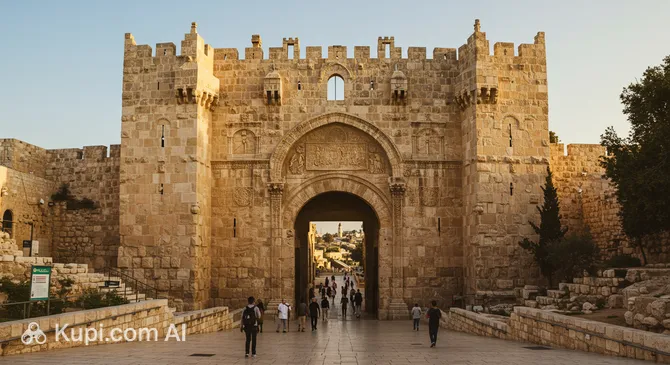
Damascus Gate. Illustration.
Source: Kupi.com AI

Traveler photos:

The massive Damascus Gate is impressive in its appearance: unlike many other gates, it is situated at the base of a wide staircase descending downwards and is flanked by two imposing towers equipped with machicolations. This feature—the steps leading down to the gate—gives it a unique character. The modern steps, resembling an amphitheater, were arranged in the early 21st century by the Jerusalem Municipality, creating a comfortable space in front of the entrance.

The Arabic name for the gate is Bab al-Amud, which translates to "Gate of the Column." This name preserves the memory of a Roman triumphal column that once stood in the square behind the gate in ancient times. Today, the Damascus Gate remains not only an important transport hub of the Old City but also a popular meeting place and a striking landmark reflecting the centuries-old history of Jerusalem.

Contacts

Damascus Gate is one of the main entrances to the Old City of Jerusalem, and it is quite easy to find. It is located on the northern side of the ancient walls and serves as a landmark for entering the Muslim Quarter. Access to the gate is free, as it is part of the city's infrastructure.

Since it is a historical site and a public space, there are no specific contact details for the Damascus Gate. Information regarding the opening hours of markets and shops inside the Old City is best checked on-site or via Jerusalem tourism portals.

How to contactContact
AddressJerusalem

What to Do

Passing through the Damascus Gate, you are immediately immersed in the unique atmosphere of the Old City of Jerusalem. Right behind the gate, the lively Arab market begins, leading into the Muslim Quarter. This is a wonderful opportunity to experience the flavor of an Eastern bazaar: here you can find unique souvenirs, handmade crafts, aromatic spices, and, of course, try traditional local dishes. Walking through the market is a true sensory adventure, full of vibrant colors, sounds, and smells.

For those interested in history and archaeology, the Damascus Gate offers a unique opportunity to touch the past. Thanks to excavations conducted during the British Mandate period, visitors can see a section of the gate preserved from the time of the Roman Empire. This allows you to clearly imagine what this place looked like many centuries ago and appreciate the skill of ancient builders. Observing these ancient structures, built into later constructions, makes a strong impression.

Additionally, important Christian shrines are located in the immediate vicinity of the Damascus Gate. One of the most famous is the Garden Tomb, which many Protestants revere as the true site of the burial and resurrection of Jesus Christ. Visiting these places can be an important part of your spiritual journey or simply an informative walk through the historical corners of Jerusalem.

Getting There

Getting to the Damascus Gate in Jerusalem is quite simple, as it is one of the main entrances to the Old City and a well-known landmark. The gate is located on the northern side of the ancient walls and can be reached by car or on foot from various parts of the city.

One of the most convenient ways to reach the Damascus Gate is by public transport. Numerous bus routes pass near the Old City, with many stops within walking distance of the gate. For example, buses traveling along Sultan Suleiman Street stop very close by. You can also use the Jerusalem Light Rail; the nearest station, "Damascus Gate" (HaNevi'im/Damascus Gate), is located in the immediate vicinity of the gate itself.

Additionally, taxi services are always available. A taxi ride from most areas of Jerusalem to the Damascus Gate will be quick and comfortable, although more expensive than public transport. Simply tell the driver "Damascus Gate" or "Bab al-Amud," and they will easily take you to your destination.

If you are staying in one of the areas adjacent to the Old City of Jerusalem, a walk to the Damascus Gate can be an enjoyable experience in its own right. Many hotels and attractions in the New City are within a 15–30 minute walk. This allows you to better soak in the city's atmosphere and enjoy the views on your way to the ancient walls.

Nearest city: Jerusalem

History & Facts

The Damascus Gate (also known as the Shechem Gate) has a remarkably rich and multi-layered history, with roots dating back to the Second Temple period. The first gate at this strategically important site appeared as early as the 1st century BC, during the reign of Agrippa, and has since served as one of the main entrances to Jerusalem. After the city's destruction in the 2nd century AD, the Roman Emperor Hadrian took up its reconstruction and erected a new, more monumental gate. According to Hadrian's design, it had three arched openings; however, only the eastern one has survived to this day, bearing witness to the grandeur of the original Roman project.

The modern appearance of the Damascus Gate, which tourists admire today, was shaped much later, in the 16th century. In 1537 (or 1542, according to some sources), under the order of the powerful Ottoman Sultan Suleiman the Magnificent, construction of the current gate began. This was part of his large-scale initiative to strengthen the walls of Jerusalem and ensure the city's security. The new gate was built on the foundations of even older structures, continuing the tradition of this site as a key passage into the city.

An interesting detail is that the remains of the gate from Emperor Hadrian's era are hidden beneath the current Ottoman gate, making this site a true archaeological treasure. Travelers can literally touch different eras of Jerusalem's history. In the relatively recent past, in August 2011, a restoration was carried out: a small tower above the gate, including its embrasure, was restored. This work was based on historical drawings from the early 20th century, a period when Jerusalem was under the British Empire, allowing for a highly accurate recreation of the lost elements.

Time Needed

To carefully examine the Damascus Gate, appreciate its architectural features—including the massive towers and preserved elements from different eras—and take photos, an average visitor will need about 1–2 hours. This time will allow for a leisurely walk along the amphitheater-like steps and a chance to feel the historical atmosphere of this iconic entrance to the Old City of Jerusalem.

If your interests include a more detailed study of archaeological aspects, such as the remains of the Roman gate that can be seen, or if you want to observe the bustling life at the entrance to the Muslim Quarter and the doorstep of the Arab market, your stay may increase slightly. However, a simple walk through the gate and its inspection, without diving deep into the market bustle or visiting other nearby attractions, fits well within the specified time frame. This will give you a sufficiently complete impression of this important historical monument in Jerusalem.

Working Hours

The Damascus Gate is one of the main entrances to the Old City of Jerusalem, and by its nature, it is a public space. Generally, the gate is accessible for passage 24/7 and year-round, allowing free entry to the Muslim Quarter and the busy market. No special booking or ticket purchase is required simply to walk through the Damascus Gate.

If you are interested in the opening hours of specific sites located in the immediate vicinity of the gate—such as the archaeological excavations beneath it, observation decks (if available and with restricted access), or the hours of the market and shops behind the gate—this information should be checked separately. We recommend consulting official Jerusalem tourism resources or local information centers for the most up-to-date details before your visit.

Nearby

The Damascus Gate is not just an entrance to the Old City of Jerusalem, but also a starting point for exploring many other amazing places located nearby. Exploring the surrounding area will allow you to dive deeper into the multifaceted history and culture of this ancient city, complementing the impressions of the gate itself with new discoveries and emotions.

A stroll through the nearby streets and squares will reveal world-famous shrines as well as less obvious but equally interesting sites. Each of these places holds its own unique story, and visiting them will enrich your journey, providing a more complete picture of Jerusalem—a city of three religions and thousand-year-old traditions.

NameDistance
Church of the Holy Sepulchre0.4 km
Tower of David0.6 km
Western Wall0.7 km
Tacos Luis0.8 km
Mamilla Avenue0.8 km
Al-Aqsa Mosque0.8 km
Gethsemane0.9 km

Have you reached the end of the page?

So the route has been studied inside and out