Support

Kumamoto Castle

About

Kumamoto Castle is a majestic ancient castle located in the city of Kumamoto, in the heart of Japan. It is one of the country's most significant and impressive fortifications, also known by its poetic names — "Ginkgo Castle" and "Crow Castle". Throughout its centuries-old history, it has become a true symbol of the resilience and craftsmanship of Japanese architects.
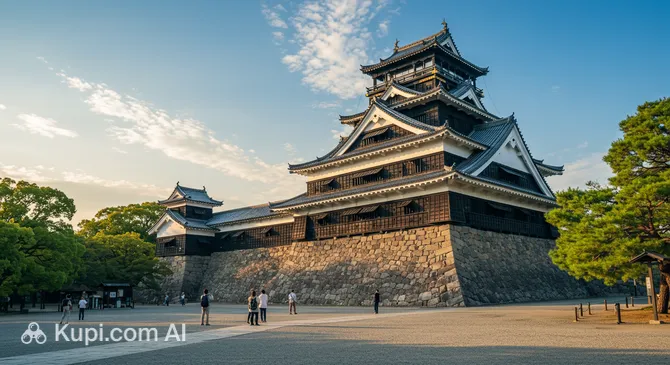
Kumamoto Castle. Illustration.
Source: Kupi.com AI

Traveler photos:

Ranking among the three largest and most important castles in Japan, Kumamoto is rightfully considered a national treasure. Its powerful fortifications, built in the early 17th century, were considered absolutely impregnable in their time, which still makes a strong impression on visitors today. The castle played a key role in many historical events, including the famous siege during the Satsuma Rebellion in 1877, when the garrison successfully withstood the onslaught of superior enemy forces.

One of the castle's most recognizable features is its unique stone walls with a curved profile, known as musha-gaeshi. This clever design made the walls practically impossible to scale—the higher an enemy tried to climb, the steeper the slope became. The main tower, rising majestically to 29.5 meters, crowns this architectural masterpiece and is open today as a museum displaying armor, weapons, and other historical artifacts.

Contacts

To obtain up-to-date information on opening hours, ticket prices, and scheduled events, it is recommended to visit the official website of the castle or contact the tourist information center. Below are the primary contact details.

How to contactContact
Address1-1 Honmaru, Chuo Ward, Kumamoto, 860-0002, Japan
Phone number+81 96-352-5900
Websitekumamoto-guide.jp

What to Do

Visiting Kumamoto Castle is a true immersion into the history of feudal Japan. Today, the complex functions as a large museum where guests can stroll through the extensive grounds, enjoying the ancient atmosphere and majestic architecture. The main attraction is the Tenshu tower, which houses exhibitions detailing the history of the castle and the entire region. Here, you can see authentic samurai armor, weapons, and other artifacts that help you better understand the lifestyle and culture of that era.

Beyond the main tower, several other valuable historical buildings have been preserved on the castle grounds. Be sure to explore the small Kotenshu tower and the Uto Turret, which is recognized as an Important Cultural Property of national significance. A special pride of the castle is its famous stone walls with the unique musha-gaeshi curved profile, designed for defense against enemies. Don't miss the chance to take impressive photos at the spot known as "Niyo-no-Ishigaki," where the intersecting angles of the walls create a unique visual effect.

You can conclude your visit by climbing to the observation decks of the castle towers. From here, magnificent panoramic views of the modern city of Kumamoto unfold, creating a striking contrast between the past and the present. A walk through the castle grounds is not just a sightseeing tour, but an opportunity to feel the spirit of old Japan and appreciate the skill of ancient builders. Additionally, the castle grounds regularly host seasonal festivals with performances by taiko drummers and other cultural events.

Getting There

Getting to Kumamoto Castle is quite simple, as it is a central landmark in the city of Kumamoto and is well-connected to the main transport network. The primary starting point for most tourists is the JR Kumamoto Station. From here, the castle can be reached by public transport, taxi, or even on foot while enjoying the city views.

The most convenient and popular way is to take the city tram. From JR Kumamoto Station, take the "A" line tram and get off at the Kumamoto Castle/City Hall (Kumamotojo-Shiyakusho-mae) stop. The journey takes about 15-20 minutes, followed by a roughly 10-minute walk to the entrance of the castle grounds. Another excellent option is the special Shiromegurin tourist bus, which runs a loop route from the station and stops at all key attractions, including the castle itself.

For those who prefer walking, the path from JR Kumamoto Station to the castle takes about 30-40 minutes. This is a wonderful opportunity to get to know the city better. Additionally, taxis are easily found throughout the city and can take you to the castle quickly and comfortably, which is especially convenient for families or travelers with limited time. A taxi ride from the station will take only about 10 minutes, depending on traffic conditions.

Nearest city: Kumamoto

History & Facts

The history of Kumamoto Castle dates back to 1467, but it acquired its modern and majestic appearance through the efforts of the powerful feudal lord Kato Kiyomasa. Under his decree, large-scale construction began in 1601 and was completed seven years later, in 1607. During this time, not just a castle, but a grand structure was erected, which for centuries became a symbol of military power and authority in the region.

Perhaps the most dramatic and telling event in the castle's history was its defense during the Satsuma Rebellion in 1877. A garrison of government troops found themselves besieged by the numerically superior army of the Satsuma Domain. Despite this, the castle's defenders successfully withstood a 50-day siege. This episode proved that even nearly three centuries later, the fortification solutions implemented during construction remained incredibly effective.

Although the defense was successful, the castle suffered heavy losses: the main Tenshu tower burned down during the battles. Following the rebellion, in that same year of 1877, the castle was officially decommissioned. Many of its original structures were destroyed at various points in history. It was only in 1960 that the main and small towers were meticulously reconstructed, albeit out of reinforced concrete, to once again stand proudly over the city of Kumamoto and serve as a reminder of Japan's rich history.

Time Needed

When planning a visit to Kumamoto Castle, it is worth setting aside 2 to 3 hours for its exploration. This amount of time is generally sufficient to get acquainted with the main highlights of the complex, including climbing the main tower, viewing the internal exhibits, and walking through the surrounding grounds. This timeframe will allow you to get a general idea of the scale and significance of this historical monument without rushing.

The majority of the time is spent exploring the reconstructed palace buildings and the main tower, which houses a museum. Inside, you can see armor, weapons, and historical documents, which can take about an hour or an hour and a half. Additional time will be needed for a walk through the extensive castle courtyards to fully appreciate the famous musha-gaeshi stone walls and surviving original structures, such as the Uto Turret. Photographers and admirers of Japanese architecture may wish to stay even longer.

If you want to do more than just a brief tour and truly immerse yourself in the atmosphere, feel the history, and enjoy the views at a leisurely pace, it is better to allocate half a day for your visit. This will allow you not only to see all the key objects but also to relax in the park area and visit the Honmaru Goten Palace, which is a magnificent reconstruction of a daimyo's residence. Such an unhurried approach will make your visit to Kumamoto Castle truly unforgettable.

Working Hours

Kumamoto Castle is open to visitors daily, making it easy to include in any travel itinerary. Standard opening hours are from 9:00 AM to 5:00 PM, with the last entry permitted until 4:30 PM. The castle is open year-round, except for a few days at the end of December (usually from December 29 to 31), when it is closed to the public. In case of bad weather, the castle may also be closed, so it is recommended to check for current information on the official website before your visit.

Generally, advance ticket booking for individual visits is not required; tickets can be purchased at the on-site ticket offices. However, keep in mind that during peak seasons, such as the cherry blossom season in late March and early April, or during national holidays, there may be queues at the ticket counters. To save time, it is worth arriving early. If you plan to visit the castle as part of an organized group or during special events, it is best to check the entry conditions and the need for pre-registration on the castle's official resources.

9:00 – 17:00

Nearby

A visit to Kumamoto Castle is undoubtedly the main highlight for any visitor to the city. However, to fully experience the atmosphere of this historical site, it is worth dedicating some time to its immediate surroundings. Many interesting attractions are located around the castle walls, which will enrich your experience and allow you to dive deeper into the culture and history of Kumamoto.

Many of these iconic sites are within walking distance, making their exploration particularly convenient. A stroll through the neighborhood will allow you to see not only historical shrines and museums but also modern cultural spaces, creating a complete picture of this amazing corner of Japan. Below is a list of attractions located very close to the castle.

NameDistance
Katō Shrine0.1 km
Kumamoto Castle Inari Shrine0.2 km
Sakura-no-baba Josaien0.3 km
Kumamoto Castle Park (Ninomaru Square)0.4 km
Kumamoto Prefectural Museum of Art Main Building0.5 km
Kumamoto Roynet Hotel0.5 km
Beer Restaurant Oden0.6 km

Have you reached the end of the page?

So the route has been studied inside and out