Support

Brahma Gate, Bulguksa Temple

About

The Brahma Gate is an important part of the famous Buddhist monastery Bulguksa (불국사), which translates to "Temple of the Buddha Land." This outstanding historical complex is located near the city of Gyeongju in South Korea. Bulguksa Temple, including its Brahma Gate, is a significant site of pilgrimage and tourist interest, immersing visitors in an atmosphere of ancient spirituality.
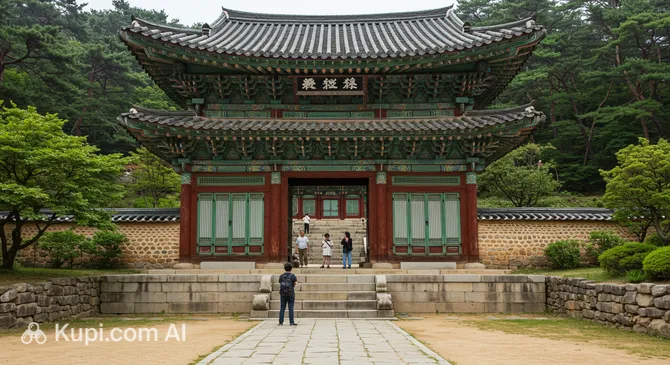
Brahma Gate, Bulguksa Temple. Illustration.
Source: Kupi.com AI

Traveler photos:

Bulguksa is rightly considered a masterpiece of Buddhist art of the Silla era. Its cultural and historical value is so great that in 1995, the entire temple complex, along with the nearby Seokguram Grotto, was included in the UNESCO World Heritage list. This recognition highlights the monastery's uniqueness and importance to world culture, making it a must-visit when exploring the historical heritage of the region.

On the grounds of Bulguksa, there are seven objects included in the list of National Treasures of Korea. These include the famous stone pagodas Dabotap and Seokgatap, the picturesque Cheongungyo Bridge, and two magnificent gilded bronze Buddha statues. The Brahma Gate, being one of the key architectural elements of this sacred place, serves as a gateway to the world of spirituality and ancient history that opens up to temple visitors, inviting them to further explore this amazing complex.

Contacts

To find current information about visiting the Brahma Gate at Bulguksa Temple, it is recommended to consult the official tourism resources of Gyeongju or South Korea. Since this is a significant historical site, direct contact numbers may not be available; for details on opening hours and visiting conditions, it is best to use official websites or tourist information centers.

As a rule, historical sites such as the Brahma Gate at Bulguksa Temple can be reached by public transport or taxi from the center of Gyeongju. Please check detailed routes and current opening schedules on-site or on official tourism portals before your visit.

How to contactContact
AddressJinhyeon-dong, Gyeongju-si, Gyeongsangbuk-do, South Korea

What to Do

Visiting the Brahma Gate and the entire Bulguksa temple complex in Gyeongju is an immersion into the rich history and culture of South Korea. Here, you can take a leisurely walk through the extensive grounds, enjoying the outstanding artistic merits and peaceful beauty of this place, which has rightfully earned worldwide fame. Every corner of the temple breathes history, offering visitors unique experiences.

Special attention should be paid to the unique architectural structures of Bulguksa Temple. You will see the famous stone pagodas Dabotap and Seokgatap, recognized as national treasures of Korea. No less impressive are the Cheongungyo bridge and the skillfully crafted gilded bronze Buddha statues, also part of the national heritage. These masterpieces of ancient architecture and sculpture will tell you about the high skill of Korean artisans.

For a complete experience, it is also recommended to visit the nearby Seokguram Grotto. This incredible cave temple, together with Bulguksa Temple, is listed as a UNESCO World Heritage site, and seeing it will be a perfect addition to your journey into the world of ancient Korean culture.

Getting There

Getting to the Brahma Gate, located on the grounds of the famous Bulguksa Temple, is easy as it is one of the key attractions in Gyeongju. The temple is situated slightly away from the city center but is well-connected by transport, making it accessible for all travelers wishing to experience the history of South Korea.

The most popular and economical way to reach Bulguksa Temple is by public transport. From the center of Gyeongju, for instance, from the Gyeongju Railway Station or the Intercity Bus Terminal, city buses (often routes No. 10 or No. 11) depart regularly and go directly to the temple complex. The bus ride usually takes about 40-50 minutes and allows you to enjoy scenic views of the surrounding area.

An alternative option is a taxi. This is faster and more comfortable, especially if you are traveling in a small group or have limited time. Taxis are easy to find anywhere in Gyeongju or can be booked via an app. Upon arrival at the main entrance of Bulguksa Temple, you just need to enter the grounds, where the Brahma Gate is located, serving as one of the entrances to the inner parts of the sanctuary.

Nearest city: Gyeongju

History & Facts

The history of the majestic Bulguksa temple, which includes the Brahma Gate, dates back to the 6th century. According to ancient chronicles, the first sanctuary on this site in Gyeongju was built in 528, during the reign of King Beopheung of the Silla Dynasty. Initially, the temple was named Hwaeom Bulguksa and was later known as Beomnyusa. These early stages laid the foundation for South Korea's future spiritual center.

A significant transformation of the temple occurred in the 8th century. In 751, during the reign of King Gyeongdeok, Prime Minister Kim Dae-seong initiated a large-scale reconstruction. The "Samguk Yusa" chronicles state that Kim Dae-seong dedicated this construction to the peace of his ancestors' souls. The work was completed in 774, under the next ruler, King Hyegong. It was then that the temple received its current name — Bulguksa, which translates to "Temple of the Buddha Land," emphasizing its deep spiritual significance.

Over the following centuries, during the Goryeo and Joseon dynasties, Bulguksa was rebuilt and renovated several times. However, its history was also marked by tragic events. During the Imjin War (1592-1598), the temple suffered severe damage — all wooden structures were destroyed by fire. This was a heavy blow to Korean culture.

Despite the destruction, the spirit of the temple was not broken. Restoration work began as early as 1604, and until 1805, about forty different construction and restoration projects were carried out to revive its former glory. Later, during the period of Japanese colonial rule (1910-1945), restoration attempts were also made, although they were not fully completed. These centuries-long efforts testify to the incredible value of Bulguksa Temple for the Korean people.

Time Needed

To fully enjoy the atmosphere and see the Brahma Gate and Bulguksa Temple in Gyeongju, you should set aside enough time. Bulguksa is a significant historical and architectural complex with many buildings, pagodas, and scenic spots, so a quick walk-through will not allow you to appreciate all its splendor and soak in its spirit.

On average, most visitors spend between 2 and 3 hours carefully exploring the main elements of the temple complex, including the Brahma Gate, and taking a leisurely stroll through its well-kept grounds. This is usually enough time to see the main pavilions, admire the ancient stonework and wood carvings, take commemorative photos, and feel the tranquility of this sacred place. If you have a deep interest in Buddhist culture, architecture, or the history of South Korea and wish to study every detail, your visit may last longer, perhaps up to half a day.

Working Hours

The Brahma Gate at Bulguksa Temple, located in the city of Gyeongju, is an important part of this famous complex. Access to it usually coincides with the general opening hours of Bulguksa Temple. Typically, the temple is open to visitors daily, but the exact hours may vary depending on the season. Roughly, the complex receives guests from the morning (around 7:00-9:00 AM) until the evening (around 17:00-18:00), though operating hours may be slightly shorter during the winter period.

To obtain the most accurate and up-to-date information regarding the opening hours of the Brahma Gate and the entire Bulguksa Temple, as well as the possible need for advance ticket booking (which may be relevant for group visits or participation in special events), it is highly recommended to visit the temple's official website or inquire at tourist centers in Gyeongju. Bulguksa Temple, including its famous Brahma Gate, is usually open to visitors year-round, allowing travelers to plan their visit at any convenient time.

9:00 – 18:00

Nearby

Visiting such an iconic landmark as the Brahma Gate at Bulguksa Temple is a highlight in itself. However, to make your trip to Gyeongju even more rewarding and memorable, it is worth taking the time to explore the surroundings. Often, it is the nearby sites that help you gain a deeper understanding of the culture, history, and atmosphere of a place, offering new perspectives and impressions.

There are several interesting locations around the Brahma Gate and Bulguksa Temple that can complement your itinerary and reveal new facets of this amazing corner of South Korea. Below is a list of some of them, including their distance.

NameDistance
Bulguksa Temple0.3 km
Seokguram Grotto2 km
Blue One Private Condo5.3 km
Kangdong Resort5.6 km
Gyeongju Tower5.9 km
Jurung Jurung Gyeongju6.2 km
California Beach6.7 km

Have you reached the end of the page?

So the route has been studied inside and out