Support

Paldalmun Gate

About

Paldalmun Gate (팔달문) is the majestic southern gate of the famous Hwaseong Fortress, located in the city of Suwon, South Korea. This gate is not just an entrance but a true symbol of the country's historical heritage and one of the four main passages in the fortress walls, representing an outstanding example of fortification art.
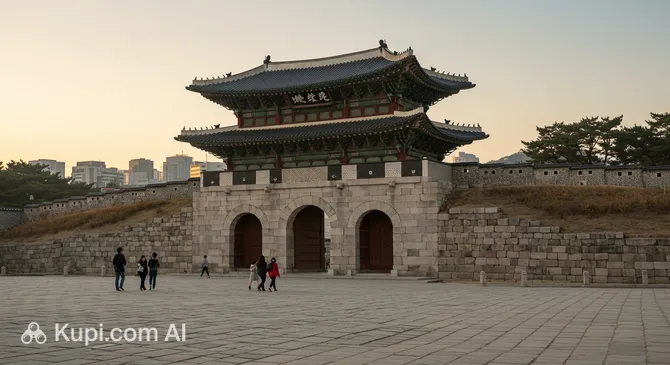
Paldalmun Gate. Illustration.
Source: Kupi.com AI

Traveler photos:

The special historical value of Paldalmun lies in the fact that it is the only one of the four main gates of Hwaseong Fortress to have preserved its original wooden frame from the late 18th century. This element highlights the authenticity of the structure and the skill of the Korean architects of that era, making the gate a key object for understanding architectural traditions.

Architecturally, Paldalmun Gate demonstrates an impressive example of traditional Korean defensive architecture. Its appearance harmoniously combines Eastern construction traditions with some Western influences, a characteristic feature of the entire Hwaseong Fortress complex. Like the other main gates, Paldalmun was strategically reinforced by surrounding miniature bastion-fortresses, where guards were previously stationed to ensure security.

Along with the entire Hwaseong Fortress, Paldalmun Gate has been included in the UNESCO World Heritage List since 1997. This international recognition highlights its outstanding universal value as part of a unique fortification structure reflecting the scientific, cultural, and technical achievements of its time. Visiting the gate allows you to touch the rich history of South Korea and appreciate the scale of the engineering thought of the past.

Contacts

Since Paldalmun Gate is a historical monument and part of the large Hwaseong Fortress complex, direct contact details specifically for the gate are not usually provided. To find up-to-date information on visiting hours for the entire complex, admission fees (if applicable), and available tours, we recommend visiting the official Hwaseong Fortress website. For general tourist information or help planning your visit, you can also contact local tourist information centers or consult official travel materials dedicated to Hwaseong Fortress.

Paldalmun Gate is one of the four main gates of the fortress. It can be reached as part of a general visit to Hwaseong Fortress by following the signs on the grounds. It is highly visible and is a key part of sightseeing routes through the fortress.

How to contactContact
Address780 Jeongjo-ro, Paldal-gu, Suwon, Gyeonggi-do, South Korea
Phone number+82 31-290-3600
Websitewww.swcf.or.kr

What to Do

A visit to Paldalmun Gate is an opportunity to touch history and enjoy magnificent views. Guests can examine the gate's unique architecture in detail, paying special attention to the preserved original wooden frame, which stands as a testament to the skill of ancient architects. Don't miss the chance to appreciate the historical significance of this structure, imagining the events that unfolded by its walls. Additionally, Paldalmun Gate offers picturesque panoramic views of the surroundings, making it a wonderful spot for commemorative photos.

Viewing Paldalmun Gate is often part of a more extensive tour of the entire Hwaseong Fortress. The fortress grounds feature information centers and special pavilions where visitors can deepen their knowledge of this grand structure's history. Here, you can learn about the complex fate of the fortress, the stages of its construction, and ongoing restoration work, which helps to better understand the context and significance of Paldalmun Gate as an integral part of this historical complex.

When planning a visit to Paldalmun Gate, you can choose the format that suits you best: join an organized tour group or explore Hwaseong Fortress independently at your own pace. In either case, getting to know this majestic gate will provide vivid impressions and allow you to feel the spirit of old Korea. Studying its construction and defensive elements, or simply walking through the adjacent territory, will be an important part of your trip to Seoul and its surroundings.

Getting There

To get to Paldalmun Gate, you first need to travel to the city of Suwon, where this famous landmark—part of Hwaseong Fortress—is located. From Seoul, Suwon is easily accessible by public transport. The most popular and convenient way is by train. You can take Subway Line 1 (the dark blue line), which goes directly to Suwon Station. The subway ride takes approximately 1 hour. High-speed KTX trains and regular trains also run from Seoul to Suwon, departing from Seoul Station or other major hubs.

Upon arriving at Suwon Station, you can reach Paldalmun Gate itself by local bus or taxi. The gate is located in the city center, and many bus routes pass nearby or have a "Paldalmun" stop. The bus ride from Suwon Station usually takes about 10–15 minutes. A taxi is a faster but more expensive option. Since Paldalmun Gate is a well-known landmark, taxi drivers will easily understand where you need to go.

Additionally, Paldalmun Gate serves as the southern gate of Hwaseong Fortress, so if you plan to explore the entire fortress, you can follow the signs for Hwaseong Fortress. The gate is clearly visible and is a major transport hub in this part of Suwon, often surrounded by busy traffic. It is recommended to check public transport routes in advance using online maps or navigation apps to choose the most convenient path from your location in Seoul or directly from Suwon Station.

Nearest city: Seoul

History & Facts

Paldalmun Gate was erected in 1796 as an integral part of the grand Hwaseong Fortress. The construction was initiated by King Jeongjo, who pursued several ambitious goals. First, he sought to honor the memory of his father, Crown Prince Sado, whose tragic fate left a deep mark on Korean history. Second, King Jeongjo considered moving the state capital to Suwon, and Hwaseong Fortress was intended to be the core of the new administrative center. To stimulate population growth in the area and attract people to the new city, local residents were exempt from paying taxes for a full ten years—a very generous measure for that time.

The design of Hwaseong Fortress, including Paldalmun Gate, was entrusted to the leading minds of the time—Jeong Yak-yong, also known by the pen name Dasan, and Yu Hyeong-won. These architects were not afraid of innovative solutions, successfully harmonizing classical principles of Korean fortification with elements of Western architecture. The result was a unique structure that featured traits of two different cultural traditions. Their work was based on the principles of the "Silhak" school (the "school of practical learning"). This movement advocated for the active development of applied, natural, and exact sciences, considering them critical for improving daily life and the prosperity of the state.

The 20th century brought significant changes to Paldalmun Gate, and after sustaining damage during the mid-century period, it required extensive care. Fortunately, thanks to meticulously preserved historical documents published in 1800, which contained detailed blueprints and descriptions of the fortress, the gate was fully restored in 1975 with maximum historical accuracy. Today, Paldalmun boasts a special status: it is the only one of the four main gates of Hwaseong Fortress that has preserved its original wooden frame dating back to its construction in the late 18th century. This fact makes it an invaluable testament to the skill of Korean architects of the past.

Time Needed

For a typical visitor to explore Paldalmun Gate itself—to appreciate its architecture, take commemorative photos, and soak in the atmosphere of this significant historical structure—it will take approximately 30 minutes to 1 hour. This time is quite sufficient to carefully examine the details of the gate, which is famous for being the only one of the four main gates of Hwaseong Fortress to have preserved its original wooden frame from the late 18th century.

It is important to keep in mind that Paldalmun Gate is a prominent but still only one element of the massive Hwaseong Fortress complex, a UNESCO World Heritage site. If your plans include not just viewing the gate but also a more detailed exploration of other parts of the fortress, such as its walls, watchtowers, pavilions, and inner buildings, then you should set aside significantly more time. A full tour of Hwaseong Fortress can take from 2–3 hours to half a day, and for those who wish to delve into the history and architecture of the complex without rushing, even more time may be required.

Working Hours

Paldalmun Gate, being part of the large historical complex of Hwaseong Fortress, is generally available for external viewing at any time, as it is a free-standing structure. However, if you plan to visit the inner areas of Hwaseong Fortress, pass through the gates, or use any services on the complex grounds, it is important to take into account the general operating hours of the fortress itself. It is recommended to check the current schedule on the official Hwaseong Fortress website or at local tourist information centers, as hours may change depending on the season.

As a rule, for a simple external viewing of Paldalmun Gate, no advance ticket booking is required. Entry to the grounds of Hwaseong Fortress itself may require a fee, in which case tickets are purchased on-site or online, if that option is available. Hwaseong Fortress and, consequently, Paldalmun Gate are open to visitors year-round, but operating hours may be shortened during the winter period. To avoid misunderstandings and plan your visit in the best way possible, always check for the most up-to-date information before your trip.

Open 24 hours

Nearby

Visiting such an iconic site as Paldalmun Gate certainly leaves a lasting impression. However, to make your journey through the historical corners of South Korea even richer, it is worth paying attention to other interesting sites located nearby. Exploring the attractions in the vicinity of Paldalmun Gate will allow you to dive deeper into the rich history and culture of this region.

Paldalmun Gate is part of the magnificent Hwaseong Fortress complex in the city of Suwon. Suwon itself and its surroundings offer many unique monuments. Here are a few notable places located very close to Paldalmun Gate that can complement your cultural program, offering new discoveries and experiences:

NameDistance
Hwaseong Haenggung Palace0.6 km
Hwaseong Fortress1.1 km
Caribbean Bay16.4 km
Seoul Grand Park16.6 km
Gwacheon National Science Museum17.8 km
Coex Aquarium26.4 km
World Aquarium27.3 km

Have you reached the end of the page?

So the route has been studied inside and out